
Chords + Lyrics | Fly Me To The Moon
Intro
||: N.C :|| x4
Verse 1
| Am7 | Dm7 | G7 | Cmaj7 |
Fly me to the moon, let me play among the stars.
| Fmaj7 | Bm7b5 | E7b9 | Am7 A7 |
Let me see what spring is like on Jupiter and Mars.
| Dm7 | G7 | Cmaj7 | Em7 A7 |
In other words, hold my hand.
| Dm7 | G7 | Cmaj7 | Bm7b5 E7b9 |
In other words, baby kiss me.
Verse 2
Fill my heart with song and let me sing for, evermore.
You are all I long for all I worship and adore.
In other words, please be true.
In other words, I love you.
Solo
| Am7 | Dm7 | G7 | Cmaj7 |
| Fmaj7 | Bm7b5 | E7b9 | Am7 A7 |
| Dm7 | G7 | Gm6 | A7 |
| Dm7 | G7 | Cmaj7 | E7b9 |
Verse 3
| Am7 | Dm7 | G7 | Cmaj7 |
Fill my heart with song and let me sing for, evermore.
| Fmaj7 | Bm7b5 | E7b9 | Am7 A7 |
You are all I long for all I worship and adore.
| Dm7 | G7 | Gm6 | A7 |
In other words, please be true.
| Dm7 | Dm7 | G7 | G7/B |
In other words, in other words,
| Bb6 | Bdim7 | C6/9 N.C | N.C C5 |
I love you.
Fly Me to the Moon Backing Tracks | Chord Analysis
Above, you’ll find backing tracks to use when learning Fly Me to the Moon. Rather than using stem separation to extract the guitar as I usually do, this backing track in four keys was created using iReal Pro, based on the famous Frank Sinatra version.
The other three versions are transposed to F and Bb, and Eb, using the same progression as in the original key of C.
After studying the chords and TAB, use my backing tracks to prepare yourself for playing this tune with a band.
Chord Progressions – What’s Going On?
The chords in Fly Me to the Moon are classic, often used by theory and jazz teachers as a prime example of the cycle of fourths.
Verse 1
Starting on VI, the progression moves up a fourth, using mostly diatonic chords. The first eight bars follow this pattern:
| Am7 (VI) | Dm7 (II) | G7 (V) | Cmaj7 (I) |
| Fmaj7 (IV) | Bm7b5 (VII) | E7b9 (IIIx) | Am7 (VI) A7 (VIx) |
The E7b9 is the first chord to step slightly outside the diatonic framework, as it would normally be minor. The b9 naturally appears in the Phrygian or Phrygian dominant mode no matter if the chord is minor or major.
The final chord, A7, is also non-diatonic, but it strengthens the resolution to Dm7, just as E7b9 directs more clearly towards Am7.
In the TAB, we explore four chordal ideas that progressively grow more sophisticated, incorporating different shapes and adding a bass line. You’ll find said TAB further down this guitar lesson.
The next eight bars continue the diatonic movement:
| Dm7 (II) | G7 (V) | Cmaj7 (I) | Em7 (III) A7 (VI) |
| Dm7 (II) | G7 (V) | Cmaj7 (I) | Bm7b5 (VII) E7b9 (IIIx) |
That final movement, VII – IIIx, is often referred to as a minor II – V – I, as it functions similarly to Dm7 – G7 – Cmaj7 (Bm7b5 – E7b9 – Am7). Both progressions move up a fourth—one resolving to major, the other to minor.
Verse 2
Verse 2 follows the same progression as what we just studied. You should record this using a loop pedal and practise playing the melody of Fly Me to the Moon in all positions, or use the backing tracks.
Once you’re comfortable, try improvising using modes and arpeggios. When you feel ready—change the key!
Verse 3
Speaking of soloing, both the instrumental solo and verse 3 start the same way as verses 1 and 2 before venturing further from the key of Am. Here are bars 9-12:
| Dm7 (II) | G7 (V) | Gm6 (Vm) | A7 (VIx) |
The Gm6 (Vm) stands out the most, as all other variations have appeared before. Check out A Natural Woman for another great example of a Vm chord in action.
Solo
Next, the solo follows this progression:
| Dm7 (II) | G7 (V) | Cmaj7 (I) | E7b9 (IIIx) |
The third verse initially follows the same pattern but stretches out the chords in the third line:
| Dm7 (II) | Dm7 (II | G7 (V) | G7/B (V/3) |
The last four bars build towards the I chord:
| Bb6 (bVIIx) | Bdim7 (VIIdim7) | C6/9 (I) N.C | N.C C5 |
Here’s a chord chart for Fly Me to the Moon. Use this as you practise soloing over this jazz classic.

Fly Me To The Moon Chord Chart | PDF + iReal Pro Download
Should you want to download my chart, here’s a PDF: Fly Me To The Moon chord chart PDF.
This chord chart was created using iReal Pro, here’s a link to that file: Fly Me To The Moon iReal Pro. Using this and the iRealPro app, you can change the key.
Fly Me To The Moon | TAB
Let’s take a look at how to comp Fly Me To The Moon.
We’ll do this in a few different ways — not by changing the chords, but by changing how we comp it.
Here’s idea 1. This is simple and requires a bass player, so you could use this approach if you’re in a band and want to keep it simple.
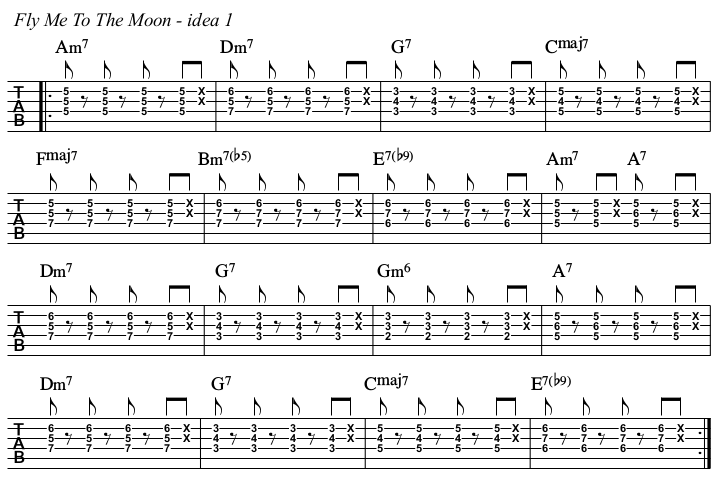
Let’s move up the neck and play all chords there. We won’t change anything harmonically — although it will seem like it!
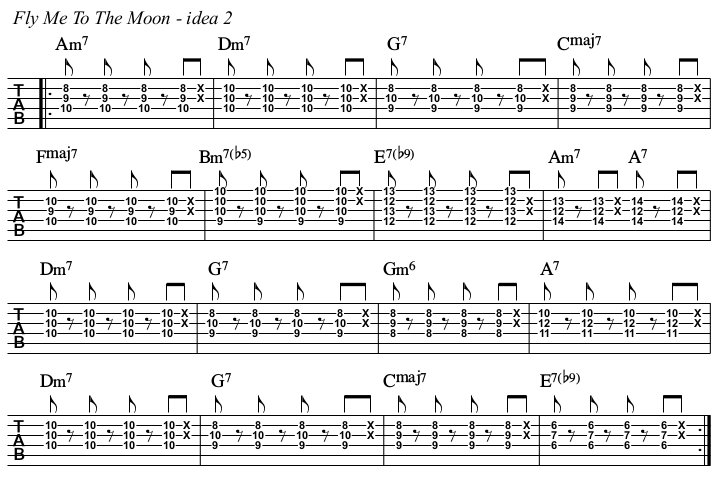
That first Am7 looks like a C — it’s a Dm-shaped Am with the m3rd in the bass. For the Bm7b5, I’m using a bigger shape, a full Dm shape.
Notice how the E7b9 looks like a Ddim7. Study the intervals and make sure you can see it has all the intervals of an E7b9, just without the root.
The Gm6 looks like an E-shaped C7. Again, study the intervals and you’ll see it’s a Gm6 with the m3rd in the bass.
The final E7b9 looks like an E-shaped Bb7.
Let’s try playing the chord progression with a bass note on beat one.
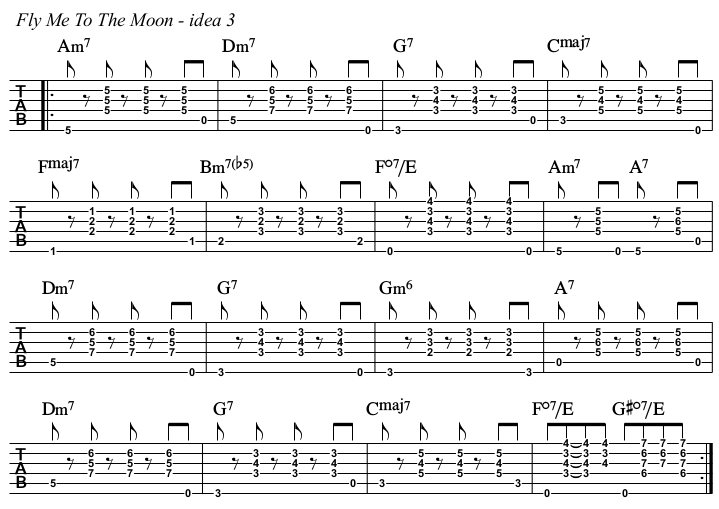
I’m using an open string or a chromatic note to get from one chord to the next.
The Fdim7/E is still an E7b9, just like described before. We can use a Ddim7 chord, and now we use an Fdim7, which is the same notes but adding that low E. I call it Fdim7/E because it’s easier to visualise it.
In the final bar, we take this even further as we move from Fdim7/E to G#dim7/E — again, it’s all the same notes.
Here’s the last idea, where we mainly play a walking bass line.
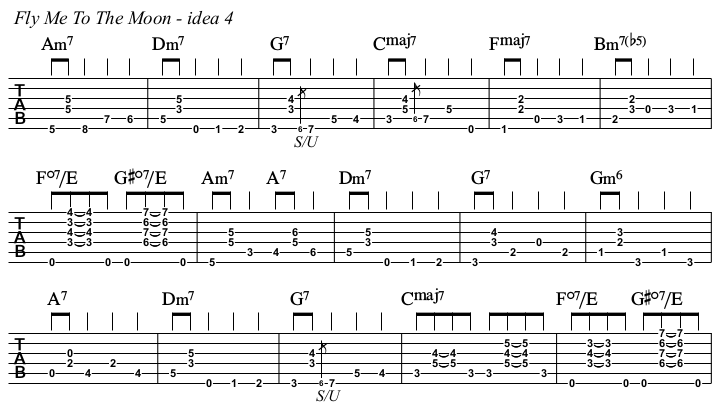
I’m using the arpeggio of each chord in combination with chromatic notes to move to the next chord.
Practise all four ideas individually, then along with the backing track, and finally, see if you can blend and develop them!
A jazz standard
As one of the most recognised jazz standards, Fly Me to the Moon has been covered by nearly every singer who’s performed in the genre.
Usually, in cases like this, there isn’t a definitive version to study. However, with Fly Me to the Moon, there is!
Frank Sinatra’s 1964 recording is the version, which is remarkable considering that Julie London, Peggy Lee, Doris Day, Paul Anka, and several others had already had great success with it before Frank recorded his, with the help of Count Basie and Quincy Jones.
Since Sinatra’s 1964 release, Fly Me to the Moon has been recorded over 300 times, yet whenever someone calls it, they mean Sinatra’s version—so study the chords and lyrics above carefully.
Fly Me To The Moon Chords: Continue Learning
Step-by-step Guitar Courses

Master guitar by studying real tunes. Build your skills with video lessons, eBooks and practice routines that connect theory with the music you love!
Explore SpyTunes step-by-step Guitar Courses.
Five similar tunes | Chords + Lyrics


