
Chords + Lyrics | L-O-V-E
Intro
||: G G6 | Gmaj7 G6 :||
Verse 1
| G G6 | Gmaj7 G6 | A7sus4 Am | Am6 Am7 |
L, is for the way you look at me.
| D7 D9 | D7 D9 | G G6 | Gmaj7 G6 |
O, is for the only one I see.
| G G9 | G7 G9 | C C6 | Cmaj7 C6 |
V, is very, very extraordinary.
| A7 A | A9 A7 | D7 N.C | N.C |
E, is even more than anyone that you adore.
Verse 2
| G G6 | Gmaj7 G6 | A7sus4 Am | Am6 Am7 |
Can love, is all that I can give to you.
| D7 D9 | D7 D9 | G G6 | Gmaj7 G6 |
Love, is more than just a game for two.
| G G9 | G7 G9 | C C6 | C#dim7 Edim7 |
Two in love can make it, take my heart and please don’t break it.
| G G6 | D7 D9 | G G6 | Ab7 |
Love, was made for me and you.
Solo
| Ab Ab6 | Abmaj7 Ab6 | Bb7sus4 Bbm | Bbm6 Bbm7 |
| Eb7 Eb9 | Eb7 Eb9 | Ab Ab6 | Abmaj7 Ab6 |
| Ab Ab9 | Ab7 Ab9 | Db Db6 | Ddim7 Fdim7 |
| Ab Ab6 | Eb7 Eb9 | Ab Ab6 | A7 |
Verse 3
| A A6 | Amaj7 A6 | B7sus4 Bm | Bm6 Bm7 |
L, is for the way you look at me.
| E7 E9 | E7 E9 | A A6 | Amaj7 A6 |
O, is for the only one I see.
| A A9 | A7 A9 | D D6 | Dmaj7 D6 |
V, is very, very extraordinary.
| B7 B | B9 B7 | E7 N.C | N.C |
E, is even more than anyone that you adore.
Verse 4
| A A6 | Amaj7 A6 | B7sus4 Bm | Bm6 Bm7 |
Can love, is all that I can give to you.
| E7 E9 | E7 E9 | A A6 | Amaj7 A6 |
Love, is more than just a game for two.
| A A9 | A7 A9 | D D6 | D#dim7 F#dim7 |
Two in love can make it, take my heart and please don’t break it.
| A A6 | E7 E9 | A A6 | F#9 F#7 |
Love, was made for me and you.
End
| Bm7 Bm11 | E9 E7 | A A6 | F#9 F#7 |
Love was made for me and you.
| Bm7 Bm11 | E9 E7 | A A/G | A/F# A/F | A/E | (E F# G# A) | A6 |
Love was made for me and you.
L-O-V-E Backing Tracks | Chord Analysis
Above, you’ll find a backing track to use when learning L-O-V-E. Instead of stem separation to extract the guitar, I made this using the iReal Pro app since this is what most people will reference, rather than the famous recording by Nat King Cole upon which all this is based.
After studying the chords and TAB, use my backing tracks to prepare for playing this tune with a band.
Chord Progressions – What’s Going On?
The chords for L-O-V-E are much simpler than they might seem when paired with lyrics.
At its core, the song follows a common chord progression, but when combined with two distinct melodies, it produces sophisticated-sounding chord extensions. Once you break these elements down, everything falls into place.
Here are the basic chords for the first verse in the key of G:
| Gmaj7 | Gmaj7 | Am7 | Am7 |
| D7 | D7 | Gmaj7 | Gmaj7 |
| G7 | G7 | Cmaj7 | Cmaj7 |
| A7 | A7 | D7 N.C | N.C |
The first half follows the I – II – V – I progression.
In the second half, the I chord becomes a dominant 7, leading into IV and IIx, before stopping on V—a common movement.
Melody and Chord Extensions
The first melody line moves through D – E – F# – E, producing these extensions:
G = | G G6 | Gmaj7 G6 |
Am = | A7sus4 Am | Am6 Am7 |
D = | D7 D9 | D7 D9 |
For the second half, the melody shifts to G – A – B – A, creating:
G7 = | G G9 | G7 G9 |
C = | C C6 | Cmaj7 C6 |
A = | A7 A | A9 A |
At first glance, these extensions may seem complex, but once you see the pattern, the concept is surprisingly simple—and brilliant.
To get detailed TAB for how to play all these chords, check out my TAB further down this guitar lesson.
Verse 2 Variations
The second verse modifies the second half:
| G7 G9 | G7 G9 | C C6 | C#dim7 Edim7 |
| G G6 | D9 D7 | G G6 | Ab7 |
Here, the IV chord (C) moves to a diminished 7th. The transition from C#dim7 to Edim7 maintains harmonic momentum while keeping the two-bar changes consistent—these chords share the same notes.
The final line is another I – V – I resolution, keeping the extended voicings consistent with the rest of the song. The last bar modulates up a semitone.
Modulations and Song Structure
- The solo repeats verse 2, transposed up a semitone to Ab.
- Verses 3 and 4 follow the structure of verses 1 and 2, now in A.
- The ending features a II – V – I – VI progression—classic jazz changes—with extended voicings adding sophistication.
Play along with the backing track, and original recording (playlist at the top of the page) using the chord charts (below) and/or chord and lyrics (above) as a guide. You’ll soon realise that L-O-V-E‘s chords, as played by Nat King Cole, are far less intimidating than they appear.
The chord chart spans two pages due to key changes. The only way to fit it onto one page would be to write Change Key twice at the end and rely on your ability to shift keys on the fly.
I’d recommend practising this way, but for a gig, it’s best to have the full chart. Then again, if you spend enough time with L-O-V-E‘s chords, you’ll memorise them!
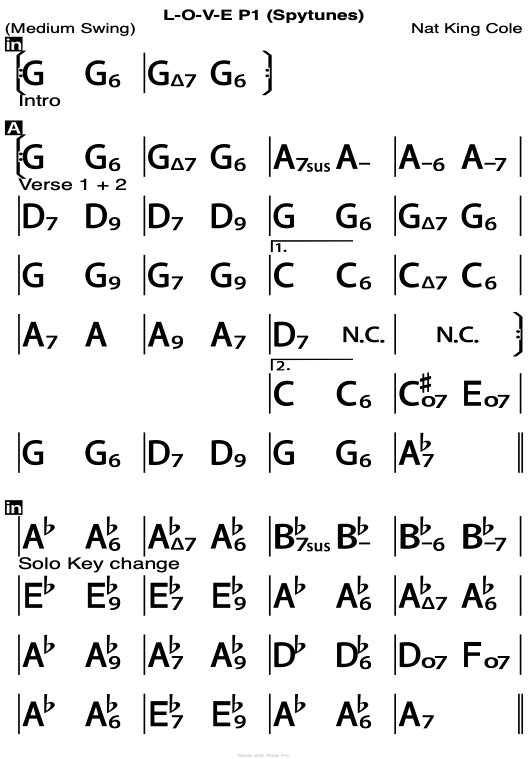
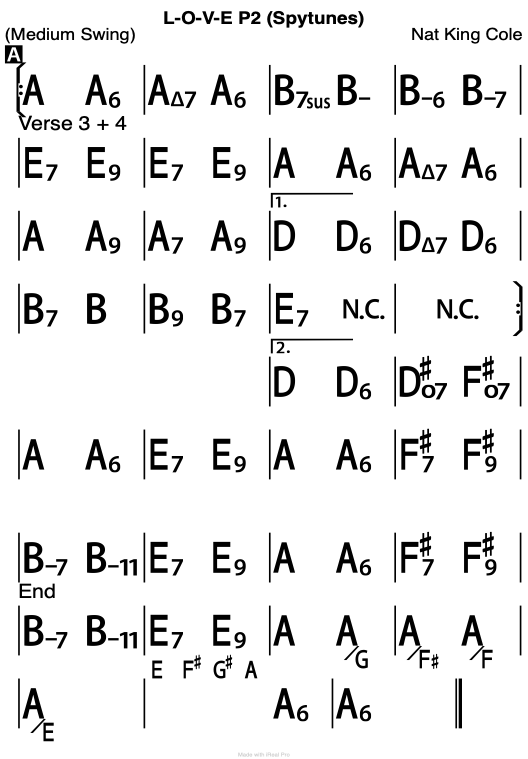
L-O-V-E Chord Chart | PDF + iReal Pro Download
Download my chord charts as a PDF or in the iReal Pro format.
Since L-O-V-E is a jazz standard, the iReal Pro version is highly recommended. The app’s backing track feature allows you to practise comping, soloing, and playing the melody in all 12 keys!
- L-O-V-E chord chart PDF – page 1
- L-O-V-E chord chart PDF – page 2
- L-O-V-E iReal Pro – page 1
- L-O-V-E iReal Pro – page 2
L-O-V-E | TAB
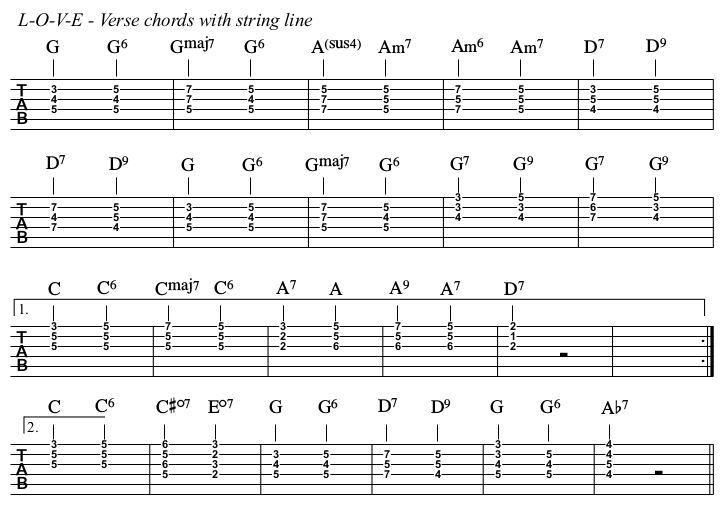
Let’s begin by learning the string line. Play along with Nat or the backing track for the first verse and focus solely on this part:

When we pair this with the chords, name them, and move to the nearest and most logical shapes, we get this (some chords are not perfectly corresponding with the TAB for the extensions:
Comping
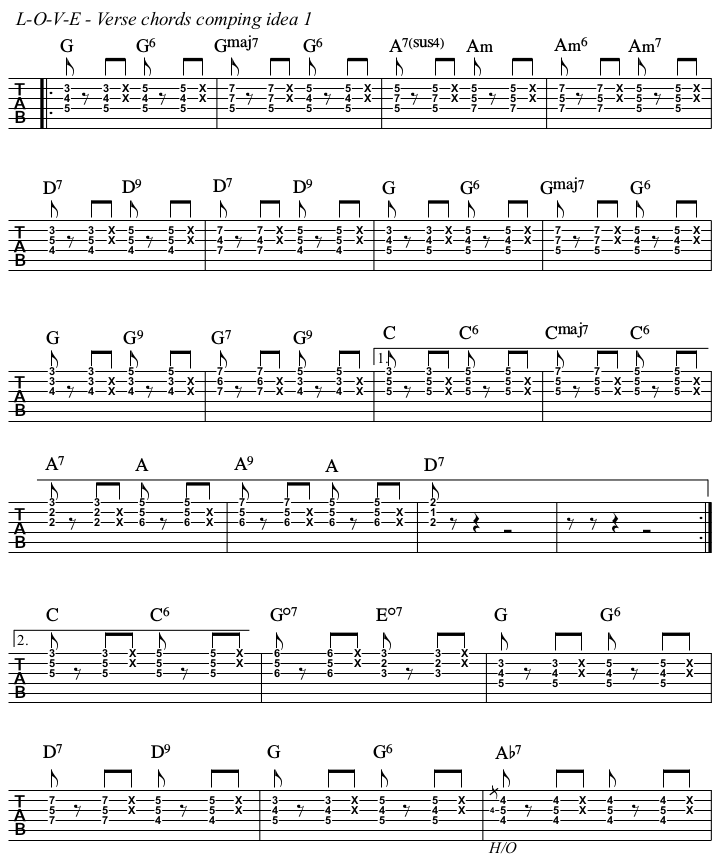
Now let’s turn those chord shapes into a simple comping part. I have made some changes/clarifications here:
- Bar 3 has Am, not Am7
- Bar 9 has a G first, not G7
- Bar 14 has an A, not A7
- The C#dim7 chord is notated as a Gdim7 instead (same notes)
I guess the lesson here is that we don’t have to fit every note in all the time.
We need to be freer than the example above, so try this variation:
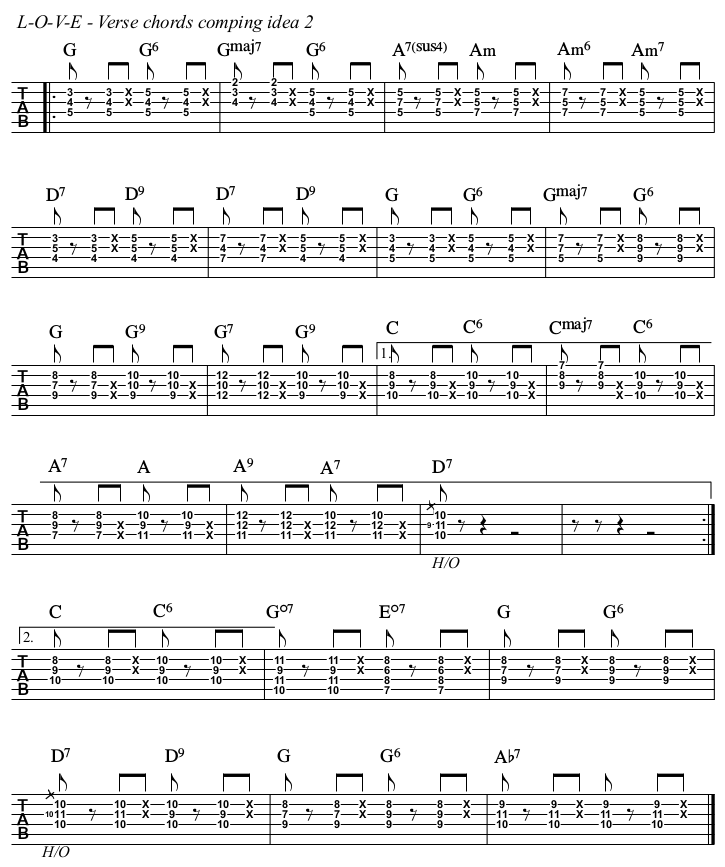
Before moving on to the key changes, stay with the key of G for several days. Don’t play the melody, the solo, just keep experimenting with rhythmic variations. You need to reach a point where this first key feels effortless.
Once you’re ready, move on to the chords for the solo and the final verses in the keys of Ab and A. The ending introduces a few new chords as well.
Ultimately, how difficult this tune feels will be determined by how much time you spend mastering that initial key of G.
When you feel confident in all keys, return to the backing track and play all hte way through.
From Instrumental to Icon: How L-O-V-E Became Nat King Cole’s Multilingual Classic
Few songs feel as effortlessly charming as L-O-V-E by Nat King Cole. Released in 1965 during the final year of his life, it became one of his most enduring recordings. Unlike many of Cole’s earlier jazz-leaning hits, L-O-V-E was written specifically for him by Bert Kaempfert, the German bandleader best known for co-writing Strangers in the Night and Spanish Eyes. Kaempfert had a gift for crafting melodies that felt both instantly familiar and subtly sophisticated, and L-O-V-E is perhaps his finest example.
Originally conceived as an instrumental titled Bert’s Tune, the piece caught Nat’s attention during a session in Los Angeles. Rather than simply singing over the arrangement, Cole worked with lyricist Milt Gabler to create a playful, almost conversational set of lines built around the spelling of “love.” It was a clever twist: simple enough for any listener to remember, yet rhythmically intricate in a way only a jazz singer with Cole’s phrasing could pull off.
But Cole didn’t stop there, he recorded the song in multiple languages — Japanese, Spanish, German, Italian, and French — each version sung with remarkable accuracy. This wasn’t a gimmick; international releases were becoming a major part of Capitol Records’ strategy, and Cole was uniquely capable of making foreign-language versions sound natural rather than forced. These multilingual cuts helped the song travel further than almost any other pop vocal of the mid-60s.
The arrangement is equally noteworthy. That bright, brassy opening line sits somewhere between big band swing and early 60s lounge pop, giving the tune a timeless quality — modern yet classic, polished yet joyful. It’s no wonder L-O-V-E remains Cole’s signature song, an elegant reminder of what made him one of the most distinctive vocalists of the 20th century.
L-O-V-E Chords: Continue Learning
Step-by-step Guitar Courses

Master guitar by studying real tunes. Build your skills with video lessons, eBooks and practice routines that connect theory with the music you love!
Explore SpyTunes step-by-step Guitar Courses.
Five similar tunes | Chords + Lyrics


