
Chords + Lyrics | Pride & Joy (tune down 1/2 step)
Intro
| E7 | E7#9 | E7 | E7 |
| E7 (E6) | E7 (A/E) | E7 (E6) | E7 (A/E) |
| A7 (A6) | A7 (A6) | E7 (E6) | E7 |
| B7 | A7 | E7 | E7 (A A#) B7 |
Verse 1
| E7 | E7 | E7 | E7 |
Well, you’ve heard about love givin’ sight to the blind. My baby lovin’ cause the sun to shine.
| A7 | A7 (A6) | E7 (A/E) | E7 (A/E) |
She’s my sweet little thang. She’s my pride and joy.
| B7 | A7 | E7 | E7 (A A#) B7 |
She’s my sweet little baby, and I’m her little lover boy.
Verse 2
Yeah, I love my baby, with my heart and soul. Love like ours that won’t never grow old.
She’s my sweet little thang. She’s my pride and joy.
She’s my sweet little baby, and I’m her little lover boy.
Verse 3 (stops)
| E7 N.C | E7 N.C | E7 N.C | E7 |
Yeah, I love my lady, she’s long and lean. You mess with her, you’ll see a man get mean,
| A7 (A6) | A7 (A6) | E7 | E7 |
she’s my sweet little thang. She’s my pride and joy.
| B7 | A7 | E7 | E7 (A A#) B7 |
She’s my sweet little baby, and I’m her little lover boy.
Solo 1
| E7 | E7 | E7 | E7 |
| A7 | A7 | E7 | E7 |
| B7 | A7 | E7 | E7 C9 B9 |
Solo 2
| E7 | E7#9 | E7 | E7#9 |
| A7 | A7 | E7 | E7 |
| B7 | A7 | E7 | E7 (A A#) B7 |
Verse 4 (stops)
| E7 N.C | E7 N.C | E7 N.C | N.C |
Well, I love my baby, like the finest wine. Stick with her until the end of time.
| A7 | A7 | E7 | E7 |
And she’s my sweet little thang. She’s my pride and joy.
| B7 | A7 | E7 | E7 (A A#) B7 |
She’s my sweet little baby, and I’m her little lover boy.
Verse 5 (same as verse 1)
Yeah, I love my baby, with my heart and soul. Love like ours that won’t never grow old.
She’s my sweet little thang. She’s my pride and joy.
She’s my sweet little baby, and I’m her little lover boy.
Solo 3
| E7 | E7#9 | E7 | E7 |
| A7 | A7 | E7 | E7 |
| B7 | A7 | E7 | E7 F7 E7 | E7 |
Pride & Joy Backing Track | Chord Analysis
Above, you’ll find backing tracks to use when learning December, 1963 (Oh What A Night!). I’ve used stem separation to extract the guitar while keeping the drums, bass, and vocals intact.
After studying the chords and TAB, use my backing tracks to prepare for playing this tune with a band.
Should you want to play along with the original recording instead, you need to tune your guitar sharp to 443Hz, and then down to Eb!
In the backing tracks, I’ve done this job for you by detuning it to 440Hz, and given you two in the key of E as well so you don’t even have to tune down.
Chord Progression – What’s Going On?
Based on a standard 12-bar blues progression, there’s more to Pride & Joy‘s chords than most guitarists notice at first glance. Let’s break down a few of the small details that make it unique.
- The intro features a 4-bar build-up before the 12-bar progression begins.
- For many of the chords, a 6 extension is added in the bass line.
- For some E chords, instead of a 6, we play an A/E chord.
- During the intro and verses, as well as the second half of the solo, the progression moves chromatically from A – A# – B in the final bar.
- At the end of the first half of the solo, you’ll find a C9 – B9 movement.
- The two verses with stops differ in bar 4, while the second half of the solo includes an additional E7#9.
- Finally, the song resolves with an F7 – E7.
These small details are easy to overlook, but they’re crucial—especially in a recording setting. The takeaway is simple: if you want to add variation, use it sparingly, don’t overdo it!
These chords are combined with licks from the minor blues scale, and the exact phrasing is best understood through TAB, find this TAB further down this guitar lesson.
As the licks and chord shapes are highly improvised, creating a rigid chord chart that marks every variation can seem unnecessary. However, without one, how do you track that the intro is 4 bars before the 12-bar begins, or identify which verse includes stops?
To solve this, here’s a chord chart to accompany the lesson. It may seem extensive for a 12-bar blues, but once all the variations are included, it quickly adds up.
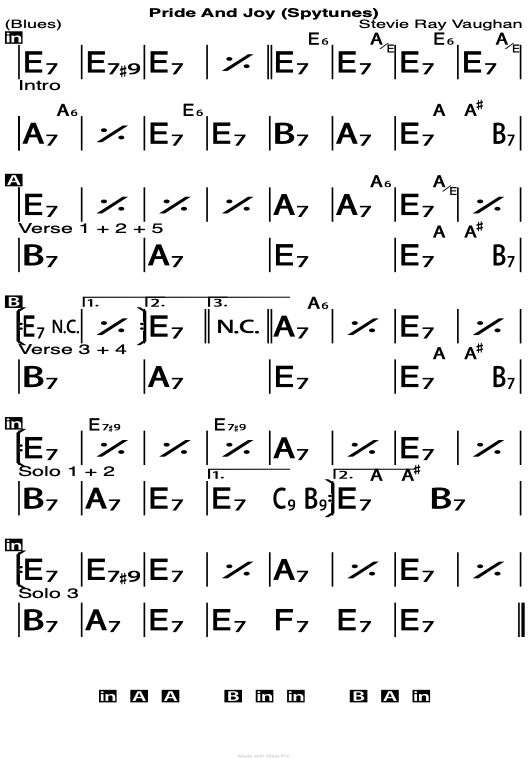
Pride & Joy Chord Chart | PDF + iReal Pro Download
If you like, you can download my chord chart for Pride & Joy as both PDF and in the iReal Pro format.
Using the iRealPro file, you could change the layout to what suits you. Technically, you could also change the key but let’s be honest, it only works if you think of it as if in E – tuned down to Eb or not!
Pride & Joy | TAB
Tune down to Eb if you’re playing along with the first couple of backing tracks. Then, bar by bar, start learning from the TAB—expect this to take many hours.
If you don’t want to tune down, use the second set of backing tracks which I’ve tuned up to the key of E.
Intro
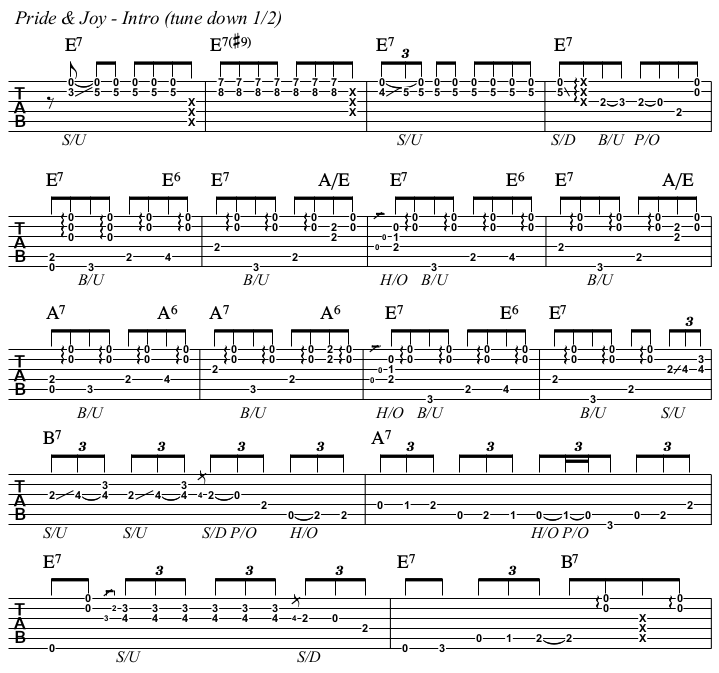
The famous intro is played as if all 8th notes are broken triplets. Start very slowly, gradually building up speed. The feel of the shuffle rhythm matters most—make sure it bounces against the bass line. Most of these notes should be played short.
Verse
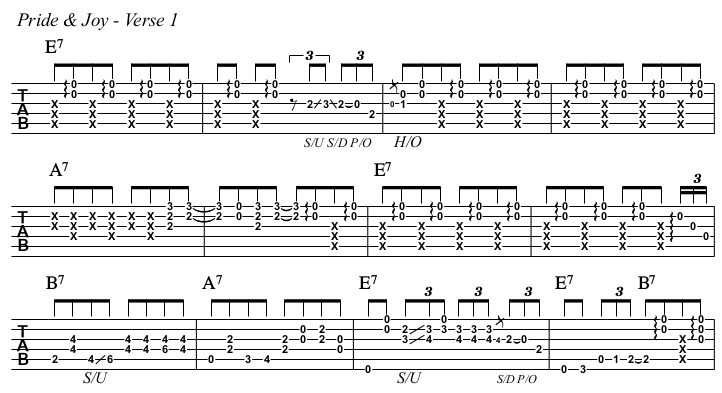
The verse relaxes slightly as we play the shuffle rhythm with scratches and open top strings. These are still played short—this is where the bounce comes from. As we reach chord V, a honky-tonk figure is introduced, hitting the 6th over B, but not over A.
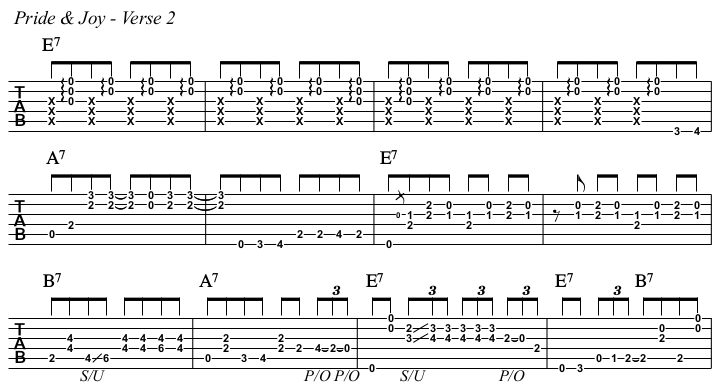
In the second verse, we follow a similar approach, though with some variation—make sure you nail this.
In bar 6, I feel as if SRV has gone back to E early! The E chord in bars 7 and 8 now features the same honky-tonk 6th we used over chord V, but this time as part of the chord rather than a bass line figure. You could describe this as A/E.
The A7 in bar 10 also briefly includes a 6th, but it’s extremely quick.
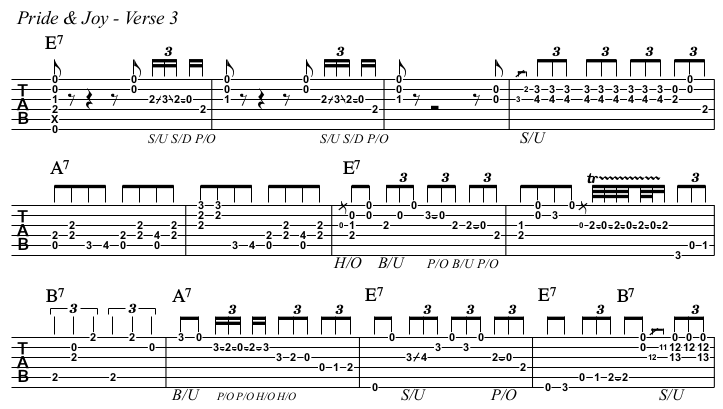
The third verse begins with stops. There are two particularly challenging licks here: the trill in bar 8, and the fast pull-offs and hammer-ons in bar 10. These will take time to master. Ultimately, it’s better to think of them as concepts rather than fixed licks.
Consider how you can move these ideas to other areas of the neck, targeting different notes from the minor blues scale, rather than relying on open strings.
Solo
The solo begins with triplets, moving between different parts of an E7 shape. After three bars, we shift between an Em-shaped blues scale at the 12th fret and the open position.
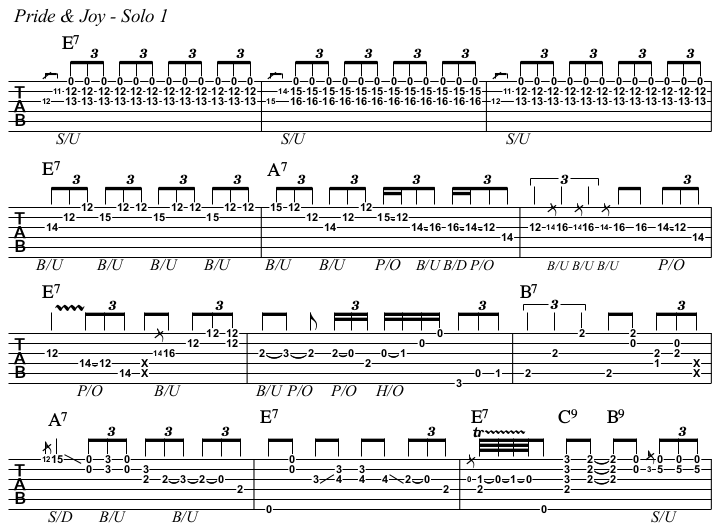
If you’ve made it this far, you’ve probably realised that Stevie is improvising—meaning that next time, he won’t play these notes in exactly the same way.
The ideas and note choices remain, but they appear as a stream of consciousness rather than something memorised.
To truly play like this, you need to reach that same state—not just reproduce this exact solo.
The only way to get there is to memorise the TAB, then let it go and play freely. It takes time—some players spend a lifetime developing this.
This doesn’t mean you should stop learning TAB. It simply means you must learn it, then let go, to discover whether it’s truly been absorbed.
From Texas Flood to Global Fame: SRV’s Blues Revival Story
Stevie Ray Vaughan’s popularity holds significant cultural value worldwide, as he played a major role in the blues revival of the ’80s.
When he tragically died in a helicopter crash, Vaughan left an entire generation of guitarists with a Strat, a Tube Screamer, aspirations of a Dumble amp—and, more often than not, a future as a guitar teacher.
His tune Pride & Joy, which you can learn using my chords, lyrics, charts and TAB, has become their signature tune worldwide.
Vaughan’s breakthrough came when he played on David Bowie’s massive single Let’s Dance (produced by Nile Rodgers) and released his debut album Texas Flood in the same year.
If you know your blues guitarists, it’s clear that SRV’s two main influences were Albert King and Eric Clapton, with John Mayer in turn a disciple of SRV.
As you memorise the legendary licks in the TAB lesson, pay close attention to the actual chords in Pride & Joy. Each verse introduces subtle variations, which are key to maintaining the listener’s attention.
Pride & Joy Chords: Continue Learning
Step-by-step Guitar Courses

Master guitar by studying real tunes. Build your skills with video lessons, eBooks and practice routines that connect theory with the music you love!
Explore SpyTunes step-by-step Guitar Courses.
Five similar tunes | Chords + Lyrics


