
Chords + Lyrics | Texas Flood
Intro
| F#7 F#6 | B7 B9 | F#7 | F#7 (B C) C#7 |
| F#7 | B7 | F#7 | F#7 |
| B7 | B7 | F#7 | F#7 |
| C#7 | B7 | F#7 B7 | F#7 (B C) C#7 |
Verse 1
| F#7 | B7 | F#7 | F#7 |
Well, it’s floodin’ down in Texas, all of the telephone lines are down.
| B7 | B7 | F#7 | F#7 |
Well, it’s floodin’ down in Texas, all of the telephone lines are down.
| C#7 | B7 | F#7 B7 | F#7 (B C) C#7 |
And I’ve been tryin’ to call my baby, Lord and I can’t get a single sound.
Verse 2
Well, dark clouds are rollin’ in, man I’m standin’ out in the rain.
Well, dark clouds are rollin’ in, man I’m standin’ out in the rain.
Yeah, flood water keep a rollin’, man it’s about to drive poor me insane.
Solo
||: F#7 | B7 | F#7 | F#7 |
| B7 | B7 | F#7 | F#7 |
| C#7 | B7 | F#7 B7 | F#7 (B C) C#7 :||
Verse 3
Well, I’m leavin’ you baby, Lord and I’m goin’ back home to stay.
Well, I’m leavin’ you baby, Lord and I’m goin’ back home to stay.
| C#7 C#9 C9 | B9 N.C | (F# A# F# A# B, B C B C) | C#7 N.C G7 F#9 |
Well back home I know floods and tornadoes, baby the sun shines on me every day.
Texas Flood Backing Track | Chord Analysis
Above, you’ll find backing tracks to use when learning Texas Flood. I’ve used stem separation to extract the guitar while keeping the drums, bass, keys, horns, and vocals intact.
After studying the chords and TAB, use my backing tracks to prepare for playing this tune with a band.
Should you want to play along in a more authentic way, you could tune your guitar down a semitone and think of all this as if in the key of G.
Alternatively, use the backing track tuned up to G so you can try it in standard tuning.
Chord Progression – What’s Going on?
Apart from the first four bars of the intro, Texas Flood follows a slow 12-bar blues progression in the key of F#, with a quick change in bar 2:
||: F#7 (I) | B7 (IV) | F#7 | F#7 |
| B7 | B7 | F#7 | F#7 |
| C#7 (V) | B7 | F#7 B7 | F#7 (B C) C#7 :||
Chord variations
There are two points where the progression deviates. The first is in the opening four bars of the intro:
| F#7 F#6 | B7 B9 |
| F#7 | F#7 (B C) C#7 |
The second occurs in the final line of the outro, where Stevie uses expressive 9 chords:
| C#7 C#9 C9 | B9 N.C |
| (F# A# F# A# B, B C B C) | C#7 N.C G7 F#9 |
The notes in brackets outline the bass line.
Time signature and tuning
Texas Flood is in 12/8, which can be thought of as 4/4 with triplets on each beat (3×4 = 12). For readability, I’ve transcribed it in 4/4.
On the original recording, Stevie tunes his guitar down a semitone. Although it sounds in F#, it’s played thinking in G on a detuned guitar. As this song doesn’t rely on open strings like Pride & Joy, I’ve chosen to transcribe everything here and in the TAB lesson in F# rather than G.
Tuning down has its advantages—it allows for heavier strings while keeping bends manageable, and it enhances resonance, giving a fuller tone. That said, most players won’t want to retune their guitar. In an ideal setup, keep one guitar permanently in Eb.
To get TAB for how to play Texas Flood, keep scrolling down this guitar lesson.
Transcription vs Exploring and Developing
While transcribing solos and licks note-for-note is valuable, Texas Flood calls for a different approach. With such fluid, stream-of-consciousness phrasing, it’s more important to understand the style than to copy it exactly.
That’s why the TAB combines transcription with targeted exercises, helping you internalise the techniques behind the playing.
Ideally, you’ll spend most of your time improvising in this style after working through the exercises, rather than trying to imitate Stevie outright.
It’s worth remembering that Stevie didn’t write these licks down—he absorbed ideas, and constantly developed them.
As soon as you’re ready, use the chord chart and play along with the backing tracks.
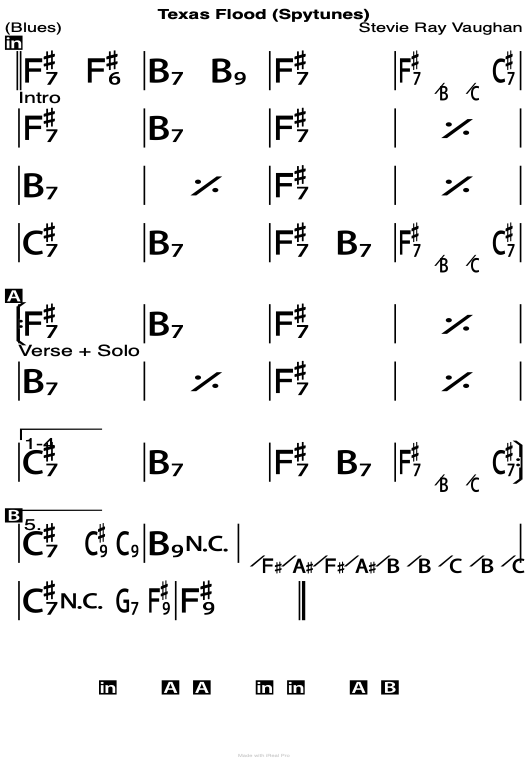
Texas Flood Chord Chart | PDF + iReal Pro Download
Download my chord chart as a PDF or iReal Pro file in the key of F#:
If you’re one step ahead and have a guitar tuned down a semitone, you can think of Texas Flood in the key of G using these chord charts:
Texas Flood | TAB
This is extremely challenging, but stick with it. The goal is clear from the outset: do not memorise this TAB.
Intro
Here’s a note-for-note transcription in the key of F#. Strictly speaking, it can’t be exact, as Stevie is thinking in G. I’ve also moved some licks from strings 1 and 2 to strings 3 and 4 i a different shape for practicality.

There’s so much happening here that I had to stop transcribing before the intro even finished.
Stevie doesn’t memorise licks and repeat them—he develops ideas in a stream-of-consciousness way. If we want to play like him, we must do the same rather than copy.
Let’s begin with the opening lick—the signature phrase and the only part played consistently. Before we develop it, we copy it.
Lick 1
Here are the first couple of bars, starting from an E shape. Musically, this is outstanding—stay with it until it feels identical to the original recording.

Let’s break it down:
- The opening notes outline F# major pentatonic
- A hammer-on moves from the minor 3rd to the major 3rd, with the 5th above
- This is followed by a quick B/F# (or F#6sus4), before repeating the idea
- We then move to F#6 before building into the IV chord
- The B7 mirrors the F#7 in the same E shape
- We finish on a B9 in a C shape
Once secure, move the idea to an A shape:

We shift the first idea up an octave while keeping the second the same, creating a descending feel. The 9 chord is now played as an E shape—similar to what Prince uses in Kiss.
Now try it in a D shape:
Here, the chord lick changes slightly. Instead of moving from the minor to major 3rd over a 5th, we play it over the root. The IV chord is also down an octave.

Lick 2
This lick is just one beat long. Stevie takes a classic F# minor pentatonic idea—three notes often repeated by players like T-Bone Walker and Chuck Berry—and transforms it.
Instead of repeating the phrase, he moves from b7 to 5th and then adds a surprising 9th. You can think of this as blending minor and major pentatonic, or simply adding colour with the 9th.
After playing the opening lick, leave a beat of space, then move it:
- First to a Dm shape, introducing new notes and finishing on the 9th
- Then to a Cm shape, with a stretch and a subtle bend on the minor 3rd
- Finally, a variation that feels similar but moves towards the 5th instead

The detail here is crucial—this is exactly how Stevie plays, constantly shaping notes with bends, hammer-ons, and pull-offs.
Lick 3
Now let’s look at a longer phrase from the turnaround:

The opening bend moves from fret 4 to 6, then settles on 5, outlining intervals of 4th, 5th, and b5th. It’s a difficult sound to control, but incredibly effective when done well.
We then descend through minor pentatonic, add a chromatic line into the V chord, and set up the next chorus by shifting position up the neck.
Move this idea up an octave into an Am shape (keeping the final lick the same).

Then into a Dm shape, transposing the ending:

Lick 4
When transcribing blues, aim to get as close as possible—and when you hit a wall, follow the rabbit hole.
This lick came directly from that process. As soon as it clicked, I wrote it down and explored it across the neck—sometimes sliding, sometimes bending.

Lick 5
For this lick, I took an idea from the final bar of the intro transcription, moved it forward by a beat, repeated it in a new position, and varied the phrasing with slides and bends.

Stevie plays in a stream-of-consciousness way, and we should aim to do the same. Use these ideas, move between them, and play along with the backing tracks. Then return to transcription, refine it, and follow the next rabbit hole.
If you struggle with a technique—such as hammer-ons and pull-offs—turn it into an exercise. For example:
On a single string, practise hammer-ons and pull-offs using different rhythms as you move up the minor pentatonic scale.

When you feel brave enough, jam along with the various backing tracks, one of them is in the key of G!
Stevie Ray Vaughan’s Influence and Lasting Legacy
John Mayer frequently cites Stevie Ray Vaughan as a major influence—just listen to the solo in Belief to hear his imprint.
Other guitar greats, including Eric Johnson and even Eric Clapton, have acknowledged SRV’s impact. Clapton once said:
“The first time I heard Stevie Ray, I thought: whoever this is, he is going to shake the world. I was in my car and remember thinking: I have to find out before the day is over who that guitar player is.”
Clapton and SRV later became close friends, even sharing the stage at what would be Stevie Ray’s final performance. Tragically, after the show, their helicopters departed separately, and SRV’s crashed.
In his wake, he left a legacy of countless guitarists striving to capture his tone and phrasing—yet no one quite like him has emerged.
Texas Flood Chords: Continue Learning
Step-by-step Guitar Courses

Master guitar by studying real tunes. Build your skills with video lessons, eBooks and practice routines that connect theory with the music you love!
Explore SpyTunes step-by-step Guitar Courses.
Five similar tunes | Chords + Lyrics

- Ain’t No Sunshine
- Born Under A Bad Sign
- Call It Stormy Monday
- Still Got The Blues
- The Thrill Is Gone


