
Chords | The Stumble
Verse 1
| N.C |
| A7 | A7 | E7 B7 | E7 |
| A7 A9 | A7 | B7 | B7 |
| E7 N.C | E7 N.C | A7 N.C A7 N.C | A#dim7 |
| E C#m | F#7 B7 | E7 A7 | E7 B7 |
Verse 2
| A9 | A7 | E7 B7 | E7 |
| A9 | A7 | B7 | B7 |
| E7 N.C | E7 N.C | A7 N.C A7 N.C | A#dim7 |
| E C#m | F#7 B7 | E7 A7 | E7 B7 |
Verse 3 (no stops)
| A7 | A7 | E7 | E7 |
| A7 | A7 | B7 | B7 |
| E7 | E7 | A7 | A#dim7 |
| E C#m | F#7 B7 | E7 A7 | E7 B7 |
Verse 4 (as verse 3)
| A7 | A7 | E7 | E7 |
| A7 | A7 | B7 | B7 |
| E7 | E7 | A7 | A#dim7 |
| E C#m | F#7 B7 | E7 A7 | E7 B7 |
Verse 5 (as verse 2)
| A9 | A7 | E7 B7 | E7 |
| A9 | A7 | B7 | B7 |
| E7 N.C | E7 N.C | A7 N.C A7 N.C | A#dim7 |
| E C#m | F#7 B7 | E7 A7 | E7 B7 |
Verse 6
| A9 | A7 | E7 B7 | E7 |
| A9 | A7 | B7 | B7 |
| E7 N.C | E7 N.C | A7 N.C A7 N.C | A#dim7 |
| E C#m | F#7 B7 | E7 E/G# A7 A#dim7 | B11 F#7 F7 E7 ||
The Stumble Backing Track | Chord Analysis
Above, you’ll find backing tracks to use when learning The Stumble. I’ve used stem separation to extract the guitar while keeping the drums, bass, and keys intact.
After studying the chords and TAB, use my backing tracks to prepare for playing this tune with a band.
Should you want to play along with the original recording instead, you need to tune your guitar sharp to 454Hz. In the backing tracks, I’ve done this job for you by tuning it to 440Hz.
Chord Progressions – What’s Going On?
Above, I’ve written the chords exactly as they appear in the tune, as I transcribed all of The Stumble note for note.
Below, you’ll find a simplified chord chart which, to be honest, makes more musical sense. Rather than tracking every variation, we’ll focus on the essential harmony.
Essentially, there are two sections — one with stops, one without — plus an ending. Here’s what you’ll find in verses 1, 2, 5, and 6:
| A7 | A7 | E7 B7 | E7 |
| A7 | A7 | B7 | B7 |
| E7 N.C | E7 N.C | A7 N.C A7 N.C | A#dim7 |
| E C#m | F#7 B7 | E7 A7 | E7 B7 |
- In bar 3, a B7 lands on beat 3+, leading into E7 in bar 4.
- The stops in bars 9 and 10 are full-bar rests.
- In bar 11, A7 hits on beats 1 and 3, while bar 12 builds tension using A#dim7.
The turnaround follows a I – VI – IIx – V – I – IV – I – V movement. Occasionally, A9 is played instead of A7 — these subtle variations are best understood through TAB, find it further down this guitar lesson.
Verse 3 + 4
In the middle section of The Stumble, the progression is played without stops:
| A7 | A7 | E7 | E7 |
| A7 | A7 | B7 | B7 |
| E7 | E7 | A7 | A#dim7 |
| E C#m | F#7 B7 | E7 A7 | E7 B7 |
The key differences here are the absence of stops, no B7 to E7 movement, and no use of A9.
End
The ending can be described using chords, although it only fully makes sense when combined with the bass movement:
| E C#m | F#7 B7 | E7 E/G# A7 A#dim7 | B11 F#7 F7 E7 |
Once you’ve worked through the full transcription, this chart becomes a helpful guide and encourages you to make The Stumble your own. Freddie King never played it the same way twice — and that’s exactly the spirit you should aim for.
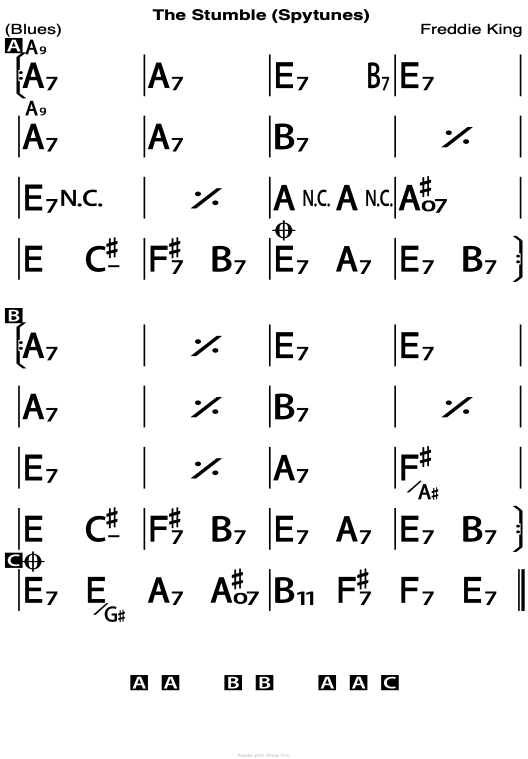
The Stumble Chord Chart | PDF + iReal Pro Download
Download my chord chart as a PDF, or use the iReal Pro format if you’d like to play it in more keys—with a backing track too! It’s a great way to practise improvising and comping across the fretboard.
The Stumble | TAB
It took me days to work all this out, so let’s start from the top. I strongly encourage you to go through everything with a fine-tooth comb.
Once you can play it as Freddie King did, let go and see what comes out naturally as you play along with the backing track. The second video in the playlist at the top of this guitar lesson is the original, just remember it is not in tune like my backing track is.
Verse 1
Here’s the main theme — stick with this until it feels easy, as everything that follows is built on the same ideas.
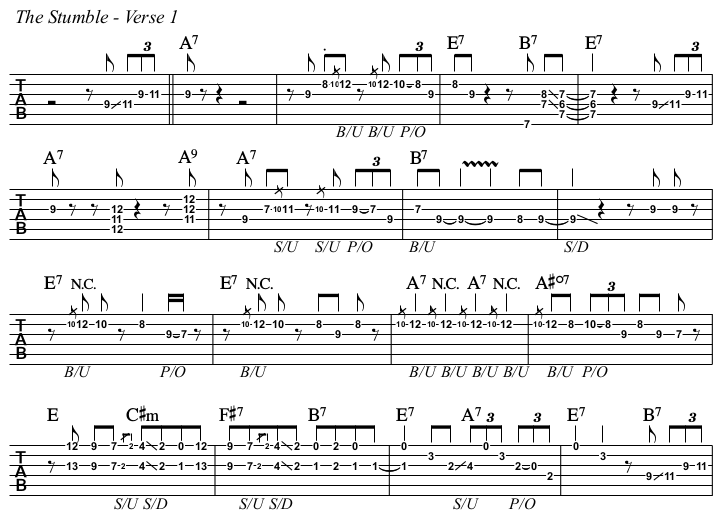
Let’s break down what’s going on:
- It’s a 16-bar blues with stops, starting on the IV chord.
- The first lick uses the E major pentatonic in a G shape.
- The second lick uses the E minor pentatonic in an Am shape.
- The B7 to E7 movement is broken up by playing the bass note, then the chord, then sliding down.
- The A9 is initially omitted, so you hear A7 first, then A9.
- For the A7 with stops, bend from the 10th to the 12th fret — experiment with gradually increasing the pitch.
- The turnaround starts on the “and” of 1, using a mix of E major and minor pentatonic ideas.
Verse 2
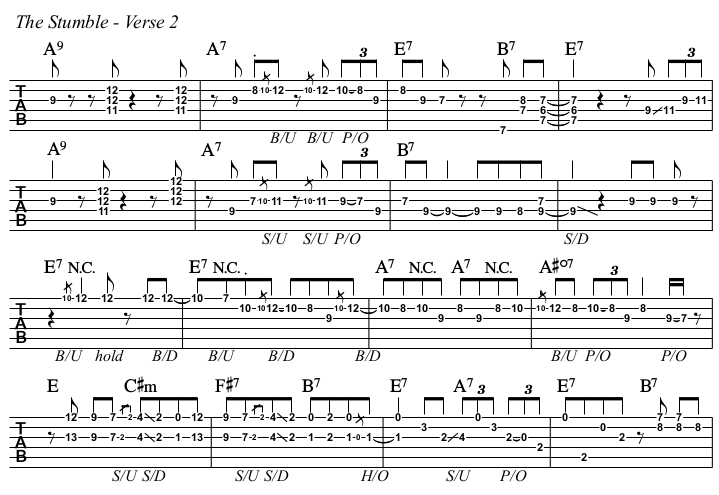
Here’s the second verse — essentially a development of verse 1.
- The A9 appears straight away.
- Bar 7 includes two notes before the slide.
- Bars 9–12 feature different licks, still using E minor pentatonic.
- The turnaround remains the same until the final bar.
Verse 3
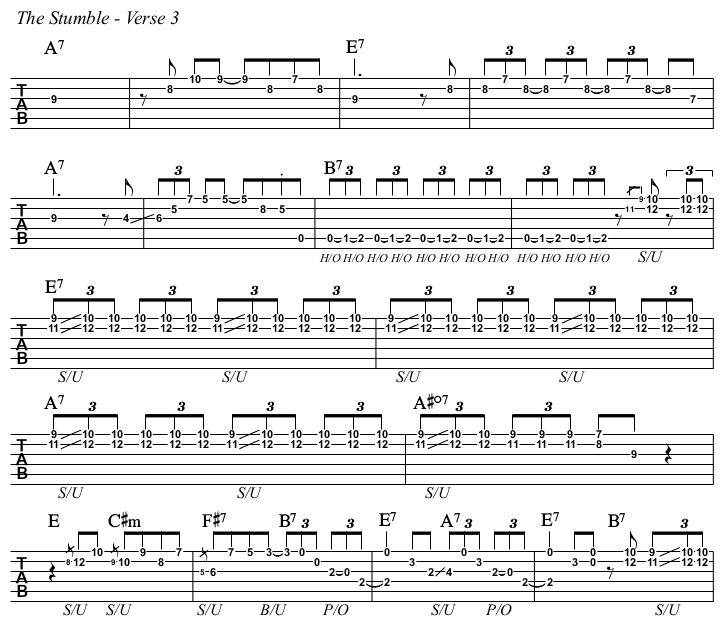
Verse 3 has no stops. The chords remain the same, but the licks are all new and follow the harmony more closely rather than relying on a blanket pentatonic scales.
- In bar 2, we move from the major 3rd to the minor 3rd over A.
- Bars 3–4 use E minor pentatonic without the B7 lead-in.
- Bar 6 introduces A major pentatonic with a b7.
- Over B7, a new chromatic hammer-on idea appears.
- Where stops previously occurred (bars 9–12), we now play through: using 5th and b7 over E, or 9 and sus4 over A.
- The turnaround becomes more complex, while the lick in bar 15 is retained.
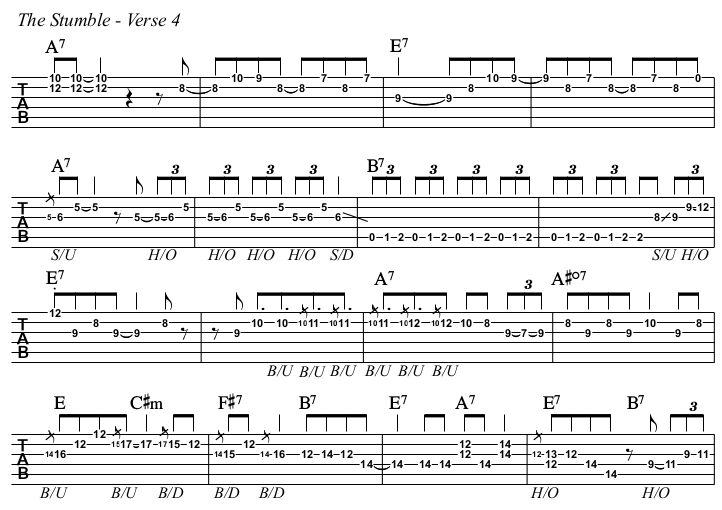
Verse 4
Verse 4 follows the same chord structure as verse 3, with these differences:
- We continue developing the idea that ended the previous verse.
- Bar 2 remains the same.
- Bar 4 introduces a new rhythm with a similar melodic idea.
- Bars 5–6 use A major pentatonic with a minor 3rd.
- After repeating the chromatic B7 idea, a new lick starts in E major pentatonic before shifting to E minor pentatonic.
- Bar 10 features a bend that gradually increases in pitch.
- The A#dim7 is approached using E minor pentatonic ideas.
- The turnaround begins with a classic E minor pentatonic lick, then shifts into the E minor blues scale.
- Bar 15 outlines minor pentatonic with a 6th (or an implied A major sound).
Verse 5
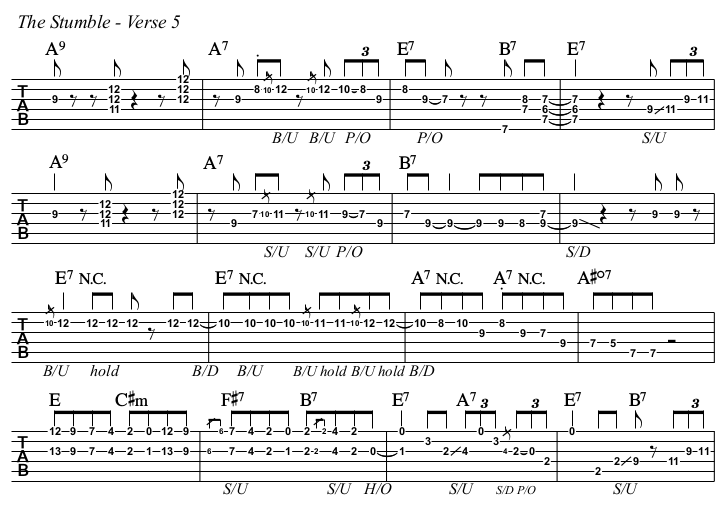
Verse 5 closely resembles verse 2 — see if you can spot the differences.
The turnaround begins an eighth note early. This feels like a mistake, but notice how it resolves and lands on the same lick used in verses 1 and 2, a great save!
Verse 6
The final verse is similar to verse 5, with new ideas in bars 9–12, again using minor pentatonic language. A cool downward bend appears in bar 11.
The turnaround remains consistent, and the ending follows the TAB. If you prefer, you can switch to chords here — both approaches work well.
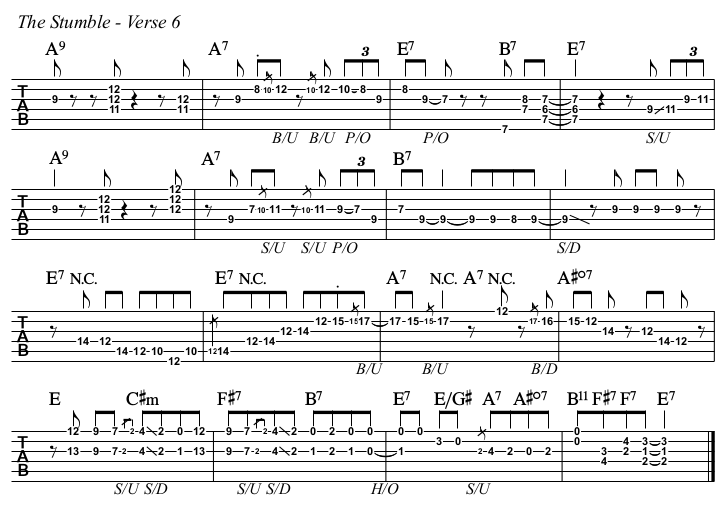
Once you can play through all the TAB, return to the chord lesson and see how much has stuck as you play using only the chart.
Freddie King: The Fiercest of the Three Blues Kings
The youngest of the legendary “Three Kings” of the blues, Freddie King earned the nickname “The Texas Cannonball” for good reason.
Born Frederick Christian King on September 3rd, 1934, in Texas, he was immersed in music from an early age. However, his family relocated to Chicago while he was still young, placing him right at the heart of a thriving blues scene. This combination of Southern roots and urban influence would go on to shape his distinctive sound.
Freddie King’s playing represents a powerful fusion of Texas and Chicago blues styles. From Texas, he drew a sense of raw energy and rhythmic drive, while Chicago contributed a harder, electrified edge. The result was a tone that was sharper, louder, and more forceful than many of his contemporaries.
Where B.B. King was known for his expressive vibrato and Albert King for his string bending, Freddie brought a fiery intensity that set him apart.
His approach to the guitar was bold and innovative. Freddie pushed improvisation further than many blues players of his time, often stretching beyond traditional phrasing and exploring more aggressive, dynamic ideas. His instrumental tracks, in particular, showcased his ability to combine precision with sheer power, making his performances both technically impressive and emotionally charged.
This fearless style didn’t just win over blues audiences—it deeply influenced the next generation of guitarists. Eric Clapton, among others, has often cited Freddie King as his favorite of the Three Kings, praising both his tone and his adventurous playing.
Freddie King’s legacy lies in that unmistakable intensity. He didn’t just play the blues—he attacked it, reshaping its possibilities and leaving a lasting mark on electric guitar music.
The Stumble Chords: Continue Learning
Step-by-step Guitar Courses

Master guitar by studying real tunes. Build your skills with video lessons, eBooks and practice routines that connect theory with the music you love!
Explore SpyTunes step-by-step Guitar Courses.
Five similar tunes | Chords + Lyrics


