
Chords | Cissy Strut
A – section
||: C9 | C9 Fus4 F :||
B – section
||: C9 | C9 :||
Solo
||: C9 :||
Cissy Strut Backing Track | Chord Analysis
Above, you’ll find backing track to use when learning Cissy Strut. I’ve used stem-seperation to extract the guitar while keeping the drums, bass, and keys intact.
After studying the chords and TAB, use my backing tracks to prepare for playing this tune with a band.
Chord Progressions – What’s Going On?
There’s seemingly not much to say about the chords in Cissy Strut—it’s essentially a static I groove, much like #6 on my Top 10 Chord Progressions list. The only deviation comes from an Fsus chord, which briefly takes us away from the tonic.
That F chord (with its suspended 4th) plays an important role. While it feels like chord IV—following the classic blues movement up a fourth—it can’t be Lydian, as Lydian would have a raised 4th rather than a suspended 4th. Instead, the keen modal theory student realises how F must be Ionian, making C Mixolydian.
The theory lines up perfectly: C9 is a dominant chord, so we’re moving V–I. And as is often the case with a static I groove, the main chord used is a dominant 7th.
While it’s tempting to say Cissy Strut is “in Mixolydian,” that wouldn’t be entirely accurate. It’s really just a blues—with a brief IV chord visit. To me, Cissy Strut is the perfect example of how you can study scales, read all the theory books, and analyse every note—but when it comes down to it, this tune only truly makes sense if you’ve spent time playing the blues.
And if you have, you’ll hear it’s half a II–V, as the melody outlines a Cm7, and half a blues, as the organ plays C9–F.
Confused? Maybe you just need the correct TAB—find it further down this lesson.
Once you can play the TAB, the theory becomes much easier to understand—you’ll feel it rather than think it. At that point, all you’ll need is this simple chord chart.

Cissy Strut Chord Chart | PDF + iReal Pro Download
You can download this super simple chord chart as a PDF: Cissy Strut chord chart PDF.
There’s also an iReal Pro version if you use the app: Cissy Strut iReal Pro.
You probably won’t need the chart to remember the chords, but it’s useful for following the arrangement—which flips after the solo.
Cissy Strut | TAB
A great way to develop as a musician is by working out melodies by ear. This isn’t about memorising fret numbers but about connecting the melody to theoretical concepts. Try this approach:
- The A-section melody is based on a Cm7 arpeggio, starting on the root and descending. The tension comes from the organ playing a 9 chord.
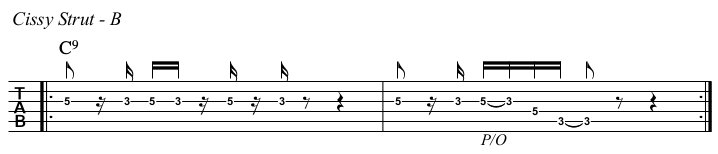
- The B-section melody uses the same notes in a different order but avoids the minor third. Like the A-section, it also begins on the root.
- Alternatively, you can think of both sections as being built on the C minor pentatonic scale.
To internalise the melody, listen to the original recording and sing along until you can recall both sections from memory. Then, visualise the C minor pentatonic scale on your fretboard, start on the root, and see if you can find the melody yourself.
Or, you could just read the TAB – hree ‘s the A -section:

Without the organ chords, it sounds like a II – V as the melody is a Cm7 arpeggio. With the organ playing C9, we get that bluesy tension.
B – section
The same applies to the bridge, or B-section.
Solo
During the organ solo, try this rhythm part.
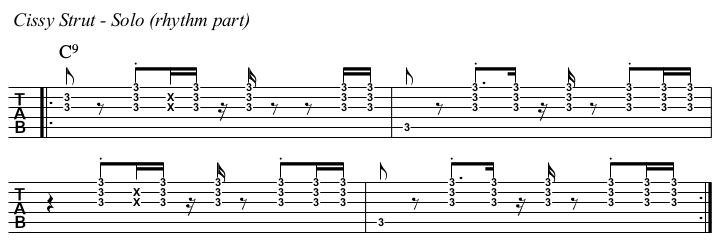
When you can play all this, play along with The Meters in my backing track using only the chord chart as your guide.
A rare instrumental jazz-funk standard that everyone can enjoy
As one of the easiest instrumental funk tunes around, Cissy Strut is a must-have in your repertoire.
Released in 1969 by The Meters, it has appeared in numerous films, earned several awards, and even charted—an uncommon feat for an instrumental track.
Countless jazz greats have recorded their versions, and even more include it in their live setlists.
In 2021, Rolling Stone magazine ranked it #158 on their 500 Greatest Songs of All Time list—an impressive achievement for a tune built on just three sections and two chords.
Perhaps this is down to the same concept that decides all other hits popularity – what it feels like for the listener.
Cissy Strut Chords: Continue Learning
Step-by-step Guitar Courses

Master guitar by studying real tunes. Build your skills with video lessons, eBooks and practice routines that connect theory with the music you love!
Explore SpyTunes step-by-step Guitar Courses.
Five similar tunes | Chords + Lyrics


