
Chords | A Night In Tunisia
Intro
||: Eb7 | Dm6 :||: Eb7 | Dm6/9 :||
A
||: Eb7 | Dm6/9 :|| Em7b5 A7b5 | Dm7 Dm6/9 :||
B
| Am7b5 | D7b9 | Gm Gmmaj7 | Gm7 C9 |
| Gm7b5 | C7b9 | F6 | Em7b5 A7#5 |
C
| Em11 | Em11 | Eb9#11 | Eb9#11 |
| Dm7 | Dm7 | G9#11 | G9#11 |
| F#min7b5 | Fmaj7 | F#7#9 | F#7#9 Fmaj7 |
||: N.C | N.C :|| Em7b5 | A7#5 |
And the Melody Still Lingers On (Night In Tunisia) | Lyrics
In 1981, Chaka Khan wrote lyrics for this classic. Now the song is called And the Melody Still Lingers On (Night In Tunisia). Here are the lyrics:
A long time ago in the 40s,
Dizzy and Bird gave us this song.
They called it a night in Tunisia,
and the melody still lingers on.
It was new and very strange,
blew the squares right off the stage.
Few could play along,
But the melody still lingers on.
Max and Miles to name just two,
together they grew.
The music was young and strong,
and the melody still lingers on.
They paved the way for generations,
from Coltrane to Stevie.
No one could stop the winds of change,
without them, where’d we be?
The Duke and the Prez were there before,
the past you can’t ignore.
The torch is lit, we’ll keep the flame,
and the melody remains the same.
||: Ba-da-da-da :||
Solo
The Duke and the Prez were there before,
the past you can’t ignore.
The torch is lit, we’ll keep the flame,
and the melody remains the same
||: Ba-da. ba-da-da-da :||
||: Ba-da-da-da :||
Solo
A long time ago in the 40s,
Dizzy and Bird gave us this song.
They called it a night in Tunisia,
and the melody still lingers on.
||: In the 40s, a night in Tunisia :II
A Night in Tunisia—with lyrics?!
When musicians say, “Let’s play A Night in Tunisia“, they’re referring to the instrumental version by Dizzy Gillespie and Charlie Parker from 1944, or my favourite, the 1946 version of Dizzy and his sextet —not Chaka Khan’s vocal adaptation.
Still, you do want to learn the melody in order to improvise over this legendary jazz standard, so perhaps having the lyrics helps, I’m not sure so I put them in above anyway.
But let’s not get carried away, to ensures you can hold your own in a live setting, start by leaving the melody and solos to the trumpet and sax players and focus first on the chords, the next step is the melody.
Once you’ve got the melody down, then start considering a solo!
With all that in mind, let’s analyse the chords we find in A Night In Tunisia.
A Night In Tunisia Backing Tracks | Chord Analysis
Above, you’ll find backing tracks to use when learning A Night In Tunisia. I’ve used stem separation to extract the horns so you can play the melody on the guitar.
After studying the chords and TAB, use my backing tracks to prepare for playing this tune with a band.
Chord Progressions – What’s Going On?
The opening Eb7 is a tritone substitution. Instead of playing A7 – Dm7 (IIIx – VI), we use Eb7, hitting an altered note from the now-imagined A7. The Dm is also not a Dm7, it’s a Dm6/9 in the 1946 recording.
The next progression, Em7b5 – A7b5 – Dm7 is a VII – IIIx – VI, also known as a minor II – V – I.
B-section
In the B-section, we shift keys and encounter several minor II – V – I progressions:
- Am7b5 – D7b9 – Gm (II – V – I in Gm)
- Gm7b5 – C7b9 – F6 (II – V – I in F, the final chord is not minor!)
- Em7b5 – A7 (II – V in Dm)
Personally, I prefer calling these progressions VII – IIIx – VI, but I acknowledge that “minor II – V – I” is the universally accepted term.
C-section
During the C section, the progression begins with Em11, before moving to that Eb7#11. This creates a sense of motion and prepares us for the Dm7 resolution a we chromatically move towards it.
Next up we have a G9#11, before an F#m7b5, which becomes an Fmaj7 – the same chord just lowering the root!
The final chord before the stop is an F#7#9 before we stop on an Fmaj7. The stop that follow is usually two bars but on my favourite recording, it’s four bars.
The sequence concludes with the Em7b5 – A7, a classic minor II – V, resolving to Dm7.
In general, this section uses a mix of minor and altered dominant chords, creating chromatic tension and release—key features of the modal jazz style that defines A Night in Tunisia. The last few chords provide a sense of movement, making the harmony feel like it is constantly shifting and evolving.
I hope it’s now clear how challenging it is to play the chords in A Night in Tunisia—make sure to master them before you start playing the melody and soloing!
Further down this guitar lesson, you get TAB for how to play these chords and the melody.
Returning from the TAB lesson, armed with the know-how of what to actually play, all you need is this chord chart.

A Night In Tunisia Chord Chart | PDF + iReal Pro Download
You can download my chord chart (based on the 1946 version) as a PDF, as this tune is rarely played in a different key.
That said, the iReal Pro format truly shines when it comes to jazz standards, as it offers MIDI backing tracks that actually sound quite good.
The serious player takes it through 12 keys—not because you’ll play it in another key, but because it deepens your understanding of the chord movements.
A Night In Tunisia | TAB
This isn’t going to be easy – Let’s begin with the chords.
Intro (bass line)
This is the bass line — essentially an arpeggio, which I’ve translated into chord names. Make sure you fully understand this foundation.

The intro then moves into chords, but as they match the verse harmony, we’ll press on.
Verse
Here we play different chord shapes from those implied by the bass line. Most people call it Dm, or perhaps Dm6. I’m convinced it’s Dm6/9. If you disagree, I’d love to hear why.
We then move to Em7b5 and A7b5, stopping on a D root.
Depending on what comes next, we get different Dm chord voicings:

As this tune is already challenging, I avoid expanding into other neck areas here — we’ll do that in later sections.
B-section
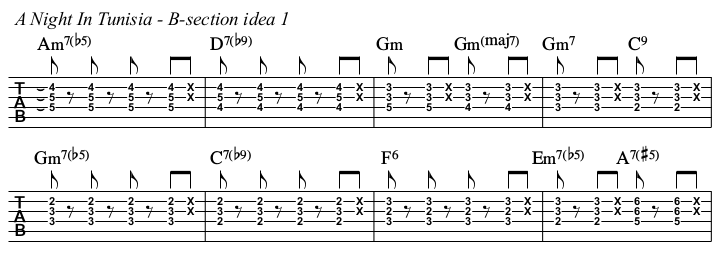
Next is a sequence of m7b5 chords followed by a dominant 7b9 — a classic minor II–V–I. The Gm → Gm(maj7) → Gm7 → C9 movement is a textbook chromatic descent in the root.
The next minor II–V–I resolves to a major chord — very unusual — followed by one final minor II–V (Em7b5 → A7#5). Both dom7b9 and dom7#5 are altered chords; remember this for later.
Here’s the first approach:
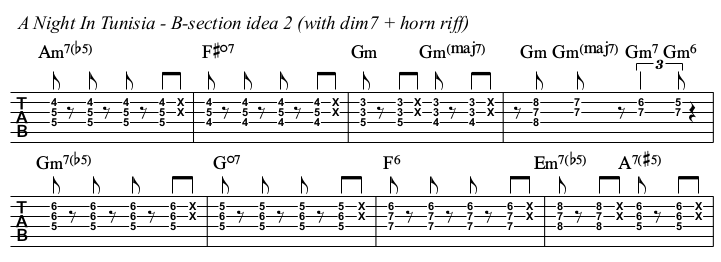
The second idea substitutes the dom7b9 chords with diminished chords — check the intervals to see how closely they relate. Elite jazz players do this on the fly; the only path there is to play a lot of jazz.
I’ve also included the horn lick in bar four and labelled the chord.
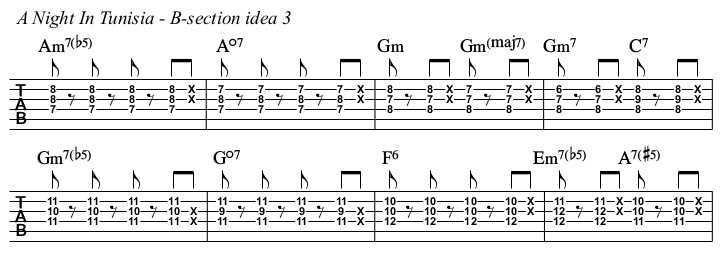
Here’s a third variation, focusing on a different fretboard area:
C-section
Here’s the first suggestion:

Most charts say “stop” for two bars, but the recording I used pauses for four. I’ve followed the horn rhythm so you can blend with it. I label this Eb7#11 (rather than b5) — that’s the common convention.
In the following phrase, after Dm7, I wrote what I actually heard rather than the Real Book changes, so my transcription differs slightly from standard charts.
Here’s another variation:

Notice I label it E7b5 here. We also use G13, and at the end we substitute the A7#5 (altered) for diminished chords.
I’m no jazz purist — true experts are the players who gig this music weekly — but these are the chords I hear.
Next up: the melody.
A Night In Tunisia | Melody TAB
I used the Real Book lead sheet as a starting point, but quickly switched to transcribing the recording — there are many differences.
A-section
Here’s the primary melody. I treat this as Bb Melodic Minor: essentially Bb Dorian with a major 7th.
The final figure is an enclosure — approaching the D from above and below before resolving.

B-section
This follows the minor II–V–I patterns mentioned earlier — first in Gm, then Fm (functioning as F6), and finally a II–V in Dm. The line outlines chord tones, so ensure you can see that clearly.

C-section
This passage is extraordinary. Using the same rhythm, we weave around richly extended chords with 16th-note triplets. It took serious time to transcribe!

Spend plenty of time on the melody before attempting to solo.
Solo tips
Let’s keep this short. You can approach it from a theory perspective (see playlist videos above), or — my recommendation — build ideas from the melody.
- A-section: Bb Melodic Minor
- B-section: Chord arpeggios
- C-section: Keep the rhythmic shape and adjust as little as possible per chord
When you can play both chords and melody, go back to the chords lesson and use the chart while playing along with Dizzy.
A Night In Tunisia Chords: Continue Learning
Step-by-step Guitar Courses

Master guitar by studying real tunes. Build your skills with video lessons, eBooks and practice routines that connect theory with the music you love!
Explore SpyTunes step-by-step Guitar Courses.
Five similar tunes | Chords + Lyrics


