
Chords + Lyrics | Papa Ain’t Salty
Intro
| G6 | G6 | G6 | G6 |
| C6 | C6 | G6 | G6 |
| D6 | C6 | G6 | G6 |
Verse 1
| G13 | G13 | G13 | G13 |
Come home little girl, your papa ain’t salty no more.
| C13 | C13 | G13 | G13 |
Come home little girl, your papa ain’t salty no more.
| D13 | C13 | G13 | G13 |
I need your love and I swear I miss you so.
Verse 2 (as verse 1)
I know I was wrong, and I know I’ve caused you pains.
I know I was wrong, and I’ve caused you pains.
I’m sorry pretty baby, I won’t do that again.
Solo 1
| G7 | C9 | G7 | G7 |
| C9 | C9 | G7 | G7 |
| D7 | D7 | G7 | G7 G6 |
| G9 (G6) | G9 (G6) | G9 (G6) | G9 (G6 C6) |
| C9 (C6) | C9 (C6 G6) | G9 (G6) | G9 (G6 D6) |
| D9 (D6 C6) | C9 (C6 G6) | G9 (G6) | G9 (G6) |
Verse 3
| G6 | G6 | G6 | G6 |
Why or why pretty baby, why did you have to go.
| C6 | C6 | G6 | G6 |
Why or why pretty baby, why did you have to go,
| D6 | N.C | N.C | G6 G9 |
Please come back home pretty mama, Papa ain’t salty no more.
Papa Ain’t Salty Backing Track | Chord Analysis
Above, you’ll find backing tracks to use when learning Papa Ain’t Salty. I’ve used stem separation to extract the guitar while keeping the drums, bass, keys, horns, and vocals intact.
After studying the chords and TAB, use my backing tracks to prepare for playing this tune with a band.
Should you want to play along with the original recording instead, you need to tune your guitar sharp to 444Hz. In the backing track, I’ve done this job for you by detuning it to 440Hz.
Chord Progression – What’s Going On?
Built around a standard 12-bar blues, Papa Ain’t Salty’s chords are extended to 6 and 9 throughout, either by moving a bass line or by sliding one chord shape into the other.
The rhythm guitar work may not be what first comes to mind when approaching a T-Bone Walker tune. After all, he was the first great electric guitar soloist, and Papa Ain’t Salty is no exception. However, the chord work here is outstanding – let’s investigate!
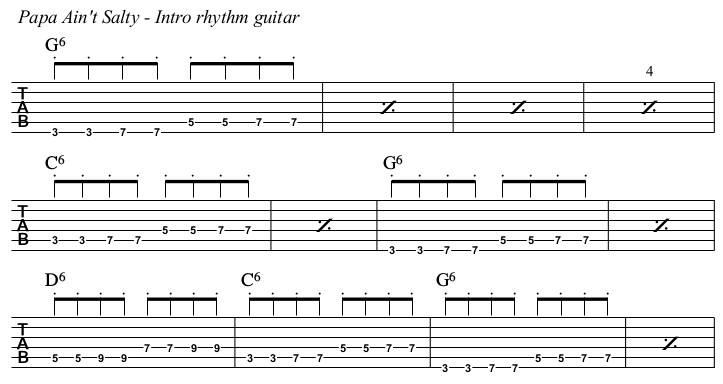
The intro rhythm guitar plays a bass line that moves root – 3rd – 5th – 6th. To simplify this, we can name the chords G6, C6, and D6, like this:
| G6 | C6 | G6 | G6 |
| C6 | C6 | G6 | G6 |
| D6 | C6 | G6 | G6 |
For the first and second verses, we change the bass line so it now moves: root – octave – b7 – 6 – 5th. Because the b7 is included, we must now name the chords as 13 rather than 6:
| G13 | C13 | G13 | G13 |
| C13 | C13 | G13 | G13 |
| D13 | C13 | G13 | G13 |
As the solo begins, we switch to dominant 7 chords for the I and V, but use a 9 chord for the IV:
| G7 | C9 | G7 | G7 |
| C9 | C9 | G7 | G7 |
| D7 | D7 | G7 | G7 G6 |
The final G6 sets up what follows: a slide from 6 to 9 in the second part of the solo. The lead guitar answers with the same chord lick immediately afterwards, but with a noticeably darker tone.
To explain this properly, TAB is essential — you’ll find it further down this guitar lesson.
Above (chords and lyrics), I included some chords in brackets because fitting two guitars moving G6 (tied from the previous bar) to G9 — and then answering with G6 to G9 — within a single bar becomes rather hectic.
The final verse mirrors the intro, returning to the 6-based bass line instead of the 13. The only difference is that we stop after the V chord and finish on G6 – G9.
Here’s the chord chart — I can’t believe I managed to fit it all in!
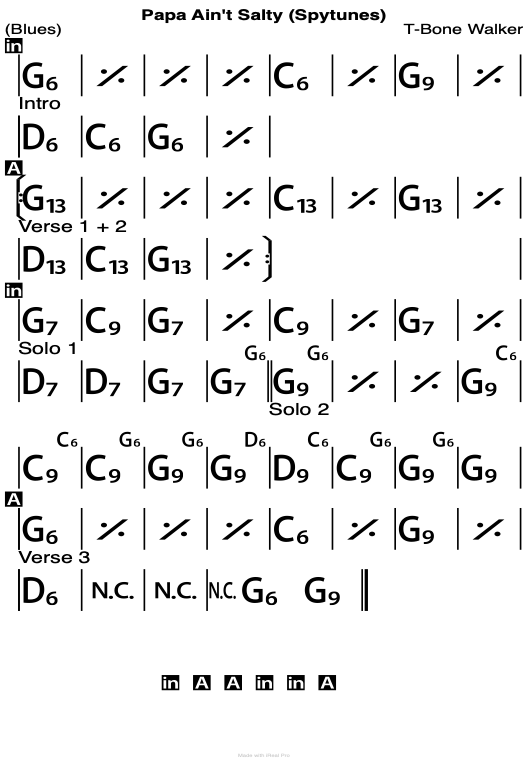
Papa Ain’t Salty Chord Chart | PDF + iReal Pro Download
My chord chart can be acquired in either PDF or iReal Pro format:
Papa Ain’t Salty | TAB
Before we get our teeth into the lead work, let’s spend some time working out what the band’s rhythm guitarist is playing — it’s superb!
Intro (rhythm)
Here, we play a bass line riff using the 6, hence naming the chords G6, C6, and D6. The dots above the stems mean “play short”.
Verse
As the verses begin, we include the b7 and rearrange the notes:

Verse 3 returns to the intro idea but stops after the D6:

Solo (rhythm)
The first solo mainly uses dominant 7 chords; only the IV chord is played as a 9, it’s also a quick change, and we stay on the V chord.

The second solo feels more like a comping feature, where we slide from 6 to 9 chords. Here’s the first rhythm guitar:

And here’s T-Bone answering using the same lick, but with a darker tone:

Let’s now take a look at the lead playing.
Intro solo
Here’s the complete intro solo, note for note! make sure you practice this until it’s bang on.

Rather than now moving on, memorising the next solo, instead, let’s focus on the note choices. The rhythm is pretty much triplets and broken triplets so that’s easy to just keep going with, but what notes does T-Bone chose?
- The first lick is a G minor blues scale, Starting on the b5, ending on the b7, it generates tension.
- The next few licks are a blend of the minor blues scale and the maj 3rd. make sure you can see all intervals.
- As we move out of the IV chord the 6th of C/9th of G appear for the first time, just before the G chord return.
- Over the returning G chord we don’t play a minor blues scale anymore, instead it is the 6th and maj 3rd that is added to the minor pentatonic.
- Over the D6 and C6, it’s all G minor blues scale.
- The final lick is G minor pentatonic with a maj 3rd added.
So, with all that knowledge (memorised the solo, and understood the intervals chosen), can you now play these kind of solos?
The answer is yes, if you keep practicing – to the backing tracks!
T-Bone Walker: The Electric Guitar Pioneer and His Influence on the Blues
Like many Texans before and after him, T-Bone Walker moved to California to record. It was there that he first got his hands on one of the earliest electric guitars, the Gibson ES-150, known as the “Electric Spanish”.
Around 1939, T-Bone made his mark on musical history by recording one of the first blues tracks featuring electric guitar.
He could have stopped there and still been a legend. Fortunately for us, he didn’t. Many of the most celebrated blues guitarists who followed cite T-Bone as a primary influence.
Papa Ain’t Salty Chords: Continue Learning
Step-by-step Guitar Courses

Master guitar by studying real tunes. Build your skills with video lessons, eBooks and practice routines that connect theory with the music you love!
Explore SpyTunes step-by-step Guitar Courses.
Five similar tunes | Chords + Lyrics


