
Chords + Lyrics | Call It Stormy Monday
Intro
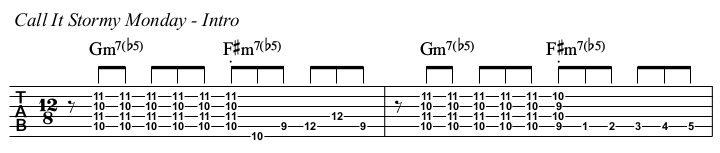
| Gm7b5 F#m7b5 (D F# A D F#) | Gm7b5 (C#9) F#m7b5 (A# B C C# D) |
Verse 1
| G9 | C9 | G9 | G9 |
They call it stormy Monday, but Tuesday’s just as bad.
| C9 | C9 | G9 | G9 |
They call it stormy Monday, but Tuesday’s just as bad.
| D7/A D7 | D7 | G9 C9 | G9 D7 |
Wednesday’s worse, and Thursday’s also sad.
Verse 2
| G9 (Db9) | C9 | G7 Gm7 G7 Ab7 | G7 Gm7 G7 Ab7 G7 |
Yes, the eagle flies on Friday, and Saturday I go out to play.
| C9 | C9 | G7 Gm7 G7 Ab7 | G7 Gm7 G7 Ab7 G7 |
Eagle flies on Friday, and Saturday I go out to play.
| D7/A D7 | D7 | G9 C9 | G9 D7 |
Sunday I go to church, then I kneel down and pray.
Solo
| G9 | C9 | G9 | G9 |
| C9 | C9 | G9 | G9 |
| D7/A D7 | D7 | G9 C9 | G9 D7 |
Verse 3
| G7 | C9 | G7 Gm7 G7 Ab7 | G7 Gm7 G7 Ab7 G7 Db9 |
Lord have mercy, Lord have mercy on me.
| C9 | C9 | G7 Ab7 | G7 |
Lord have mercy, my heart’s in misery.
| D7/A D7 Eb7 | D7 | G9 C9 | G9 Ab9 G9 | G9 |
Crazy about my Baby, yes, send her back to me.
Call It Stormy Monday Backing Track | Chord Analysis
Above, you’ll find backing tracks to use when learning Call It Stormy Monday. I’ve used stem separation to extract the guitar while keeping the drums, bass, keys, horns, and vocals intact.
After studying the chords and TAB, use my backing tracks to prepare for playing this tune with a band.
Chord Progression – What’s Going On?
A jazz theorist might argue that T-Bone Walker is using chord substitutions in the intro, playing Gm7b5 and F#m7b5 (in Am shapes) instead of Eb9 and D9.
The same idea applies to the I chord once the verse begins. Rather than playing G9, he uses C#m7b5 sliding down to Bm7b5.
This is a great harmonic device — first heard clearly on T-Bone recordings — and once I started doing this, I have to admit, I began using it everywhere.
Verse
At its core, Call It Stormy Monday follows a standard 12-bar blues progression, built mostly around dominant 9 chords. Interestingly, the V chord is always just a plain dominant 7. Here’s the first verse and solo:
||: G9 | C9 | G9 | G9 |
| C9 | C9 | G9 | G9 |
| D7/A D7 | D7 | G9 C9 | G9 D7 :||
The second verse introduces a series of chromatic movements:
| G9 (Db9) | C9 | G7 Gm7 G7 Ab7 | G7 Gm7 G7 Ab7 G7 |
| C9 | C9 | G7 Gm7 G7 Ab7 | G7 Gm7 G7 Ab7 G7 |
| D7/A D7 | D7 | G9 C9 | G9 D7 |
- In the first bar, the Db9 functions as a tritone substitution. Rather than adding altered extensions to G9, the tritone sub creates the same harmonic tension.
- In bars three and four, we introduce Gm — a classic blues move, swapping major for minor. While this is more common melodically, it’s interesting to see it spelled out so clearly in the harmony here.
- The Ab7 that follows is another tritone substitution, this time standing in for D7. This particular chord lick is best understood through TAB.
You really do need the TAB to get all of this right, as the rhythmic feel of the chords changes as the verse develops. You can find the TAB further down this guitar lesson.
The solo follows the same progression as the first verse.
Verse 3 + End
The third verse introduces further variations:
| G7 | C9 | G7 Gm7 G7 Ab7 | G7 Gm7 G7 Ab7 G7 Db9 |
| C9 | C9 | G7 Ab7 | G7 |
| D7/A D7 Eb7 | D7 | G9 C9 | G9 Ab9 G9 | G9 |
The tritone substitution that previously appeared in bar one now shows up in bar four — the same idea, just shifted.
In bar seven, Ab7 remains, but the full chord lick is reduced. Bar nine introduces Eb7, which doesn’t function as a tritone substitution in quite the same way. It feels closer to the colour chord heard in The Thrill Is Gone — sitting just above the dominant.
The final bar confirms the tritone concept once again, resolving Ab9 back to G9.
Here’s a chord chart to guide you.
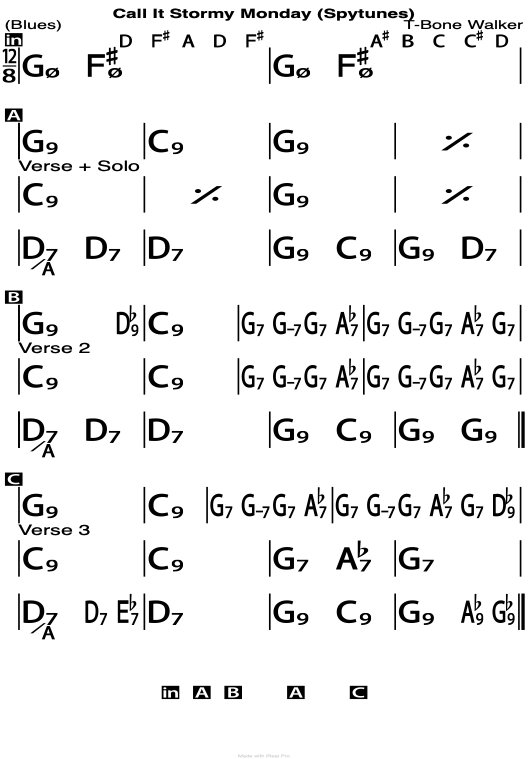
Call It Stormy Monday Chord Chart | PDF + iReal Pro Download
You may want to download my chord chart as a quick reference for Call It Stormy Monday’s chords — even though it’s “just” a blues.
Here’s the PDF: Call It Stormy Monday chord chart (PDF)
And here’s the iReal Pro version: Call It Stormy Monday chord chart (iReal Pro)
With the app, you can not only change key but also create a solid backing track to practise soloing over Call It Stormy Monday’s chords in all 12 keys — a great way to internalise the progression.
Call It Stormy Monday | TAB
Before we start studying T-Bone’s licks, let’s first work out how to comp the complete tune. Here’s the intro.
Verse 1 + Solo comping
This is the first — and simplest — verse. You can also use this comping pattern during the solo, so either loop it the first time through using a loop pedal, or play it while someone else takes a solo.
In all of these examples, I’m playing a more blues-style bass line. T-Bone’s approach is more jazz-influenced, but I felt it was easier to make this work when playing on your own by using the ascending bass notes before each chord. If you’re playing along with T-Bone, or with a band that includes a bass player, simply leave the bass lines out.

Verse 2 + 3
Next, we start changing the chords. When T-Bone and his piano player performed this, he was almost certainly improvising — but let’s not get ahead of ourselves. First, we’ll work out exactly what they played and learn from it. Take note of the tritone substitutions here.

In verse 3, things calm down a little. Notice how some ideas are recycled, then deliberately held back.

Call It Stormy Monday | Licks
Now you can record all of that comping — using a loop pedal — and then try out these two incredible licks.
The first lick is unbelievably difficult to play, not to mention to transcribe. I spent hours on this one. Your goal here is not just to learn it, but to learn from it.
We’re playing a G minor blues scale with an added 9th. Practise extremely slowly and aim to play along with T-Bone at around 14 seconds into the recording, then on your own using the backing tracks.

The second lick is perhaps even trickier. The scale is the same, although we also introduce a natural 6th towards the end of bar one.

At this point, I’d encourage you to jam over the backing tracks. Solo over them using these two licks and explore continuing in this style.
The Lasting Impact of Call It Stormy Monday on Blues Guitar Soloing
Call It Stormy Monday (But Tuesday Is Just as Bad) was first recorded by T-Bone Walker in 1947 and released the following year, becoming one of the defining blues recordings of the post-war era.
While chart data from the late 1940s is limited compared to later decades, the song was a major hit on the Billboard R&B charts and quickly established itself as a modern blues standard. More importantly than its chart position, Stormy Monday became a cornerstone of the electric blues repertoire, regularly performed, re-recorded, and reinterpreted by generations of musicians.
The song’s impact lies largely in Walker’s approach to phrasing and soloing. Unlike earlier country blues guitarists, T-Bone Walker played fluid, horn-like single-note lines on an electric guitar, drawing heavily from jazz vocabulary. His solos on Stormy Monday are lyrical, spacious, and harmonically aware, often outlining chord changes rather than relying on repetitive pentatonic shapes. This marked a crucial shift in how the electric guitar was perceived — not just as a rhythm instrument, but as a lead voice capable of melodic sophistication and emotional nuance.
Numerous artists have recorded influential versions of Stormy Monday, each helping to cement its status as a blues essential. B.B. King’s interpretation leaned into expressive vibrato and vocal-style phrasing, while Allman Brothers Band performances, particularly live, brought the song into a rock-blues context, with extended improvisation and dual-guitar interplay. These versions ensured the song’s relevance well beyond its original era.
For T-Bone Walker himself, Stormy Monday became a signature piece that defined his legacy. It solidified his reputation as a pioneering electric guitarist and a bridge between jazz, blues, and early rhythm and blues. His influence can be heard clearly in the playing of B.B. King, Chuck Berry, Eric Clapton, Stevie Ray Vaughan, and countless others who adopted his smooth phrasing, use of chord tones, and conversational approach to soloing.
Ultimately, Call It Stormy Monday didn’t just succeed as a song — it reshaped the language of electric guitar soloing, setting a blueprint that still underpins blues and blues-influenced guitar playing today.
Call It Stormy Monday Chords: Continue Learning
Step-by-step Guitar Courses

Master guitar by studying real tunes. Build your skills with video lessons, eBooks and practice routines that connect theory with the music you love!
Explore SpyTunes step-by-step Guitar Courses.
Five similar tunes | Chords + Lyrics


