
Chords + Lyrics | Don’t Wait Too Long
Intro
||: D G/B | E7 A7sus4 :||
Verse 1
| D G/B | E7 A7sus4 | D G/B | E7 A7sus4 |
You can cry a million tears, you can wait a million years.
| D G | F#7 Bm7 | E7 A7sus4 | D |
If you think that time will change your ways, don’t wait too long.
Verse 2
When your morning turns to night, who’ll be loving you by candlelight?
If you think that time will change your ways, don’t wait too long.
Bridge 1
| G | F#7 Bm7 | E7 A7 | D |
Maybe I got a lot to learn, time can slip away.
| G | F#7 Bm7 | E7 | A7 |
Sometimes you got to lose it all, before you find your way.
Verse 3
Take a chance, and play your part. Make romance, it might break your heart.
But if you think that time will change your ways, don’t wait too long.
Solo
| D G/B | E7 A7sus4 | D G/B | E7 A7sus4 |
| D G | F#7 Bm7 | E7 A7sus4 | D |
Verse 4
It may rain, it may shine, love will age like fine red wine.
But if you think that time will change your ways, don’t wait too long.
Bridge 2
Maybe you and I got a lot to learn, don’t waste another day.
Maybe you got to lose it all, before you find your way.
Verse 5
Take a chance, play your part. Make romance, it might break your heart.
| D G | F#7 Bm7 | E7 A7sus4 |
But if you think that time will change your ways, don’t wait too long.
Outro
||: D G/B | E7 A7sus4 :||
Don’t wait, don’t wait. Getting older.
Don’t Wait Too Long Backing Tracks | Chord Analysis
Above, you’ll find backing tracks to use when learning Don’t Wait Too Long. As well as using stem separation to extract the guitar as I usually do, there is also a backing track in four keys created using iReal Pro for you to practice with.
After studying the chords and TAB, use my backing tracks to prepare for playing this tune with a band, or as I do further down this guitar lesson, with a singer and a loop pedal.
Chord Progressions – What’s Going On?
Madeleine Peyroux’s Don’t Wait Too Long is best played using traditional jazz comping, based on a steady downward strumming pattern on the beat.
To get good at this, you need to practice in all areas of the neck and in many keys. Let’s take a look at all the chords found in this modern classic that sounds just like a jazz standard.
Intro
The intro chords establish the main theme, following a I – IV/3 – IIx – V progression. In the key of D, this becomes:
||: D (I) G/B (IV/3) | E7 (IIx) A7sus4 (V) :||
Using TAB, you’ll get a better sense of how to play these chords, to find it keep scrolling down this guitar lesson.
Verse
The verse begins just like the intro before introducing a turnaround progression:
||: D (I) G/B (IV/3) | E7 (IIx) A7sus4 (V) :||
| D (I) G (IV) | F#7 (IIIx) Bm7 (VI) |
| E7 (IIx) A7sus4 (V) | D (I) |
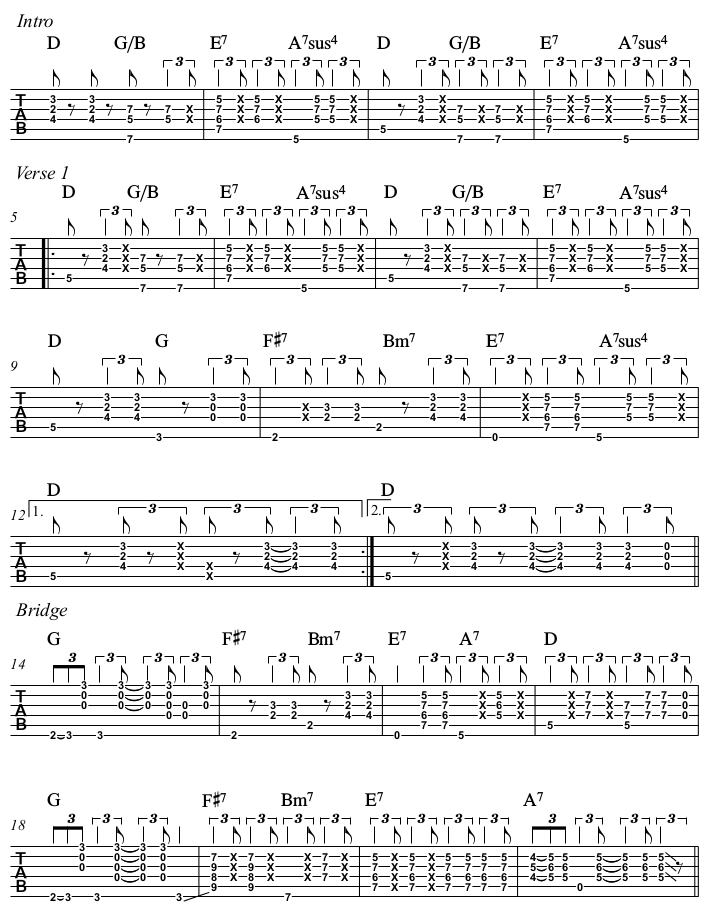
In my recording (see further down this guitar lesson), the chord shapes for this progression varies throughout, so I’ve written out the full arrangement for you. You don’t have to play it exactly as I did, but the TAB provides all the details you might want to explore.
Bridge
The bridge chords in Don’t Wait Too Long, like many songs in this style, begin on IV, creating a sense of movement:
| G (IV) | F#7 (IIIx) Bm7 (VI) |
| E7 (IIx) A7 (V) | D (I) |
| G (IV) | F#7 (IIIx) Bm7 (VI) |
| E7 (IIx) | A7 (V) |
Once you’ve studied my TAB from the video lesson, this simple chord chart is all you’ll need to play Don’t Wait Too Long yourself.

Don’t Wait Too Long Chord Chart | PDF + iReal Pro Download
Should you want to download this chart, here’s a PDF: Don’t Wait Too Long chord chart PDF.
This chord chart was created using iReal Pro, here’s a link to that file: Don’t Wait Too Long iReal Pro. Using this and the iRealPro app, you can change the key (more why you should do this below).
Below is an acoustic arrangement for how you could play Don’t Wait Too Long with a singer. If you want to solo in this scenario, use a loop pedal.
Don’t Wait Too Long | TAB
I recorded Don’t Wait Too Long by Madeleine Peyroux as an acoustic arrangement back in 2007 when Spytunes firt launched.
Here’s the complete TAB for what I play in the video.


Don’t Wait Too Long | TAB (solo)
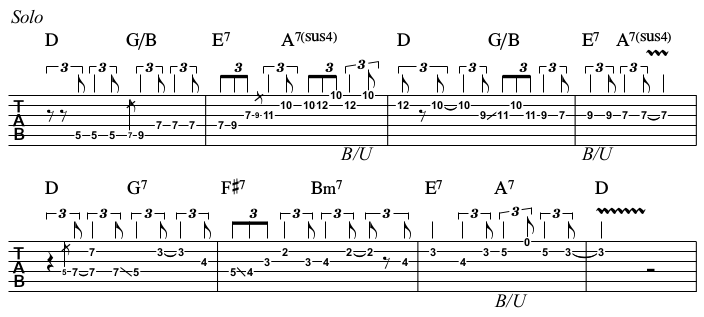
Here’s the solo you hear in the video above.
Use Don’t Wait Too Long to practise soloing with Modes and Arpeggios
When soloing in this style, it’s essential to switch between modes and arpeggios for each chord. To do this effectively, you need to think in chord numbers as you apply arpeggios and modal scales.
For example, you’d use Phrygian Dominant over IIIx and Aeolian over VI.
The bridge section follows the cycle of fourths, moving through IV – IIIx – VI – IIx – V7sus4 – I—an ideal framework for practising modal scales:
| G (Lydian) | F#7 (Phrygian Dom) Bm7 (Aeolian) |
| E7 (Mixolydian) A7 (Mixolydian) | D (Ionian) |
If you don’t know your pentatonic scales, arpeggios, and modes in every position, you’ll struggle to relax enough to solo in a jazz style with confidence.
But once you do, jazz becomes effortless—you’ll start playing around with melodies and chords like a footballer with a ball, constantly discovering new possibilities.
A great way to achieve this, is to practice soloing using the backing tracks in 4 keys above, an even better way would be using the iReal Pro app and do it in 12 keys.
Don’t Wait Too Long Chords: Continue Learning
Step-by-step Guitar Courses

Master guitar by studying real tunes. Build your skills with video lessons, eBooks and practice routines that connect theory with the music you love!
Explore SpyTunes step-by-step Guitar Courses.
Five similar tunes | Chords + Lyrics


