
Chords + Lyrics | The Thrill Is Gone
Intro
| Bm7 | Bm7 | Bm7 | Bm7 |
| Em7 | Em7 | Bm7 | Bm7 |
| Gmaj7 | F#7 | Bm7 | Bm7 |
Verse 1
| Bm7 | Bm7 | Bm7 | Bm7 |
The thrill is gone, the thrill is gone away.
| Em7 | Em7 | Bm7 | Bm7 |
The thrill is gone baby, the thrill is gone away.
| Gmaj7 | F#7 | Bm7 | Bm7 |
You know you done me wrong baby, and you’ll be sorry someday.
Verse 2
The thrill is gone, it’s gone away from me.
The thrill is gone baby, the thrill is gone away from me.
Although, I’ll still live on, but so lonely I’ll be.
Solo
| Bm7 | Bm7 | Bm7 | Bm7 |
| Em7 | Em7 | Bm7 | Bm7 |
| Gmaj7 | F#7 | Bm7 | Bm7 |
Verse 3
The thrill is gone, it’s gone away for good.
All the thrill is gone baby, it’s gone away for good.
Someday I know I’ll be open-armed baby, just like I know, a good man should.
Verse 4
You know, I’m free, free now, baby, I’m free from your spell.
Oh, I’m free, free, free now, I’m free from your spell.
And now that it’s all over, all that I can do is wish you well.
Solo
| Bm7 | Bm7 | Bm7 | Bm7 |
| Em7 | Em7 | Bm7 | Bm7 |
| Gmaj7 | F#7 | Bm7 | Bm7 |
Outro
||: Bm7 | Bm7 :|| repeat to fade
The Thrill Is Gone Backing Track | Chord Analysis
Above, you’ll find backing tracks to use when learning The Thrill Is Gone. I’ve used stem separation to extract the guitar while keeping the drums, bass, keys, horns, and vocals intact.
After studying the chords and TAB, use my backing tracks to prepare for playing this tune with a band.
Should you want to play along with the original recording instead, you need to tune your guitar sharp to 442Hz. In the backing track, I’ve done this job for you by detuning to 440Hz.
Chord Progression – What’s Going On?
The legendary 12-bar minor blues progression in The Thrill Is Gone remains unchanged right up until the ending, where the song vamps on a Bm chord.
Up to that point, the harmony follows a VI – II – VI movement, closely mirroring how a major blues works with I7 – IV7 – I7. Some teachers prefer to label this progression Im – IVm – Im, but I strongly disagree. The tonal centre never truly shifts away from chord VI, a sound firmly rooted in the Aeolian mode. More importantly, a IVm chord is usually a manipulated IV, carrying a very specific colour — one that doesn’t apply here.
The Thrill Is Gone illustrates this perfectly. After the familiar “up a fourth and back” motion, we land on chord IV (Gmaj7), followed by a IIIx (F#7), which resolves convincingly back to VI (Bm).
Verse + Solo
Here’s the complete progression used for both the verse and solo:
||: Bm7 (VI) | Bm7 | Bm7 | Bm7 |
| Em7 (II) | Em7 | Bm7 | Bm7 |
| Gmaj7 (IV) | F#7 (IIIx) | Bm7 | Bm7 :||
If we continue thinking in Roman numerals and modes, the natural mode for a IIIx chord is Phrygian Dominant. Compare how this chord functions in The Thrill Is Gone with One More Cup of Coffee by Bob Dylan and you’ll hear the same pull and tension. This further supports keeping the numerals as VI – II, rather than relabelling them as Im – IVm.
That said, The Thrill Is Gone is a minor blues and should be approached as such, rather than forcing it into a strict, classical interpretation of Roman numerals.
For guitarists, the real question is: how do you solo convincingly over a minor blues like this? The answer is to start by transcribing what B.B. King actually played, analysing his note choices, and then expanding on them with the goal of improvisation.
You’ll quickly discover that B.B. relies almost entirely on a minor pentatonic framework — not modes. But simply playing the scale isn’t enough. To sound authentic, you must study his phrasing, timing, and restraint.
That’s exactly what we do in the TAB you find further down this guitar lesson.
Armed with the TAB, use this chord chart to bring the whole tune together.

The Thrill Is Gone Chord Chart | PDF + iReal Pro Download
Download my chord chart as a PDF or in the iReal Pro format if you need to change the key.
The Thrill Is Gone | TAB
Before we start soloing, let’s play some rhythm guitar.
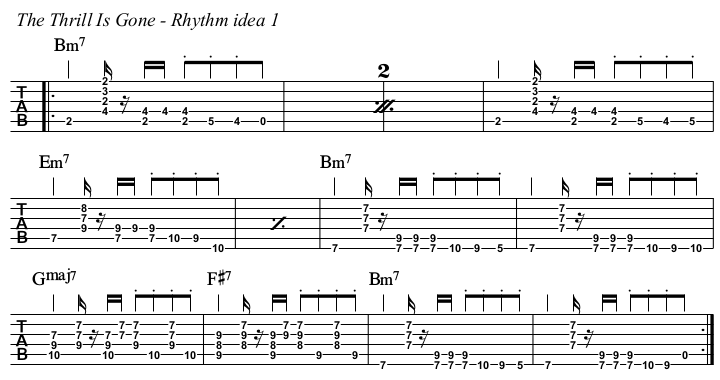
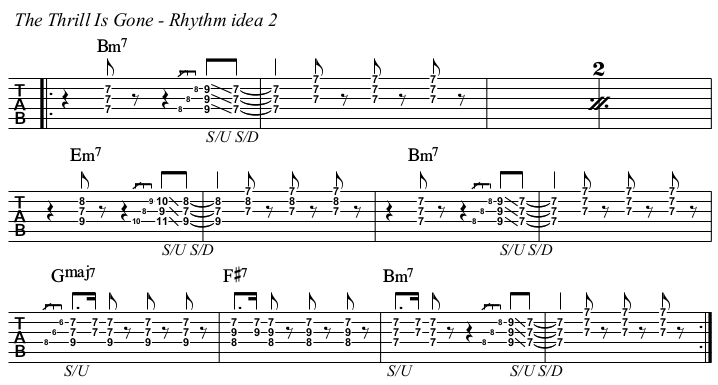
On the recording, there’s plenty of production, including a string section! I wanted to create a rhythm guitar part you could play in a band, so I based it on the string section and rhythm guitars and then made it more repetetive.
Here’s the first idea, it’s based on the strings, use a crunchy tone.
And here’s the second idea, this is based on the rhythm guitars on the record, use a clean sound.
Intro Solo
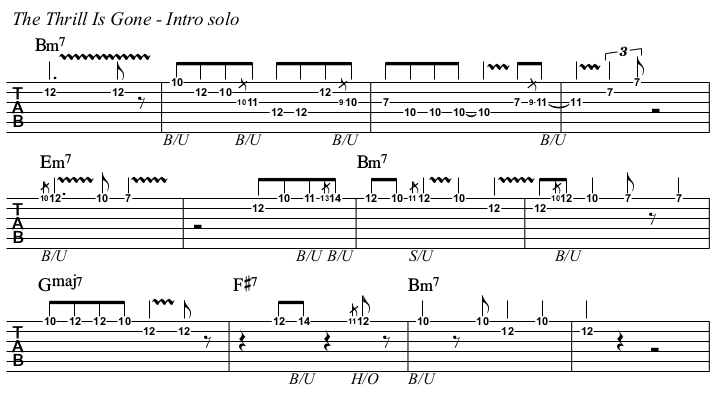
There is so much here to discuss, I have to reign myself in as the best way to learn here is to listen to the original and study the TAB.
Notice how the tone is very thin and fragile, the phrasing is packed with details. Below you can see this indicated with bends. Take your time working through this bar by bar, use the original recording for reference.
Note choices
Overall, we are using the B minor pentatonic here, it’s not the scale that brings the magic, it’s the way he plays it that makes it interesting.
In bar 6 there are some chromatic notes that are out of tune, but since we resolve, it ads to the vulnerability of the playing. This is perhaps the greatest lesson we can learn from B.B., study this bar in depth, listen to the original and keep copying!
When you can play the TAB, aim to expand on this way of playing in an improvised way. You need to maintain the same feel – just stick with it and you’ll soon be on the right track.
Perhaps you could record both rhythm guitar parts using a loop pedal to solo over, or my backing tracks!
How B.B. King Made It a Blues Classic
The Thrill Is Gone was originally written by Roy Hawkins and Rick Darnell and released in 1951. Hawkins’ version enjoyed moderate success, reaching No. 6 on the R&B charts, but it remained firmly rooted in the jump-blues tradition of the era. Nearly twenty years later, in 1969, B.B. King reimagined the tune for his album Completely Well — and in doing so, transformed its legacy.
King’s version slowed the tempo, introduced a string arrangement, and leaned heavily into the minor blues mood that now defines the song. His restrained phrasing, vocal-like vibrato, and space-conscious soloing elevated the track far beyond a standard 12-bar blues. The result was a huge crossover success, reaching No. 3 on the Billboard Hot 100, earning a Grammy Award, and cementing King’s reputation with a new, wider audience.
Since then, The Thrill Is Gone has become a rite of passage for blues musicians. Notable cover versions include performances by Gary Moore, who brought a more aggressive rock edge to the tune, and Jeff Beck, whose instrumental interpretations highlight its harmonic depth. The song has also been covered by artists such as Eric Clapton and Joe Bonamassa, each drawing inspiration from King’s definitive approach.
Ultimately, The Thrill Is Gone stands as a perfect example of how interpretation — not authorship — can define a song’s place in music history.
The Thrill Is Gone Chords: Continue Learning
Step-by-step Guitar Courses

Master guitar by studying real tunes. Build your skills with video lessons, eBooks and practice routines that connect theory with the music you love!
Explore SpyTunes step-by-step Guitar Courses.
Five similar tunes | Chords + Lyrics

- Ain’t No Sunshine
- Call It Stormy Monday
- I Heard It Through The Grapevine
- Need Your Love So Bad
- Still Got The Blues


