
Chords + Lyrics | Still Got The Blues
Intro
| 6/8 Dm7 | Dm7/G | Cmaj7 | Fmaj7 | Bm7b5 | E7 | Am | N.C (A C E) |
Verse 1
| Dm7 | Dm7/G | Cmaj7 | Fmaj7 |
Used to be so easy, to give my heart away.
| Bm7b5 | E7 | Am Am/B | C (A C E) |
But I found out the hard way, there’s a price you have to pay.
| Dm7 | Dm7/G | Cmaj7 | Fmaj7 |
I found out that love, was no friend of mine,
| Bm7b5 | Bm7b5 | E7 | E7 |
I should have known, time after time.
Chorus 1
| Am | Em7 | Am | D9 |
So long, it was so long ago,
| F9 | E7#9 | Am | N.C (A C E) |
but I’ve still got the blues for you.
Verse 2
Used to be so easy, to fall in love again.
But I found out the hard way, it’s a road that leads to pain.
I found that love, was more than just a game,
you’re playing to win, but you lose just the same.
Chorus 2
| Am | Em7 | Am | D9 |
So long, it was so long ago,
| F9 | E7#9 | Am | Am |
but I’ve still got the blues for you.
Middle 8
| Bm7 | E7 | Am Am/B | C |
So many years, since I’ve seen your face.
| Bm7 | E7 | Fmaj7 Em7 | Dm7 | Am | N.C (A C E) |
Here in my heart, there’s an empty space, where you used to be.
Solo
| Dm7 | Dm7/G | Cmaj7 | Fmaj7 |
| Bm7b5 | E7 | Am Am/B | C (A C E) |
| Dm7 | Dm7/G | Cmaj7 | Fmaj7 |
| Bm7b5 | Bm7b5 | E7 | E7 |
Chorus 3 (as chorus 2)
So long, it was so long ago,
but I’ve still got the blues for you.
Chorus 4
| Am | Em7 | Am | D9 |
Though the days come and go, there is one thing I know,
| F9 | F9 | E7#9 | E7#9 |
I’ve still, got the blues, for you.
Outro solo
||: Dm7 | Dm7/G | Cmaj7 | Fmaj7 |
| Bm7b5 | E7 | Am Am/B | C (A C E) :||
| Dm7 | Dm7/G | Cmaj7 | Fmaj7 |
| Bm7b5 | E7 | E7 | E7 | Am |
Still Got The Blues Backing Track | Chord Analysis
Above, you’ll find backing tracks to use when learning Still Got The Blues. I’ve used stem separation to extract the guitar while keeping the drums, bass, keys, and vocals intact.
After studying the chords and TAB, use my backing tracks to prepare for playing this tune with a band.
Chord Progression – What’s Going On?
This is the title track from Gary Moore’s 1990 smash-hit album Still Got The Blues. The record firmly established Moore as one of the great British blues guitarists and marked a defining moment in his later career.
Ironically, the song itself is not a blues. Instead, it uses all the diatonic chords from the key of Am. With a chord progression very similar to Parisienne Walkways. This slow 6/8 ballad lends itself to long, expressive solo sections and endless phrasing ideas.
Intro
Still Got The Blues opens with the following chord sequence:
| Dm7 | Dm7/G | Cmaj7 | Fmaj7 |
| Bm7b5 | E7 | Am | N.C (A C E) |
This outlines a II – V – I – IV – VII – IIIx – VI movement, also known as a cycle of fourths, as each chord is a fourth above the previous one. A useful comparison here is I Will Survive, which uses a very similar harmonic concept.
The V chord is modified to Dm7/G rather than a straight G7. Viewed from G, this spells G11 (root, 9, sus4, b7). Since we’ve just played a Dm7, it’s easier — and more practical — to think of this as Dm7 over G.
Verse
The verse is similar to the intro but not identical. Here, a bass movement is introduced, and the section ends on C. On the repeat, the Bm7b5 and E7 are each held for two bars.
| Dm7 | Dm7/G | Cmaj7 | Fmaj7 |
| Bm7b5 | E7 | Am Am/B | C (A C E) |
| Dm7 | Dm7/G | Cmaj7 | Fmaj7 |
| Bm7b5 | Bm7b5 | E7 | E7 |
To get TAB for how to play all of Still Got The Blues’ chords — and master the entire fretboard at the same time — check out the TAB further down this guitar lesson.
Chorus
The chorus introduces new harmony, most notably Em7 (III) instead of E7 (IIIx):
| Am | Em7 | Am | D9 |
| F9 | E7#9 | Am | N.C (A C E) |
The second and third choruses use the following progression:
| Am | Em7 | Am | D9 |
| F9 | F9 | E7#9 | E7#9 |
In the TAB, this section is played using downstrokes and the closest possible chord shapes for smooth transitions.
Middle 8
The middle 8 introduces another harmonic variation:
| Bm7 | E7 | Am Am/B | C |
| Bm7 | E7 | Fmaj7 Em7 | Dm7 | Am | N.C (A C E) |
This section is played in much the same way as the chorus, again using downstrokes (see the TAB for details).
Solo chords
The first solo follows the same progression as the verse.
The outro solo uses the first half of the verse and is repeated freely — ideally until the neighbours start complaining:
||: Dm7 | Dm7/G | Cmaj7 | Fmaj7 |
| Bm7b5 | E7 | Am Am/B | C (A C E) :||
Finally, the song ends by holding a long E7, before resolving to Am:
| Dm7 | Dm7/G | Cmaj7 | Fmaj7 |
| Bm7b5 | E7 | E7 | E7 | Am |
Here’s a chord chart to guide you.


Still Got The Blues Chord Chart | PDF + iReal Pro Download
It really bothers me when I have to make a two-page chart, so I tried for a long time to avoid it. But in the end, I had to accept that if you want to see all of Still Got The Blues‘ chords, it has to be done on two pages.
Download my chord charts as a PDF or in the iReal Pro format:
- Still Got The Blues chord chart PDF, page 1
- Still Got The Blues chord chart PDF, page 2
- Still Got The Blues iReal Pro, page 1
- Still Got The Blues iReal Pro, page 2
Still Got The Blues | TAB
This lesson contains a substantial amount of TAB, primarily aimed at helping you learn the chords and intro melody of Still Got The Blues. We start with the intro chords.
Intro chords
Here’s the first example — played exactly as on the record. I’m calling this a Dm shape, as that’s the first chord, using an open Dm chord. Notice that the Bm7b5 could also be considered a Dm/B.

Before moving on to the intro melody, let’s take these chords through the CAGED system.
Cm Shape: A very challenging version, but useful for learning the fretboard. If you can’t manage it, move to the next example.
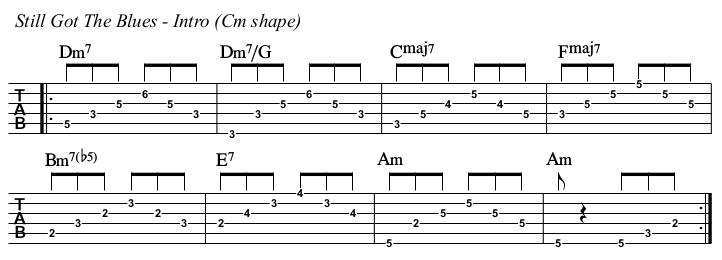
That Dm7/G is so difficult to play and also, doesn’t sound right or even good. We only do this in order to properly cover the complete fretboard.
Am Shape: Easier, though still mostly an exercise. For the G-shaped Cmaj7 and Gm-shaped Am in bars 3 and 7, release the root note to fret the upper strings.

Gm Shape: Not ideal for sound, but valuable for learning positioning.

Em Shape: Another challenging version. Let go of the root notes for the stretch chords in bars 4, 6, and 7.

The goal of this exercise is not to sound perfect — it’s to learn to move chords across the entire fretboard. The first example remains the one used on the record.
Intro Melody
Next, we apply the same concept to the melody. The goal is to target the intervals of each chord all over the fretboard, anchoring the melody to the chord shapes.
Dm Shape: See how the melody hits specific chord intervals.

Here’s what actually happened:
- The build up is over an Am chord, we hit root – sus4 – 5th
- Bar two is m3rd down to 2 of a Dm7
- Bar three is root – b7 – root of the Dm7/G
- Bar four is 3rd – 9th of a Cmaj7
- Bar five is 5th – 3rd – 4th – 5th of an Fmaj7
- Bar six is m3rd – root of a Bm7b5
- Bar seven is 5th – sus4 – m3rd/#9 of an E7
- Bar eight is just the root (resolve)
Cm Shape: Focus on the same intervals in a different position.

Am Shape: Continue practising interval targeting.

Gm Shape: Apply the same principle.

Em Shape: Repeat for full fretboard coverage.

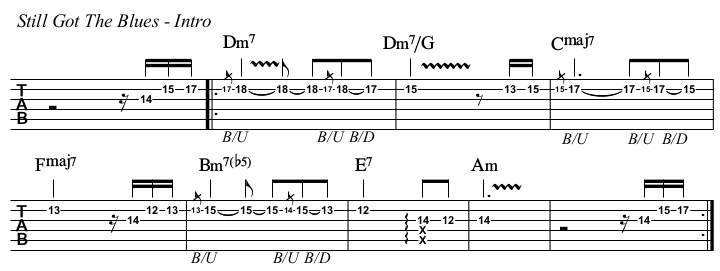
Finally, play it like Gary Moore, with all the expressive details notated — but keep focusing on the intervals.
Verse + Chorus + Middle 8
Now that the intro is mastered, let’s look at examples for the remaining sections.
Verse: Can be played during the solo or recorded on a loop pedal for practice.

Chorus: Strum and release each chord to create a bouncy feel.

Middle 8: Played similarly to the chorus.

Once you can play all this TAB, try the backing track to assemble the full arrangement. When practising soloing, focus on targeting the key notes of each chord, just as the intro melody did.
The Album That Defined Gary Moore’s Legacy
Still Got The Blues remains Gary Moore’s most successful album and the recording that ultimately defined his legacy. Released in 1990, it marked a decisive shift away from the hard rock and fusion styles that had dominated much of his earlier career, firmly establishing Moore as a leading figure in modern blues. While he had always been deeply rooted in the blues, this album felt like a full commitment—both artistically and emotionally—and the response was immediate.
The title track became Moore’s signature song, introducing him to a far wider audience and securing heavy radio rotation across Europe. Its slow-burning intensity, lyrical phrasing, and expressive vibrato showcased Moore’s ability to combine technical mastery with raw feeling, influencing generations of blues and rock guitarists that followed. For many listeners, Still Got The Blues was their first real encounter with contemporary blues guitar, and it remains a gateway album to the genre.
A major part of the album’s appeal lies in its remarkable guest appearances, each chosen with clear reverence for blues history. On Oh, Pretty Woman, Moore is joined by Albert King—one of his greatest influences—creating a powerful link between blues tradition and modern interpretation (and not to be confused with the Roy Orbison song of the same name). Albert Collins appears on Too Tired, bringing his unmistakable biting tone and Texas blues authority to the session. Perhaps most surprising is the appearance of George Harrison on That Kind of Woman, whose understated slide playing adds a distinct, tasteful contrast to Moore’s more fiery approach.
Together, these collaborations underline Moore’s deep respect for the blues lineage while reinforcing his place within it. Still Got The Blues is not just a commercial high point—it’s a statement of identity, sincerity, and enduring influence.
Still Got The Blues Chords: Continue Learning
Step-by-step Guitar Courses

Master guitar by studying real tunes. Build your skills with video lessons, eBooks and practice routines that connect theory with the music you love!
Explore SpyTunes step-by-step Guitar Courses.
Five similar tunes | Chords + Lyrics

- Ain’t No Sunshine
- Call It Stormy Monday
- I Heard It Through The Grapevine
- Parisienne Walkways
- The Thrill Is Gone


