
Chords + Lyrics | In the Midnight Hour
Intro
| N.C | D | B | A | G |
| E A | E A |
Verse 1
||: E A | E A | E A | E A :||
I’m gonna wait ’til the midnight hour, that’s when my love comes tumbling down.
I’m gonna wait ’til the midnight hour, when there’s no one else around.
Bridge 1
| B | A | B | A |
I’m gonna take you, girl, and hold you. And do all things I told you, in the midnight hour.
| E A | E A | E A | D | B |
Yes, I am, oh, yes I am. One more thing I just wanna say right here
Verse 2
I’m gonna wait ’til the stars come out, and see that twinkle in your eyes.
I’m gonna wait ’til the midnight hour, that’s when my love begins to shine.
Bridge 2
You’re the only girl I know, that really love me so, in the midnight hour.
Oh yeah, in the midnight hour. Yeah, alright, play it for me one time now.
Instrumental
||: E A | E A | E A | B :||
Outro
||: E A | E A | E A | E A :||
I’m gonna wait ’til the midnight hour, that’s when my love comes tumbling down.
I’m gonna wait, way in the midnight hour, that’s when my love begins to shine, just you and I.
Oh, baby, huh, just you and I. Nobody around baby, just you and I.
Alright, you know what? I’m gonna hold you in my arms, just you and I.
Oh yeah, in the midnight hour. Oh baby, in the midnight hour.
In the Midnight Hour Backing Tracks | Chord Analysis
Above, you’ll find backing tracks to use when learning In the Midnight Hour. I’ve used stem separation to extract the guitar while keeping the drums, bass, keys, horns, and vocals intact.
After studying the chords and TAB, use my backing tracks to prepare for playing this tune with a band.
Chord Progressions – What’s Going On?
One of the easiest tunes in this style is Wilson Pickett’s In the Midnight Hour. The chords are refreshingly straightforward, with no extensions — just pure, powerful triads. Let’s investigate!
Intro
The intro starts with a simple downward motion through the E minor pentatonic scale. The tension comes from beginning on the b7 (D), moving down the scale and setting up the bluesy E chord. These are the chords:
| D | B | A | G |
Verse
Next, we dive straight into the verse, built around a back-and-forth movement between E and A, each within the same bar:
||: E A | E A :||
The melody for the verse is pure E minor pentatonic, echoing the intro chords. Even though using the minor pentatonic over a major chord is common practice in blues, having the intro set it up without actually playing an Em or E chord is a stroke of genius.
Bridge
For the bridge, we move to the V–IV progression — B to A — before returning to E and A, and finishing with D and B, again echoing the intro:
| B | A | B | A |
| E A | E A | E A | D5 | B5 |
The melody here expands on the E minor pentatonic as we hit the 5th of the B chord (F#). When you solo over a blues, it’s a great idea to take inspiration from the melody of the song itself — I cover this in detail in the course for Money (That’s What I Want).
You can easily apply the same idea to In the Midnight Hour and countless other tunes.
Instrumental
The instrumental section follows a similar structure with the same E–A movement, but with the V chord (B) added every fourth bar:
||: E A | E A | E A | B :||
Outro
Finally, the outro is a simple yet effective repetition of E and A — a classic I–IV combination and #1 in my top 10 chord progressions.
To get TAB for all sections, check out the TAB further down this guitar lesson.
Once you return from the TAB lesson, full of new ideas, all you need is this simple chord chart to help you play this soul classic with your band.

In the Midnight Hour Chord Chart | PDF + iReal Pro Download
Download my chart as a PDF, or in the iReal Pro format so you can edit layout and change the key.
In the Midnight Hour | TAB
There are two parts for every section: one simple, one an exercise. Try both and keep exploring!
Intro
This is the best way to play the intro in my opinion. The same A-shape moves down the neck. Next, we play a G-shaped E and a D-shaped A chord.

Here’s a more complex part. The question is: how many more ways can you play this?

Verse
Here’s the verse — it’s essentially the same idea we’ve already played.
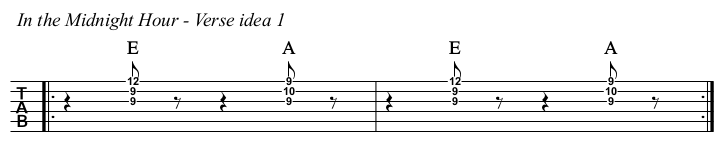
Let’s turn this simple part into an exercise:
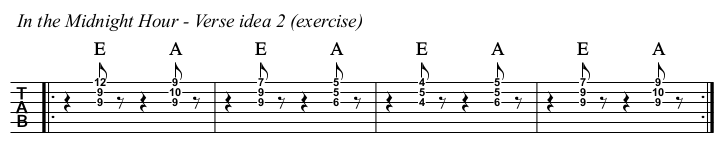
How many more shapes can you find? Can you explore the fretboard on a gig?
Bridge
The next section is the bridge. Here’s a great way to play it:
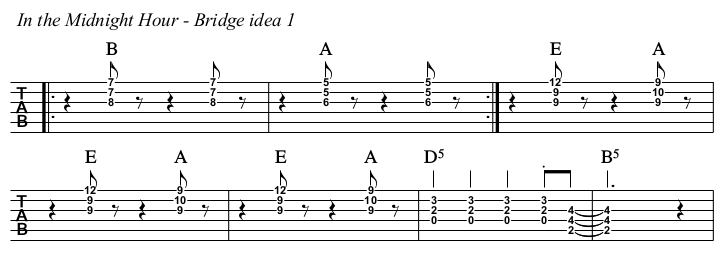
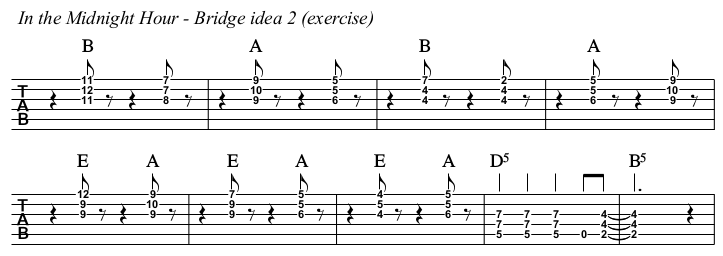
But why stop at something so simple? Let’s explore the fretboard to make sure we’ve found the perfect shapes — and at the same time, test whether we can actually do this.
Instrumental
The final section is the most difficult as it uses two strokes per chord.

Let’s make it more challenging!

Once you can play all this TAB, go back to the chord chart, play along with the backing track, and see if you can do all this in an improvised way!
Wilson Pickett worked with three of the most influential guitarists of all time
A year after releasing In the Midnight Hour in 1965 — a tune shaped by the legendary Steve Cropper at Stax Studios — Wilson Pickett found himself on stage with another soon-to-be icon: Jimi Hendrix. Before he set his guitar on fire or fronted the Experience, Hendrix was working the U.S. soul circuit, playing behind stars like Little Richard, the Isley Brothers, Don Covay, and briefly, Mr Wilson Pickett.
By 1966, Pickett was touring hard, and Hendrix, still an unknown sideman, was earning his living as a hired gun. There are no confirmed recordings of Hendrix with Pickett, but the connection is real — one of those fleeting crossroads in music history where two giants briefly shared the same stage.
Ironically, another future guitar hero would help shape Pickett’s sound just a few years later: Duane Allman, whose searing solo on Pickett’s 1968 cover of Hey Jude (The Beatles) launched both men into new territory.
From Steve Cropper’s disciplined Stax groove to Hendrix’s raw energy and Allman’s Southern fire, Wilson Pickett somehow became the common thread between three of the most influential guitarists of all time.
In the Midnight Hour Chords: Continue Learning
Step-by-step Guitar Courses

Master guitar by studying real tunes. Build your skills with video lessons, eBooks and practice routines that connect theory with the music you love!
Explore SpyTunes step-by-step Guitar Courses.
Five similar tunes | Chords + Lyrics


