
Chords + Lyrics | Dancing Queen
Intro
||: A | Dsus2/A :|| x3
| E/G# A E/G# | D A |
Ooh-oh.
Bridge 1
| E | C# |
You can dance, you can jive.
|F#m | B7 |
Having the time of your life, oh-oh.
| D | Bm7 (E7) |
See that girl, watch that scene
Tag 1
| A | Dsus2/A | A D | A D |
Digging the dancing queen.
Verse 1
| A | Dsus2/A |
Friday night and the lights are low.
| A | F#m |
Looking out for a place to go.
| E Esus4 | E Esus4 |
Mmm, where they play the right music, getting in the swing.
| E F#m | E F#m |
You come to look for a king.
Verse 2
Anybody could be that guy.
Night is young and the music’s high.
With a bit of rock music, everything is fine.
You’re in the mood for a dance.
| Bm7 | E |
And when you get the chance.
Chorus 1
| A | Dsus2/A | A | Dsus2/A |
You are the dancing queen, young and sweet, only seventeen.
| A | Dsus2/A | A E/G# | D/F# A |
Dancing queen, feel the beat from the tambourine, oh, yeah.
Bridge 2
You can dance, you can jive.
Having the time of your life
Ooh, see that girl, watch that scene
Tag 2
||: A | Dsus2/A :|| A D | A D |
Digging the dancing queen.
Verse 3 (as verse 2)
You’re a teaser, you turn ’em on.
Leave ’em burning and then you’re gone.
Looking out for another, anyone will do.
You’re in the mood for a dance.
And when you get the chance.
Chorus 2
You are the dancing queen.
Young and sweet, only seventeen.
Dancing queen, feel the beat from the tambourine, oh, yeah.
Bridge 3
You can dance, you can jive.
Having the time of your life.
Ooh, see that girl, watch that scene.
Outro
||: A | Dsus2/A :||
Digging the dancing queen.
Digging the dancing queen.
Dancing Queen Backing Tracks | Chord Analysis
Above, you’ll find backing tracks to use when learning Dancing Queen. I’ve used stem separation to extract the guitar while keeping the drums, bass, keys, horns, and vocals intact.
After studying the chords and TAB, use my backing tracks to prepare for playing this tune with a band.
Chord Progressions – What’s Going On?
In the key of A, Dancing Queen starts by revealing its main chord hook right from the intro, looping the chords A – Dsus2/A.
These return later in the tag, verse, chorus, and outro, although with subtle changes. Let’s explore them.
Intro + Tag + Chorus
The intro has a unique movement following the A – Dsus2/A loop, which goes like this:
| E/G# A E/G# | D A |
Many musicians miss that first E/G#, as it isn’t there when we reach the chorus. Here’s how the chorus ends:
| A E/G# | D/F# A |
The tags (“digging the dancing queen”) end like this instead:
| A | Dsus2/A | A D | A D |
The second tag repeats the now oh-so-familiar A – Dsus2/A chord riff.
Just as important as getting the chords right is nailing the rhythm and chord voicings, and for that you need TAB. Check out my suggestions further down this guitar lesson.
Verse
The verse starts with the same loop but then begins to move, like this:
||: A | Dsus2/A |
| A | F#m |
| E Esus4 | E Esus4 |
| E F#m | E F#m :||
| Bm7 | E |
Using Roman numerals, the movement here is I – IV, I – VI, V–Vsus4, V – VI. After repeating this, we move to a II – V to set up the chorus, which, as you already know, starts on chord I.
Bridge
The bridge, which is the first section to appear after the intro, is often described as the chorus. To me, it really does sound like a bridge, so I’m digging my heels in on that one.
Here are the chords with Roman numerals:
| E (V) | C# (IIIx) |
| F#m (VI) | B7 (IIx) |
| D (IV) | Bm7 (II) E7 (V) |
This is a feast of x chords, relative minor/major relationships, and cycle-of-fourth movements. Let’s find them all.
- E – C#, and D – Bm7 are minor falls, also known as relative major/minor relationships.
- C# – F#m – B7, and Bm7 – E7 embrace a cycle of fourths.
Once you can play my TAB, see if you can play along with ABBA using just this chord chart.

Dancing Queen Chord Chart | PDF + iReal Pro Download
You can download my chord chart as a PDF: Dancing Queen chord chart PDF, or in the industry standard iRealPro format – Dancing Queen iReal Pro.
Dancing Queen | TAB
Let’s go through all sections in the order they appear in this timeless wedding classic, so you get every detail right.
Intro
The intro hits you with the main progression. I’ve written this part to mirror the keyboard, allowing the keyboard player to answer it with the piano hook. Notice the rest on beat four.
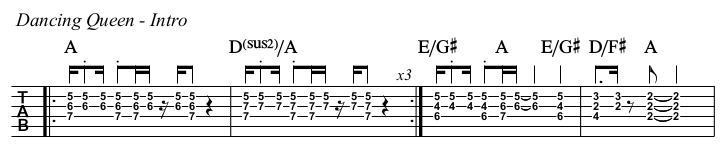
Bridge
Next up is what I like to label as a bridge. The rhythm changes from the intro, but it still echoes it. Make sure you can spot the hits that remain, as well as what’s been removed. We now hit the downbeat on beat four.
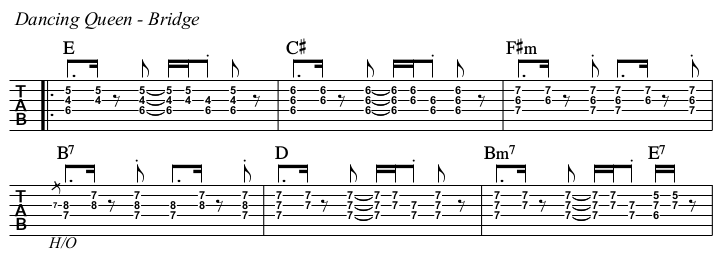
In bars three and four, the rhythm changes. In bar five it returns, and in bar six it’s varied with that final E7 chord.
Tags
The first tag goes like this:
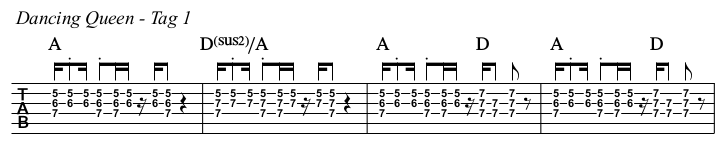
At first, it’s the same as the intro, but then we get a new chord as we move from A to D in bars three and four.
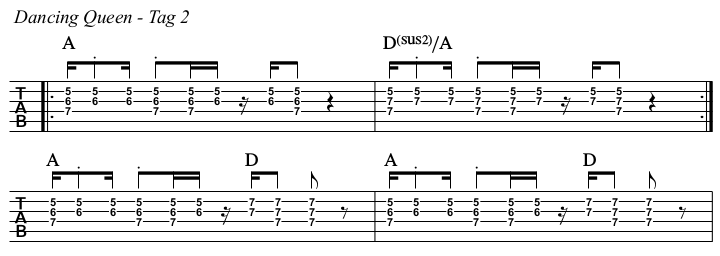
The second tag simply repeats the first two bars.
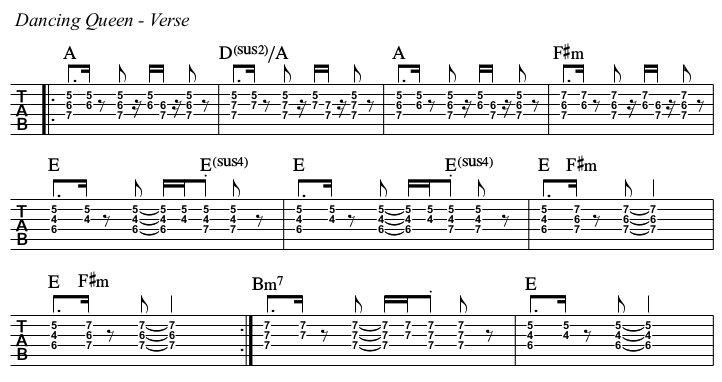
Verse
The verse is, again, similar to the intro, but only at first. Soon we begin moving between VI and V instead. To set up the chorus, it’s a classic II – V.
Chorus
At long last, here’s the chorus, which is very similar to the intro and tags — a genius move, as when we arrive at it for the first time, we’ve already heard it.

Outro
For the outro, we milk the now familiar movement:
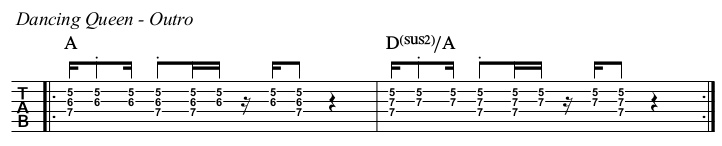
Once you can play all of this TAB, return to the backing tracks and put everything together using only a chord chart.
Dancing Queen Chords: Continue Learning
Step-by-step Guitar Courses

Master guitar by studying real tunes. Build your skills with video lessons, eBooks and practice routines that connect theory with the music you love!
Explore SpyTunes step-by-step Guitar Courses.
Five similar tunes | Chords + Lyrics


