
Chords + Lyrics | Crossroads
Intro
| A7 | A7 | A9 | A9 |
| D7 | D7 | A7 | A9 |
| E7 | D7 | A7 | A7 E7 |
Verse 1
| A5 (A6) | D5 (D6) | A7 | A7 |
I went down to the crossroads, fell down on my knee.
| D5 (D6) | D5 (D6) | A7 | A7 |
Down to the crossroads, fell down on my knee.
| E5 (E6) | D5 (D6) | A7 | A7 |
Asked the Lord above for mercy, take me if you please.
Verse 2
I went down to the crossroad, tried to flag a ride.
Down to the crossroad, tried to flag a ride.
Nobody seemed to know me, everybody passed me by.
Verse 3
Well, I’m going down to Rosedale, take my rider by my side.
Going down to Rosedale, take my rider by my side,
We can still buy our house, baby, on the riverside.
Solo 1
| A7 | D7 | A7 | A7 |
| D7 | D7 | A7 | A7 |
| E7 | D7 | A7 | A7 E |
| A7 | A7 | A7 | A7 |
| D7 | D7 | A7 | A7 |
| E7 | D7/F# | A7 | A7 |
Verse 4 (verse 3)
Going down to Rosedale, take my rider by my side.
Going down to Rosedale, take my rider by my side.
We can still buy our house, baby, on the riverside.
Solo 2
||: A7 | A7 | A7 | A7 |
| D7 | D7 | A7 | A7 |
| E7 | D7 | A7 | A7 :|| x3
Verse 5
You can run, you can run, tell my friend boy Willie Brown.
Run, you can run, tell my friend boy Willie Brown,
| E5 (E6) | D7 N.C | A7 | A7 |
and I’m standing at the crossroad, believe I’m sinking down.
Crossroads Backing Tracks | Chord Analysis
Above, you’ll find backing tracks to use when learning Crossroads. I’ve used stem separation to extract the guitar while keeping the drums, bass, and vocals intact.
After studying the chords and TAB, use my backing tracks to prepare for playing this tune with a band.
Should you want to play along with the original recording instead, you need to tune your guitar sharp to 444Hz. In the backing tracks, I’ve done this job for you by tuning it to 440Hz.
Chord Progression – What’s Going On?
Crossroads follows a standard 12-bar blues in the key of A, built around dominant 7th chords that define its punchy, driving feel.
This approach is typical of many blues standards, but Eric Clapton gives it extra character through subtle variations and rhythmic intensity. In the intro and solo sections, the progression sticks closely to the classic form, with extensions like A9 adding colour and movement:
Intro + Solo
| A7 | A7 | A9 | A9 |
| D7 | D7 | A7 | A9 |
| E7 | D7 | A7 | A7 E7 |
Many blues songs either follow this format strictly or introduce the “honky-tonk” movement between the 5 and 6 chords. Clapton blends both ideas seamlessly.
Verse
As the verse begin, he uses that honky-tonk motion for two bars with a quick change, before shifting into the signature dominant 7th riff. This fusion creates a progression that feels both rooted in tradition and uniquely expressive:
| A5 (A6) | D5 (D6) | A7 | A7 |
| D5 (D6) | D5 (D6) | A7 | A7 |
| E7 | D7 | A7 | A7 |
To truly capture the feel of Crossroads, TAB is essential, as much of Clapton’s style lies in phrasing, articulation, and timing rather than just chord shapes. You can find my TAB further down this guitar lesson.
Solos
As great as the chords are, most players are drawn to the solo. In his work with Cream, particularly their version of Crossroads originally by Robert Johnson, Clapton’s improvisation became iconic.
While it’s tempting to simplify this as just mixing major and minor pentatonics, that would be missing an enormous amount of detail which only TAB can accurately describe.
In terms of note choices, I can clearly see he uses:
- A minor pentatonic
- Add the 3rd
- Add the 6th
- A major pentatonic
- Add the 4th
- F# minor pentatonic
Looking at the transcription, it’s clear when he’s “thinking” A major pentatonic in an E shape, and when he shifts to F# minor pentatonic in an Em shape.
It’s equally clear when he’s working from an A minor pentatonic in an Em shape, adding the 3rd and 6th.
The framework is so well defined that to say he’s simply mixing A minor and A major pentatonic oversimplifies Eric Clapton’s playing.
Having absorbed, rather than memorised the TAB, keep this chord chart in your back pocket for the gig.
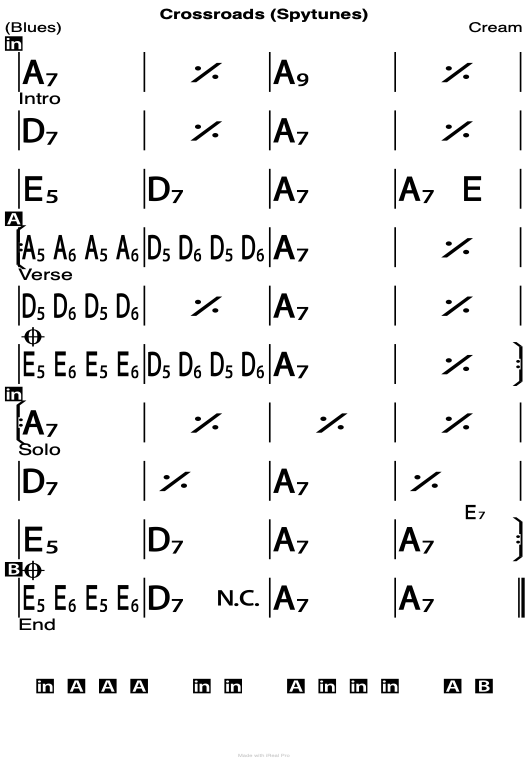
Crossroads Chord Chart | PDF + iReal Pro Download
At its core, this is a blues progression with a quick change to chord IV in bar 2 during the verse but not the solos.
At times, you play dom7, other times a 5 – 6 honky-tonk-style move.
Specifying exactly when these variations occur is important as this is what sets Crossroads apart from your average 12 bar blues.
If you’d like to download my chart, here’s the PDF: Crossroads chord chart PDF.
If you prefer the iReal Pro format, you can get the file here: Crossroads chord chart iReal Pro.
Using the app, you can change the layout and key, though you won’t be able to play the open A chord riff if you mess with the key signature.
Crossroads | TAB
Let’s break down how to play this iconic improvised performance note for note—after all, this is music history.
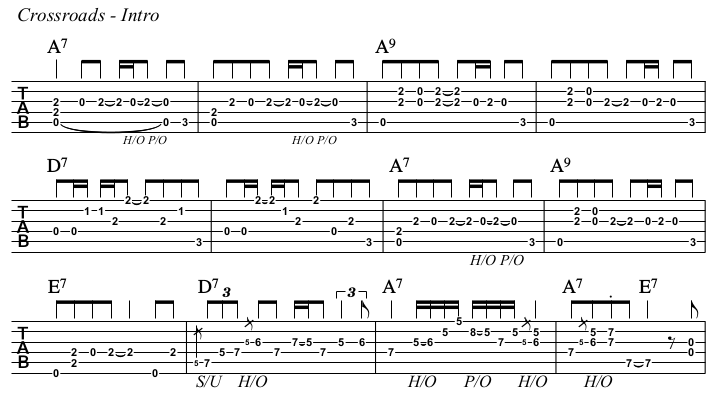
Intro
The intro begins with the riff. Pay close attention to the small details, as they define the feel:
- Clapton often mixes straight rhythms with triplets.
- The first beat is a quarter note in bar one, with the open A ringing through—this never happens again.
- The A9 is achieved by playing both strings 2 and 3.
- In bar 8, the A9 is not followed by a 3rd above.
Verse
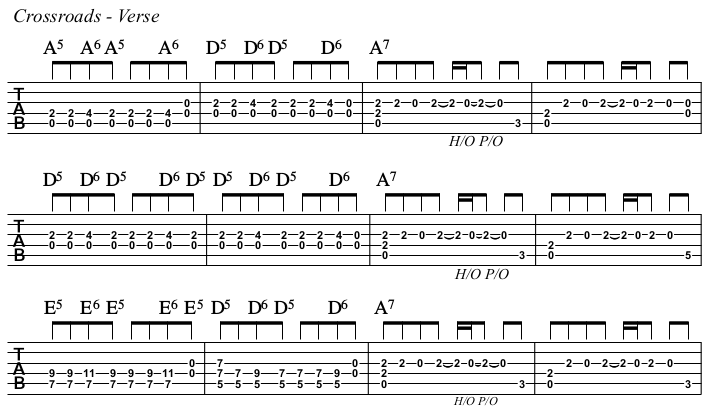
The verse blends the honky-tonk idea with the dominant 7th riff. Make sure you really drive the rhythm—this is not played in a laid-back way.
Solo
Towards the end of the intro, we use licks based on the minor pentatonic with an added 3rd, which also reflects the vocal melody.
As the solo begins, there’s a noticeable lift, with the opening phrases drawing from F# minor pentatonic/A major pentatonic. The shift back to A minor pentatonic happens in the bar before moving to the IV chord.
Using the minor pentatonic of chord I over chord IV is a common sound, and this blanket scale idea continues through the first half of the solo.
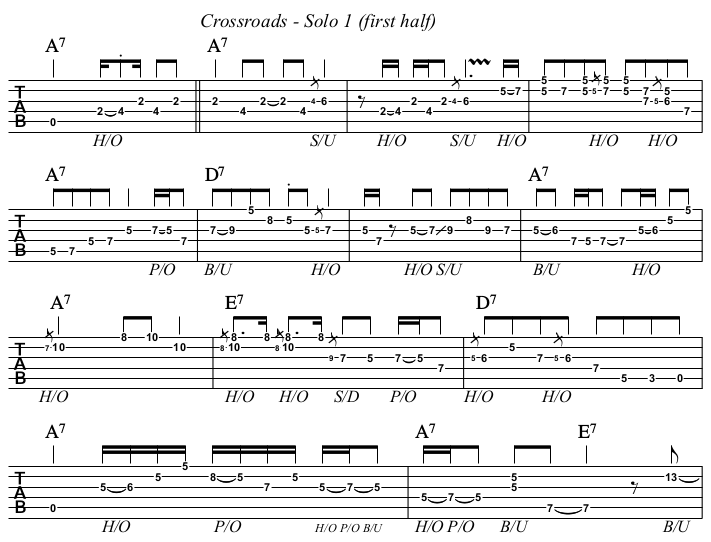
In the second half, the solo opens with long bends in a Cm-shaped A minor pentatonic. We then move up to the Am shape, only returning to the Cm shape to catch the minor 3rd and b7th on strings 4 and 5.
As we reach the final D7 (chord IV), Clapton briefly shifts to A major pentatonic/F# minor pentatonic. This is relatively rare, as the minor sound is more commonly used here. This move to a major tonality gives the solo a more uplifting, resolved ending.
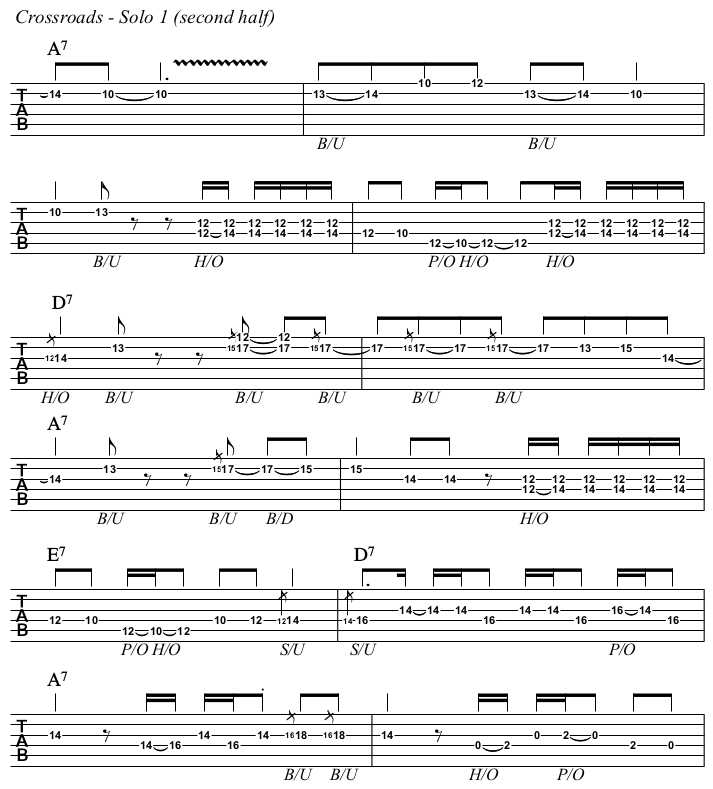
Once you can play the full TAB, begin to move away from it. Use these ideas as a foundation for improvisation, aiming to stop overthinking and instead play more freely and expressively.
Remember the core language:
- A minor pentatonic
- Add the 3rd
- Add the 6th
- F# minor pentatonic
- A major pentatonic
Use the backing track and chord chart as you summon the spirit of Clapton to play Crossroads yourself.
Is Eric Clapton the greatest British guitarist of all time?
Probably the most famous British electric guitarist, Eric Clapton is undoubtedly one of the all-time greats. Emerging in the early 1960s, he quickly built a reputation for his precise phrasing, expressive tone, and deep understanding of the blues.
At a time when British musicians were discovering American blues traditions, Clapton stood out for his ability to channel that influence into something both authentic and distinctly his own. His playing was never just technical—it carried emotion, space, and a vocal-like quality that made every note feel deliberate and meaningful.
He first gained recognition with his phenomenal playing in bands like The Yardbirds and John Mayall & the Bluesbreakers, where his style began to crystallise. During this period, his use of sustain, overdrive, and fluid phrasing set a new standard for electric guitarists, earning him the nickname “God” among London’s underground music scene.
However, it was with Cream that Clapton reached a global audience. As part of this power trio, he expanded his sound further, blending blues with rock and psychedelia, and embracing extended improvisation in live performances.
Their version of Crossroads, originally by Robert Johnson, became a defining moment—not just for Clapton, but for rock guitar as a whole. His fiery solo showcased speed, control, and emotional intensity, capturing the raw spirit of the blues while pushing it into a louder, more modern context.
From that point on, Clapton’s influence spread far beyond Britain, shaping generations of guitarists and securing his place as one of music’s most enduring figures.
Crossroads Chords: Continue Learning
Step-by-step Guitar Courses

Master guitar by studying real tunes. Build your skills with video lessons, eBooks and practice routines that connect theory with the music you love!
Explore SpyTunes step-by-step Guitar Courses.
Five similar tunes | Chords + Lyrics


