
Chords + Lyrics | Roll Over Beethoven
Intro
| N.C | D N.C | N.C | D N.C | N.C |
| G | G | D | D |
| A7 | A7 | D | D |
Verse 1
| D | G | D | D |
Well, I’ma write a little letter, I’m gonna mail it to my local DJ.
| G | G | D | D |
Yeah, it’s a jumping little record I want my jockey to play.
| A | A | D | D |
Roll over Beethoven, I gotta hear it again today.
Verse 2
You know my temperature rising, the jukebox blowin’ a fuse.
My heart’s beating rhythm and my soul keep a-singing the blues.
Ah, roll over Beethoven, tell Tchaikovsky the news.
Verse 3
I got the rockin’ pneumonia, I need a shot of rhythm and blues.
I caught the rollin’ arthritis sittin’ down at a rhythm review.
Ah, roll over Beethoven, they rockin’ in two by two.
Verse 4
Well if you feel it and like it, go get your lover, then reel and rock it. Roll it over then.
Move on up, and yes-a, try for further and reel and rock with, one another.
Roll over Beethoven, dig this rhythm and blues.
Solo
| D | D | D | D |
| G | G | D | D |
| A | A | D | D |
Verse 5
Well early in the mornin’, I’m giving you my mornin’ don’t you step on my blue suede shoes.
Hey diddle-diddle, I’m-a play you my fiddle, ain’t got nothing to lose.
Roll over Beethoven, tell Tchaikovsky the news.
Verse 6
You know she wiggle like a glow worm, dance like a spinnin’ top.
She got a crazy partner, you oughta see ‘em reel and rock.
Long as she got a dime, the music will never stop.
Outro
| D | D | D | D |
Ah, roll over Beethoven, ah roll over Beethoven.
| G | G | D | D |
Roll over Beethoven, roll over Beethoven.
| A | N.C | N.C | D9 |
Roll over Beethoven and dig these rhythm and blues.
Roll Over Beethoven Chords: How to Play Along with the Original Recording (Tuning Sharp)
Chuck Berry’s Roll Over Beethoven is played in either D or Eb, depending on how you choose to adjust your tuning.
Either way, if you try to play along with the original recording, you’ll notice the pitch doesn’t quite line up. This may be because the tape was played back at a slightly faster speed, pushing the pitch beyond D — but not quite to Eb.
Another possibility is that Chuck and his band weren’t tuned to concert pitch. Whichever the case, to play along accurately you’ll need to adjust your tuning. My free online guitar tuner can help you set this to 458Hz.
Alternatively, you can use Serato to pitch-shift the track itself. Dropping the recording by 3.2% allows you to play comfortably in the key of D. This is the method I used when working out the chords and licks.
Once you’re correctly tuned — or the track has been adjusted — the chord progression follows this pattern:
||: D (I) | G (IV) | D | D |
| G | G | D | D |
| A (V) | A | D | D :||
In bar two, there’s a quick change to the IV chord (G) before returning to the I chord (D). The turnaround moves from the V (A) back to the I (D).

Intro + Solo
For the intro, you’ll play double stops over a static D chord — no quick change or extensions — staying on D until the move to the V chord (A).
The solo follows the same chord progression as verse four, without the quick change. The outro works the same way, stopping on an A before finishing with a D9 chord.
Most of the chords in Roll Over Beethoven are written as triads. While this is technically accurate, there’s more going on. For example, the second guitar plays a honky-tonk rhythm using D5–D6–D5–D6. This style of comping is typical of many Chuck Berry songs and has been widely adopted by other artists. I cover this technique in detail in the I Can’t Stand the Rain lessons in the Intermediate Acoustic Course.
There’s also a piano part on the recording, where we hear more dominant 7th extensions. In the TAB lesson, I give you plenty of ideas for extending these chords to include 6ths and dom7s.
To access the TAB, follow this link: Roll Over Beethoven – Guitar Lesson with TAB.
Once you’ve worked through all the TAB, a simple chord chart like this is all you need as you shape your part to suit the band you’re playing with.
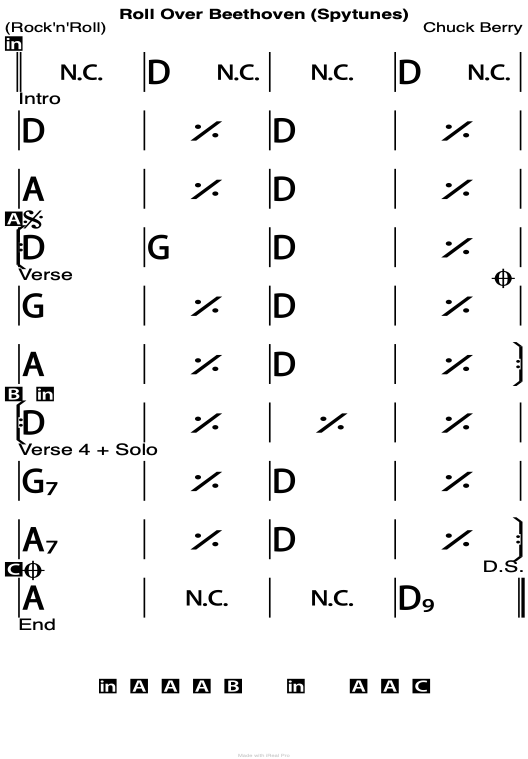
Roll Over Beethoven Chord Chart | PDF + iReal Pro Download
Download my chord chart and use it as a reminder on the gig. You’ve got the static PDF or iReal Pro in case you wnat to change the key.
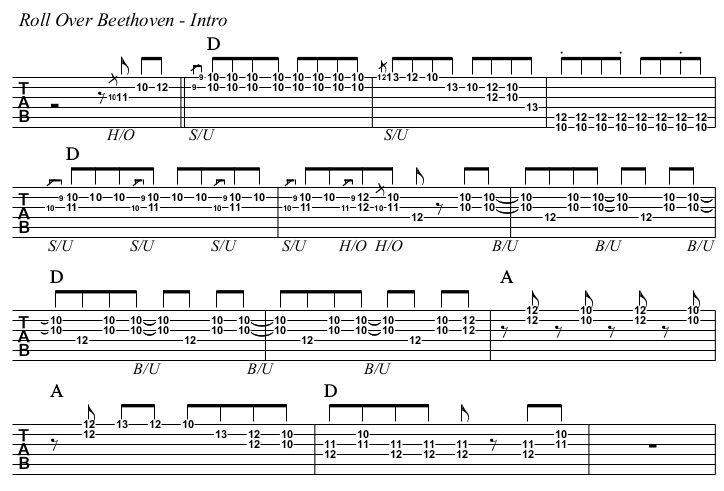
Roll Over Beethoven TAB | Course Preview
In the course, we look at five TAB examples showing how you can approach the rhythm guitar part, including how simple triads can be extended to include 6ths and dominant 7ths.
As a preview, here’s the Roll Over Beethoven intro TAB in the key of D:
Before Johnny B. Goode: Tracing Chuck Berry’s Most Famous Intro
Chuck Berry’s Roll Over Beethoven and Johnny B. Goode are closely linked, not just in spirit but in the musical DNA that helped define early rock ’n’ roll guitar. At the heart of both songs is Berry’s unmistakable intro figure — a bright, double-stop-driven phrase that announces the groove before the band even locks in. While the songs differ in tempo, feel, and lyrical focus, the opening guitar language is strikingly similar, built around the same rhythmic confidence and blues-based vocabulary.
Roll Over Beethoven, released in 1956, came first. Its intro is aggressive and percussive, leaning heavily on double stops and boogie-woogie rhythm guitar ideas. This approach mirrors the left-hand patterns of piano players Berry admired, translated onto the guitar in a way that cut through loud bands and crowded jukeboxes. Two years later, in 1958, Johnny B. Goode refined that concept into something even more iconic. The famous opening lick is cleaner, more melodic, and instantly recognisable — but structurally, it’s built from the same toolkit.
Berry reused variations of this intro style throughout his catalogue. Songs like Carol, Little Queenie, and Too Much Monkey Business all feature related opening ideas, suggesting that Berry wasn’t copying himself so much as perfecting a signature language. This was common practice in early rock ’n’ roll, where establishing a recognisable sound mattered more than constant reinvention.
Tracing the intro back further leads us to blues and jump-blues guitarists such as T-Bone Walker and Carl Hogan, whose double-stop phrasing and horn-like lines laid the groundwork. Berry fused those influences with country picking and piano rhythms, creating a hybrid that became the blueprint for rock guitar.
In short, Roll Over Beethoven planted the seed, Johnny B. Goode crystallised it, and the intro style became one of the most copied guitar ideas in popular music history.
Roll Over Beethoven Chords: Continue Learning
Want to master this song? Check out the full TAB lesson here: Roll Over Beethoven (Chuck Berry) Guitar Lesson with TAB.
Alternatively, here are five similar tunes you might enjoy:


