
Chords + Lyrics | You Never Can Tell
Intro
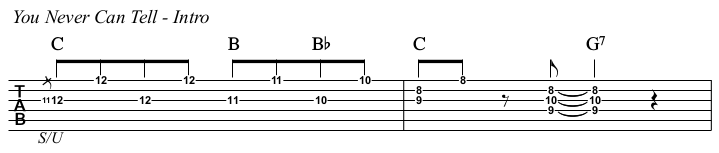
| C B Bb | C G7 |
Verse 1
| C | C | C | C |
It was a teenage wedding, and the old folks wished them well.
| C | C | G | G |
You could see that Pierre did truly love the mademoiselle.
| G | G | G | G |
And now the young monsieur and madame have rung the chapel bell.
| G | G | C | C |
“C’est la vie”, say the old folks, it goes to show you never can tell.
Verse 2
They furnished off an apartment with a two-room Roebuck sale.
The coolerator was crammed with TV dinners and ginger ale.
But when Pierre found work, the little money comin’ worked out well.
“C’est la vie”, say the old folks, it goes to show you never can tell.
Verse 3
They had a hi-fi phono, boy, did they let it blast.
Seven hundred little records, all rock, rhythm, and jazz.
But when the sun went down, the rapid tempo of the music fell.
“C’est la vie”, say the old folks, it goes to show you never can tell.
Verse 4
They bought a souped-up jitney, ’twas a cherry red ’53.
They drove it down to Orleans to celebrate the anniversary.
It was there where Pierre was married to the lovely mademoiselle.
“C’est la vie”, say the old folks, it goes to show you never can tell.
Solo
| C | C | C | C |
| C | C | G | G |
| G | G | G | G |
| G | G | C | C |
Verse 5
They had a teenage wedding and the old folks wished them well.
You could see that Pierre did truly love the mademoiselle.
And now the young monsieur and madame have rung the chapel bell.
“C’est la vie”, say the old folks, it goes to show you never can tell.
Outro
| C | C | C | C |
| C | C | G | G | to fade
You Never Can Tell Backing Tracks | Chord Analysis
Above, you’ll find backing tracks to use when learning You Never Can Tell. I’ve used stem separation to extract the guitar while keeping the drums, bass, keys, horns, and vocals intact.
After studying the chords and TAB, use my backing tracks to prepare for playing this tune with a band.
Should you want to play along with the original recording instead, you need to tune your guitar sharp to 444Hz. In the backing track, I’ve done this job for you by detuning it 1%.
Chord Progressions – What’s Going On?
Chuck Berry’s You Never Can Tell is a 16-bar blues built using only the I and V chords. Apart from the intro, the progression stays the same for all five verses and the solo.
Here’s the full chord progression in the key of C:
| C | C | C | C |
| C | C | G | G |
| G | G | G | G |
| G | G | C | C |
Over each chord, the piano creates its “honky-tonk” feel by playing the chord, adding the 6th, removing it, then adding it again. This is a signature Chuck Berry technique, used across many of his songs on guitar. In my courses, we explore this approach in depth when studying I Can’t Stand the Rain.
In You Never Can Tell, however, we don’t replicate this movement on guitar. Instead, we play short stabs using basic triads.
In the TAB further down this guitar lesson, we explore these shapes all over the fretboard, helping you learn your major triads across the entire neck—an invaluable lesson for beginner and intermediate players!
Below is a chord chart, mainly useful for tracking the structure: intro, four verses, solo, one verse, and the outro. The chords themselves are extremely easy to remember—the real question is: can you play them anywhere on the neck?

You Never Can Tell Chord Chart | PDF + iReal Pro Download
Download my chart as a PDF or iReal Pro file if you want to change the key.
You Never Can Tell | TAB
I’ve taken the rhythm from the original recording. Although it isn’t played all the way through, it does appear during the piano solo. However, as a working player, you’ll often end up playing it throughout.
Before we get to the TAB for moving this idea all over the neck, here’s the intro:
Verses
Here’s the first area you need to be able to play. This uses an A-shaped C and an E-shaped G. After the initial hit of three strings, slightly loosen the fretting finger so that when you hit the top two strings — even if the third string is caught — it doesn’t ring.

Once you can play this, move on to the same shapes but one string higher, like this:

Let’s move up the neck and play a G-shaped C and a D-shaped G. Here, we play the 3rd of the C on top, then switch to the 5th — just like playing two versions of a G chord, with and without the 3rd on string 2.
For the D shape, we first play strings 2–4, then 1–3. To be precise, the first chord here is actually a G5, as there’s no 3rd.

Here’s the next area. Now we play an E-shaped C and a C-shaped G:

Next, we do the same thing but one string higher. This turns the G chord into a D shape instead of a C shape. This is not 100% true as they overlap, but I feel its best to call this a D shape.

In the next area, the C chord becomes a D shape and the G chord becomes an A shape.

The final two shapes match the chord names themselves — C and G shapes.

Once you can play all of this TAB, scroll back up and play along with the backing tracks. Using only a chord chart, can you move through all areas of the neck in an improvised way while maintaining the rhythm?
You Never Can Tell Chords: Continue Learning
Step-by-step Guitar Courses

Master guitar by studying real tunes. Build your skills with video lessons, eBooks and practice routines that connect theory with the music you love!
Explore SpyTunes step-by-step Guitar Courses.
Five similar tunes | Chords + Lyrics


