
Chords + Lyrics | Belief
Intro
| N.C | N.C |
||: Dm Dsus2/4 | Gm7 G6sus4 | C9 C6 | Dm Gm :||
Verse 1
||: Dm Dsus2/4 | Gm7 G6sus4 | C9 C6 | Dm Gm :||
Is there anyone who, ever remembers, changing their mind from, the paint on a sign.
Is there anyone who really recalls ever breaking rank at all. For something, someone yelled real loud one time.
Chorus 1
||: Gm Gsus2/4 | C6 C7 | Fsus2/4 F | Bbmaj7 Bbmaj7#11 :||
Oh everyone believes, in how they think it ought to be.
Oh everyone believes, and they’re not going easily.
Instrumental 1
||: Dm Dsus2/4 | Gm7 G6sus4 | C9 C6 | Dm Gm :||
Verse 2
Belief is a beautiful armor, but makes for the heaviest sword. Like punching underwater, you never can hit who you’re trying for.
Some need the exhibition, and some have to know they’ve tried. It’s the chemical weapon, for the war that’s raging on inside.
Chorus 2
Oh everyone believes, from emptiness to everything.
Oh everyone believes, and no one’s going quietly.
Bridge 1
||: Dm7 Bbmaj7 | Gm7 Cadd9 :||
We’re never gonna win the world, we’re never gonna stop the war.
We’re never gonna beat this if belief is what we’re fighting for.
We’re never gonna win the world, we’re never gonna stop the war.
We’re never gonna beat this if belief is what we’re fighting for.
Instrumental 2 (as instr. 1)
||: Dm Dsus2/4 | Gm7 G6sus4 | C9 C6 | Dm Gm :||
Verse 3
Is there anyone who can remember? Ever surrender, with their life on the line.
Solo
||: Gm Gsus2/4 | C6 C7 | Fsus2/4 F | Bbmaj7 Bbmaj7#11 :||
Bridge 2
We’re never gonna win the world, we’re never gonna stop the war.
We’re never gonna beat this if belief is what we’re fighting for.
We’re never gonna win the world, we’re never gonna stop the war.
We’re never gonna beat this if belief is what we’re fighting for.
Outro (as bridge)
||: Dm7 Bbmaj7 | Gm7 Cadd9 :||
(||: Na na na na na na, na na na na… :||)
What puts a hundred thousand children in the sand?
Belief can. Belief can.
What puts the folded flag inside his mother’s hand?
Belief can. Belief can.
Belief Backing Track | Chord Analysis
Above, you’ll find backing tracks to use when learning Belief. I’ve used stem separation to extract the guitar while keeping the drums, bass, keys, horns, and vocals intact.
After studying the chords and TAB, use my backing tracks to prepare for playing this tune with a band.
Chord Progressions – What’s Going On?
I had to discard my initial ideas when it came to explaining the chords in John Mayer’s Belief.
After stepping away from it for a while, I realised what’s happening can be described in several ways. The best approach is to first learn how to play these riffs using TAB, then consider the chord names. I suggest you do the same by starting with the TAB you find further down this guitar lesson.
Once you can play it, study the intervals in relation to each root note established by the bass player. When you do this, the intro and verse chords are best described as:
||: Dm Dsus2/4 | Gm7 G6sus4 |
| C9 C6 | Dm Gm :||
The second chord in each bar is played on beat 4, not 3.
Chorus
The chorus chords follows the same concept of sliding shapes, introducing a new chord on beat 4. Once you’ve learned the TAB and studied the intervals, this will make sense:
||: Gm Gsus2/4 | C6 C7 |
| Fsus2/4 F | Bbmaj7 Bbmaj7#11 :||
Bridge
The bridge introduces a new concept. Instead of sliding shapes, we use more muted strumming.
The TAB clearly shows the chords as D5 – Bb5 – G6omit3 – Csus2. However, that only reflects the notes in the picked part. I prefer using fuller chord names:
||: Dm7 Bbmaj7 | Gm7 Cadd9 :||
Here’s a chord chart that will make perfect sense once you’ve learned Belief’s chords using the TAB!
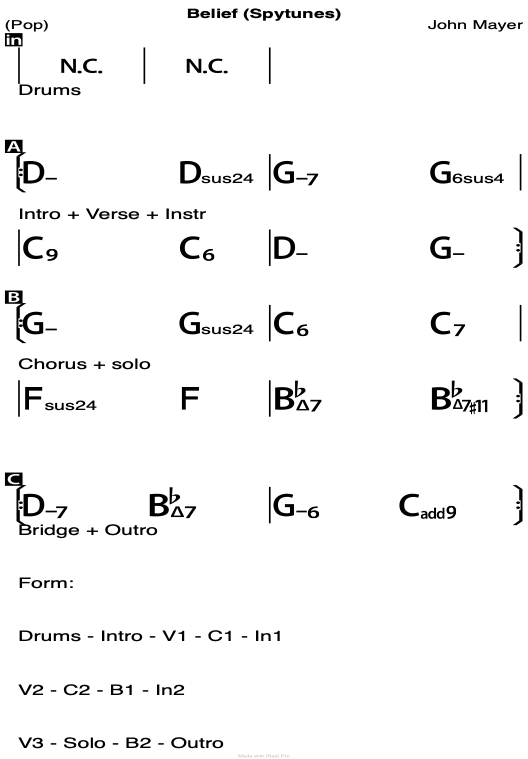
Belief Chord Chart | PDF + iReal Pro Download
You can download my chord chart as a static PDF, or go down the iReal Pro route and change the layout, maybe even the chord names!
Belief | TAB
Believe it or not, this isn’t as difficult as you may fear. Throughout Belief, John plays a series of loops which, once under your fingers, tend to play themselves.
Let’s start from the top. Keep your eye on all the small details throughout — the slides, hammer-ons, and bends.
Intro + Verse
The main riff is fairly straightforward. I actually found it more difficult to name the chords than to play the riff — so we’ll spend some time on that. First, learn this:
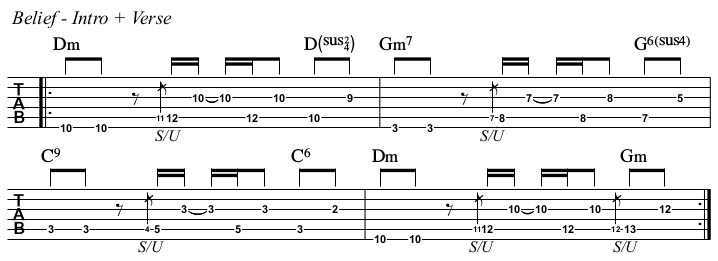
If you’re thinking something doesn’t sound 100% right, you’re correct. There’s a small detail he includes most of the time — but not always. It’s also more difficult to play, so it’s best to begin with the version above.
The missing detail appears on beat 4 in bars 1–3, where he plays two notes, muting the string in between:

Once you can play both versions with ease, make sure you can see all intervals in relation to each chord:
- Bar 1 – Root, 5th, and m3rd form the full triad. On beat 4, we play the 4th and 9th — no 3rd — so this can be named sus2/4.
- Bar 2 – Root, b7th, and 5th. There’s no 3rd, but if played fully it would be minor, so Gm7. Beat 4 gives us the 6th and 4th — G6sus4.
- Bar 3 – Root, 9th, and b7th. No 3rd, but implied major, so C9. Beat 4 is root and 6th — C6.
- Bar 4 – Root, 5th, and 3rd as in bar 1. Beat 4 gives us b6 and sus4 in relation to D, but as the bass moves to G, this becomes Gm (m3rd to root).
It’s important to understand these intervals and relate them to chord names. This is the best way to remember what to play, especially when working from a chord chart.
Chorus (+ solo chords)
The chorus follows the same concept but uses different chords. Learn it first, then analyse the harmony:
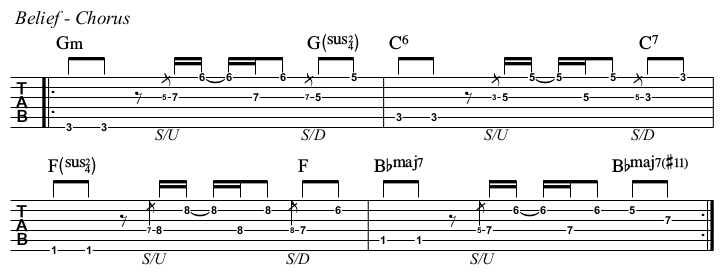
Here’s how the chords are derived:
- Gm – Root, 5th, m3rd. We then move down, similar to Soul Man (though that’s major), creating a classic movement — Gsus2/4 (or C6/G).
- C6 – Root, b7th, and 5th. No 3rd, but implied major — C6. Moving down gives us C7.
- Fsus2/4 – Root, 4th, and 9th, resolving to 3rd and root — F.
- Bbmaj7 – Root, 7th, and 5th. No 3rd, but clearly major — Bbmaj7. The final movement adds #11 and 3rd, making Bbmaj7#11. As chord IV in a Lydian context, this name is particularly useful.
Bridge
The bridge introduces muted picking. Learn it first, then consider the harmony:
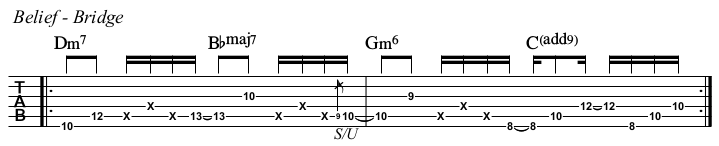
- Dm7 – No 3rd present, but established earlier as minor.
- Bbmaj7 – Only root and 5th here, but context confirms the full chord.
- Gm6 – Root and 6th, with implied minor quality.
- Cadd9 – Root, 5th, and 9th. Technically Csus2, but Cadd9 reflects the fuller harmony more accurately.
Solo
Here’s the excellent solo. Sonically, it leans a bit too much towards what Eric Clapton called “woman tone” (rolled-off highs), but the note choices, phrasing, and rhythm are superb.
Most bends are clearly indicated, showing both the starting note and target pitch. In the final bar, however, the bend is more subtle — not quite a semitone.

Once you can play all the TAB and understand the chord names, use only the chord chart and backing tracks to bring everything together.
Why Belief Matters: John Mayer’s Creative Breakthrough
Released in 2006 as part of Continuum, Belief marked a turning point in John Mayer’s career, both musically and lyrically. While earlier hits had leaned towards polished pop, this track signalled a deeper, more introspective direction.
Built around a subtle, hypnotic groove, Belief explores the power and danger of convictions, with Mayer questioning how strongly held ideas can shape — and often distort — reality.
Although Belief wasn’t his biggest commercial hit, it played an important role in establishing Continuum as a defining album of the mid-2000s. The record achieved major chart success, reaching the top 10 in multiple countries and eventually earning Grammy recognition. Songs like Waiting on the World to Change and Gravity may have drawn more radio attention, but Belief stood out for its nuanced songwriting and distinctive guitar work.
This era also saw Mayer refining his identity as a serious guitarist. Influenced heavily by blues and artists like Stevie Ray Vaughan, he began integrating more expressive phrasing and rhythmic subtlety into his playing. The delicate chord movement in Belief, combined with its laid-back feel, reflects this shift perfectly.
Around the same time, Mayer released Try! with the John Mayer Trio, a live album that further showcased his blues credentials. The contrast between the raw energy of Try! and the polished depth of Continuum highlights just how versatile he had become as an artist.
Looking back, the Continuum era represents a creative peak where songwriting, guitar playing, and artistic direction aligned. Belief may not have topped the charts, but it remains a key piece of that evolution — a song that captures Mayer’s transition from pop star to respected musician.
Belief Chords: Continue Learning
Step-by-step Guitar Courses

Master guitar by studying real tunes. Build your skills with video lessons, eBooks and practice routines that connect theory with the music you love!
Explore SpyTunes step-by-step Guitar Courses.
Five similar tunes | Chords + Lyrics


