
Chords + Lyrics | Bad Moon Rising
Intro
| D | A G | D6 riff | D6 riff |
Verse 1
||: D | A G | D6 riff | D6 riff :||
I see the bad moon a-risin’, I see trouble on the way.
I see earthquakes and lightnin’, I see bad times today.
Chorus 1
| G | G G6 | D D/A | D D6 |
Don’t go around tonight, well it’s bound to take your life.
| A | G | D6 riff | D6 riff |
There’s a bad moon on the rise.
Verse 2
I hear hurricanes a-blowin’, I know the end is comin’ soon.
I fear, rivers overflowin’, I hear the voice of rage and ruin.
Chorus 2
Don’t go around tonight, well it’s bound to take your life
There’s a bad moon on the rise, alright.
Solo
||: D | A G | D6 riff | D6 riff :||
| G | G | D6 riff | D6 riff |
| A6 | G6 | D6 riff | D6 riff |
Verse 3
Hope you got your things together. Hope you are quite prepared to die.
Looks like we’re in for nasty weather, one eye is taken for an eye.
Chorus 3
Well don’t go around tonight, well it’s bound to take your life.
There’s a bad moon on the rise.
Chorus 4
Don’t come around tonight, well it’s bound to take your life.
There’s a bad moon on the rise.
Bad Moon Rising | Chords + Lyrics (tune down 1 tone)
Intro
| E/G# | B A | E E6 | E (E6) |
Verse 1
||: E | B A | E E6 | E (E6) :||
I see the bad moon a-risin’, I see trouble on the way.
I see earthquakes and lightnin’, I see bad times today.
Chorus 1
| A | A (A6) | E | E6 E |
Don’t go around tonight, well it’s bound to take your life.
| B | A | E E6 | E (E6) |
There’s a bad moon on the rise.
Verse 2
I hear hurricanes a-blowin’, I know the end is comin’ soon.
I fear, rivers overflowin’, I hear the voice of rage and ruin.
Chorus 2
Don’t go around tonight, well it’s bound to take your life
There’s a bad moon on the rise, alright.
Solo
||: E/G# | B A | E E6 | E (E6) :||
| A | A (A6) | E | E6 E |
| B B6 | A A6 | E E6 | E (E6) |
Verse 3
Hope you got your things together. Hope you are quite prepared to die.
Looks like we’re in for nasty weather, one eye is taken for an eye.
Chorus 3
Well don’t go around tonight, well it’s bound to take your life.
There’s a bad moon on the rise.
Chorus 4
Don’t come around tonight, well it’s bound to take your life.
There’s a bad moon on the rise.
Bad Moon Rising Backing Tracks | Chord Analysis
Above, you’ll find backing tracks to use when learning Bad Moon Rising. I’ve used stem separation to extract the guitar while keeping the drums, bass, and vocals intact.
After studying the chords and TAB, use my backing tracks to prepare for playing this tune with a band.
Chord Progressions – What’s Going On?
The verse chords for Bad Moon Rising follow a classic blues turnaround, moving like this:
D (I) – A (V) – G (IV) – D (I)
Over the D chord, we hear a honky-tonk-style D6 riff—a variation on the classic blues 6th extensions.
This riff is best understood using TAB, as writing out every chord change would make it appear more complex than it is (you’ll find TAB further down this lesson).
Chorus
| G (IV) | G G6 | D (I) D/A | D D6 |
| A (V) | G (IV) | D6 riff | D6 riff |
The chorus chord movements are among the most common in popular music, built around I – V, IV – I, and V – IV—all of which feature in my Top 10 Chord Progressions list.
What makes Bad Moon Rising stand out is the contrast between its cheerful, honky-tonk-inspired riff and its dark, apocalyptic lyrics. This combination is key to the song’s unique feel.
You’ll also find Bad Moon Rising‘s chords written in the key of E, suggesting you either tune down a whole step or use a Digitech Drop pedal. This approach works well for electric guitar in a band setting, though it adds a level of complexity for beginners.
For acoustic players, the key of D is more accessible. There’s TAB for how to play in both keys. Once you’ve practised the TAB, a simple chord chart will be all you need to play Bad Moon Rising confidently.

Bad Moon Rising Chord Chart | PDF + iReal Pro Download
I’ve structured Bad Moon Rising‘s chord chart by separating the two main sections, followed by a text guide detailing the song’s form.
If you’d like to download the chart, here’s a PDF version: Bad Moon Rising chord chart PDF.
This chart was created using iRealPro, and you can access the file here: Bad Moon Rising iRealPro. With the iRealPro app, you can change the key easily—a great option if you want to play Bad Moon Rising in E while tuning your guitar down a whole step.
When transposing to the key E, you may notice the addition of E/G# in the bass for some chords. Using the chords and lyrics above, along with the iRealPro app, you can make these adjustments effortlessly.
Bad Moon Rising | TAB (key of D)
Let’s go through how to play this relatively simple tune using TAB arranged for acoustic guitar. The intro is the same as the verse and contains the main riff, so let’s start there.

There’s plenty to unpack in these four bars:
- Bar 1 is a full D chord. The only unusual part is the last beat—release the fretting hand while allowing the 4th string to keep ringing.
- Bar 2 uses a similar idea: let go of the A chord early. In both bars, this is indicated by a small dot above the note. Notice how there’s no dot above the G chord.
- Bar 3 features a D5 (power chord), not a full D. It slides in honky-tonk style to a D6. The open strings form something between a G chord and a D6sus4.
- Bar 4 continues this honky-tonk approach, again with open strings—it could be called G or D6sus4.
Here’s the chorus, which is easier (if you’ve mastered the verse!).
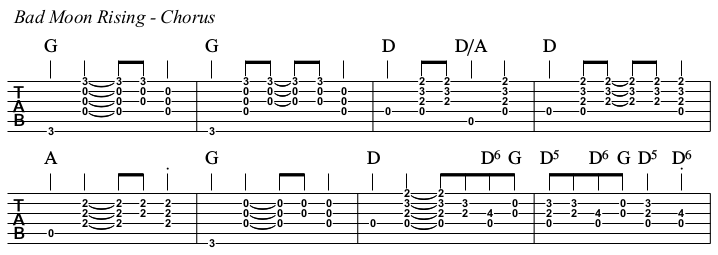
We begin simply, although bars 1 and 2 are not identical. Be sure to read the rhythms carefully. The variation between D and D/A is a nice touch.
The second line should make sense once you’ve worked out the verse and the first part of the chorus.
The only remaining section is the solo, which follows the verse and chorus, apart from the final line:

This small variation—adding a bit of honky-tonk flair to the A and G chords—is all you need to spice things up.
You can apply this honky-tonk idea in the chorus too by adding a 6 to the G and D chords. Experiment with how much you do this as “To honky-tonk or not to honky-tonk? That is the question.
Practise each section slowly, then play along with the backing tracks.
Next, let’s tune down!
Bad Moon Rising | TAB Key of E (tune down 1 tone)
Now let’s look at how to play this on electric guitar, tuned down a whole tone—similar to how John Fogerty did it.
I say “similar” because what you’ll see below is a part designed for one guitar in a band—a sort of “best of” version.
Here’s the verse. I’ve written E/G# as that’s the shape you need to see, even though the bass plays E—so it’s not strictly correct, and it’s no longer beginner-friendly.

Notice the small dot above beats 2 and 4 in bar 2—this means play it short. It’s an alternative to writing a staccato rhythm.
Here’s the same part, but now using an open E chord instead of the E/G#, which you could think of as a C shape.

Now for the chorus—I’ve created two examples for you. Learn both, then consider blending them.

Again, we use open-position chords with a small dot to indicate that the chord should be dampened early. Strike the chord, then release the fretting hand to mute it.
Here’s a more complex version. The A and B chords are in E shapes, while the E is in a C shape. All chords include 6 extensions.

When you can play the TAB on your down tuned guitar, try it with the backing tracks!
Contrast in songwriting
As a keen student of hit songs, you may have noticed that most great songs rely on contrast.
Bad Moon Rising by Creedence Clearwater Revival is a prime example. The lyrics paint a picture of storms and impending doom, yet the chords, riff, and melody are irresistibly upbeat.
John Fogerty admitted in an interview that he didn’t realise this contrast at first—he was so focused on the dark themes. It wasn’t until the band started playing the song that he realised how cheerful it sounded. Deciding to embrace the contrast, he went on to create one of his biggest hits.
Another reason for the song’s continued popularity is the misheard lyric joke. Many listeners have humorously mistaken the line “there’s a bad moon on the rise” for “there’s a bathroom on the right.” Fogerty himself has played along with the joke, occasionally singing the alternate lyric in live performances.
Once again, this proves that embracing what naturally unfolds is often a better approach than rigidly clinging to what ‘must be’.
Bad Moon Rising reached #1 in the U.K. and #2 in the U.S. in 1969. It also secured the 364th spot on Rolling Stone’s list of the 500 Greatest Songs of All Time.
Bad Moon Rising Chords: Continue Learning
Step-by-step Guitar Courses

Master guitar by studying real tunes. Build your skills with video lessons, eBooks and practice routines that connect theory with the music you love!
Explore SpyTunes step-by-step Guitar Courses.
Five similar tunes | Chords + Lyrics


