
Hundreds of millions of record sales worldwide
ABBA’s rise from a little-known Swedish pop group to one of the biggest bands in the world is inseparable from the tunes that defined each stage of their career. Formed in Stockholm in 1972, the group consisted of Agnetha Fältskog, Björn Ulvaeus, Benny Andersson, and Anni-Frid Lyngstad. Combining the first letter of each member’s name, they became ABBA.
While all four were already established musicians in Sweden, it was their songwriting, unique vocal production, meticulous studio craft, and ability to create universally appealing pop hits that propelled them onto the world stage.
Their international breakthrough came in 1974 with Waterloo, which won the Eurovision Song Contest in Brighton, U.K. The song was bold, theatrical, and unapologetically pop at a time when Eurovision winners rarely translated into long-term success. Waterloo reached number one in several European countries, including the U.K., announcing ABBA as a band capable of combining catchy melodies with a distinctive sound. More importantly, it gave them the confidence and exposure to pursue a global career.

Post-Eurovision
Following Eurovision, ABBA refined their pop formula. Tunes like SOS (1975) and Mamma Mia demonstrated a leap forward in songwriting and production. SOS in particular, showed a depth that set them apart from many pop acts, while Mamma Mia became a worldwide smash, partly thanks to its instantly recognisable intro riff. These tracks established ABBA as reliable hitmakers rather than a novelty Eurovision one-hit wonder.
The release of Dancing Queen in 1976 marked the absolute peak of their commercial success. Inspired by the emerging disco sound but grounded in classic pop songwriting, it became ABBA’s first and only number-one hit in the U.S. The lush production and soaring chorus made it a global anthem and it remains one of the most beloved pop songs of all time, as well as a guaranteed success on the wedding band set list.
Around the same period, hits like Fernando and Knowing Me, Knowing You reinforced their dominance across Europe, Australia, and beyond.
In the late 1970s, ABBA continued to evolve musically while maintaining chart success. Tunes such as The Name of the Game, Take a Chance on Me, and Voulez-Vous showcased increasingly sophisticated production and a willingness to experiment with funk, disco, and layered vocal arrangements. Take a Chance on Me, with its repetitive vocal hook and relentless momentum, was dreamed up by Benny during one of his daily runs. It became another major hit in the U.S. and U.K., cementing their global appeal.
As the years came and went, behind the upbeat melodies ABBA’s lyrics grew more introspective, often reflecting the personal relationships within the band, in a similar way to Fleetwood Mac, whose members were also romantically intertwined.
This shift became especially clear in the early 1980s. The Winner Takes It All (1980) was a stark, emotional ballad that became yet another international hit. Its raw honesty and restrained arrangement demonstrated how far ABBA had moved beyond simple pop songs. Around the same time, Super Trouper and Gimme! Gimme! Gimme! (A Man After Midnight) balanced emotional depth with dancefloor energy.
ABBA’s final years produced some of their most respected work, even as the band approached their breakup. One of Us and When All Is Said and Done captured themes of regret and reflection, while still achieving commercial success in Europe. By the time they quietly disbanded in 1982, ABBA had sold hundreds of millions of records worldwide.
Legacy and tributes
Ultimately, ABBA’s legacy rests on their extraordinary catalogue of hit tunes. Through timeless melodies, emotional honesty, and groundbreaking pop production, they transcended language and geography, becoming one of the most successful and enduring bands in music history.
Alongside Queen, Pink Floyd, and The Beatles, they are today, more than 50 years after their breakup, one of the most popular tribute acts for musicians to join, allowing them to tour theatres not just around the U.K., but worldwide. Most notably, Australian act Björn Again, with their parody “Swenglish” accents, frequently sell out stadiums and even headline festivals, proving that ABBA’s tunes were never just a 70s Swedish pop-disco novelty — they conquered the world.
ABBA tunes | Related Pages
Dancing Queen | Chords + TAB

You can learn how to play Dancing Queen by ABBA using chords, lyrics, chord analysis, a chord chart, TAB, and the original recording.
| E | C# |
You can dance, you can jive…
Check out the full TAB lesson here: Dancing Queen (ABBA) Guitar Lesson with TAB.
Mamma Mia | Chords + TAB
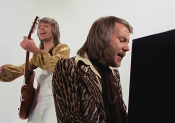
You can learn to play Mamma Mia by ABBA using chords, lyrics, chord analysis, a chord chart, TAB, and the original recording.
| D | D | G (G6)| G (Gmaj7) |
I’ve been cheated by you since I don’t know when…
Check out the full TAB lesson here: Mamma Mia (ABBA) Guitar Lesson with TAB.


