
Chords + Lyrics | What’s Going On
Intro
||: Emaj9 E6/9 | Emaj9 E6/9 :||
Verse 1
| Emaj9 | Emaj9 | C#m7 | C#m7 |
Mother, mother. There’s too many of you crying.
| Emaj9 | Emaj9 | C#m7 | C#m7 |
Brother, brother, brother. There’s far too many of you dying.
| F#m9 | F#m9 |
You know we’ve got to find a way.
| B13sus4 | B13 |
To bring some lovin’ here today, yeah.
Verse 2
Father, father. We don’t need to escalate.
You see, war is not the answer. For only love can conquer hate.
You know we’ve got to find a way.
To bring some lovin’ here today.
Bridge 1
| F#m7 | B9 | F#m7 | B9 |
Picket lines and picket signs. Don’t punish me with brutality.
| F#m7 | B9 |
Talk to me, so you can see.
Chorus 1
||: Emaj7 | C#m7 | Emaj7 | C#m7 :||
Oh, what’s going on (What’s going on). What’s going on (What’s going on).
Yeah, what’s going on (What’s going on). Oh, what’s going on (What’s going on).
Chorus Tag
||: Cmaj7/A | Cmaj7/A :|| x4
Right on, baby. Right on, baby. Right on.
||: B13 | B13 :||
Du dee do…
Verse 3
Mother, mother. Everybody thinks we’re wrong.
Oh, but who are they to judge us. Simply ’cause our hair is long.
Oh, you know we’ve got to find a way.
To bring some understanding here today.
Bridge 1
Picket lines and picket signs. Don’t punish me with brutality.
Come on talk to me, so you can see.
Chorus 2
What’s going on (What’s going on). Yeah, what’s going on (What’s going on).
Tell me what’s going on (What’s going on). I’ll tell you, what’s going on (What’s going on).
Chorus Tag
Ah, right on, baby, right on. Right on, baby.
Du dee do…
Outro
||: Cmaj7/A | Cmaj7/A :|| x4
Ah, Right on, baby, right on. Right on, baby.
||: B13 | B13 :||
Du dee do…
What’s Going On Backing Tracks | Chord Analysis
Above, you’ll find backing tracks to use when learning What’s Going On. I’ve used stem separation to extract the guitar while keeping the drums, bass, keys, horns, strings, and vocals intact.
After studying the chords and TAB, use my backing tracks to prepare for playing this tune with a band.
Should you want to play along with the original recording instead, you need to tune your guitar sharp to 441Hz. In the backing tracks, I’ve done this job for you by tuning it to 440Hz.
Chord Progressions – What’s Going On?
In the key of E, Marvin Gaye’s What’s Going On achieves its smooth sound primarily through the use of big, but natural chord extensions.
Let’s break down these chords, starting with the intro.
Intro
We begin with an Emaj9 chord, which transitions to an E6/9 chord towards the end of the bar, creating a subtle shift before the progression repeats.
You’ll find the TAB for these chords further down this guitar lesson. The parts will vary depending on whether you’re playing solo (acoustic) or with a band.
Verse
In the verse, we stick with the Emaj9 and E6/9 chords, alternating between them more frequently. Although I considered calling this an Emaj13, I opted for the Emaj9 for simplicity. Likewise, the transition between C#m7 and C#m can be tricky, but it’s best to keep it straightforward in the chord chart, and save the finer details for the TAB.
The verse also introduces a II – V progression with F#m9 and B13 chords. On the keyboard, you could play F#m11 followed by F#m13, but on guitar, we simplify by using sus4 and then adding the 3rd to create a similar effect. Again, the TAB will guide you through this.
A great electric guitar technique here is to go between Emaj9 and E6/9, and between C#m and C#m7, with plenty of movement. As we reach F#m9, we hold that for the B13sus4—both share similar notes, with just one note change to transition into the B13.
Here are the full chords for What’s Going On’s verse:
| Emaj9 (I) | Emaj9 | C#m7 (VI) | C#m7 |
| Emaj9 | Emaj9 | C#m7 | C#m7 |
| F#m9 (II) | F#m9 |
| B13sus4 (V) | B13 |
For acoustic guitar, we need to be more creative with the bass notes (there’s TAB for this too). We must then move between extensions like Emaj7, E6/9, and Emaj9 to create movement, compensating for the lack of a full band.
Bridge
Next, we have the bridge. This section is similar to the end of the verse but with smaller extensions, such as F#m7 and B9. Each chord lasts for one bar, like this:
||: F#m7 (II) | B9 (V) :|| x3
On electric guitar, the bridge will sound different from an acoustic version.
Chorus
The chorus starts similarly to the verse but with one chord per bar and smaller extensions, using just Emaj7 and C#m7.
Finally, the chorus tag marks the first departure from the key of E major. Here, we see a modal interchange from E Ionian to E Aeolian as we play a Cmaj7/A chord.
If you want to improvise over this section, try using an A Dorian scale or a C Lydian scale. These two modes share the same notes but will prompt you to target different intervals.
Having explored both electric and acoustic approaches to What’s Going On in the TAB, this chord chart serves as a helpful reminder of the progressions.

What’s Going On Chord Chart | PDF + iReal Pro Download
If you’d like to download this chart, here’s a PDF: What’s Going On chord chart PDF.
This chart was created using iReal Pro—here’s the file: What’s Going On iReal Pro. With the iReal Pro app, you can easily change the key.
Since this is such a great tune to practise soloing over, try using the app’s backing track feature. That way, you can work on your solos in all 12 keys.
What’s Going On | TAB
There’s a lot of TAB here as we cover several sections of What’s Going On. I felt the greatest value would come from learning the tune both on acoustic (to back a singer) and electric (in a band setting). Let’s dive in and compare each approach along the way.
We begin with the intro. The electric version is quite busy, moving between a maj9 and a 6/9 chord. Practise along with the backing tracks and it’ll make sense.

When playing acoustic, we need to adapt the part — adding bass notes, more strings, and using more space. Here’s an example of how that could work:

Remember – You’ll get the most out of this lesson by working on both electric and acoustic versions.
Verse
Next up is the verse — let’s start with the electric part (practise with backing tracks!).
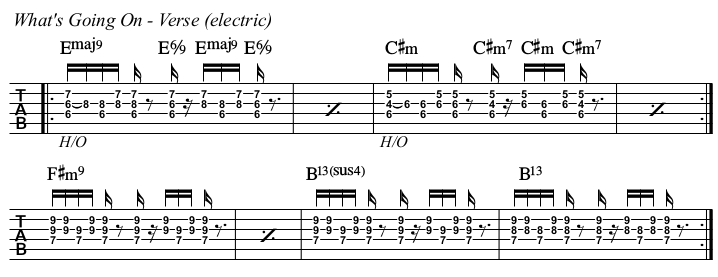
I keep the same rhythm throughout, moving between the chords similarly for E and C#m. For F#m9 and B13sus4, I maintain the same shape and slide one fret to get to B13.
Here’s an acoustic version — this one’s a bit tricky!

That opening E chord is a bit wild, but it sounds great once you get it right — definitely worth the effort. Where the electric version played F#m9, I begin with F#m7, then use a combination of F#sus2 and F#m to imply the full F#m9.
For the second bar of F#m, you’ll need to use your thumb over the neck.
The B11 is a slight change — I opted for this instead of a B13, which didn’t translate as well to the acoustic.
Bridge
Here’s the bridge on electric — we start low, then move up. That last B9 is technically a 7sus2, not a 9, but I think it still works well.

And here’s the same section adapted for acoustic. Now we need to include bass notes and even add melodic lines.

Chorus
Now for the chorus. I kept it simple here, only changing shapes slightly to create some movement.

On acoustic, the approach is different — we stay in place and focus on nailing the initial bass note cleanly.

Tag
Finally, we have the chorus tag. This section is a brilliant example of modal interchange — can you hear the Em within the Cmaj7 chord? We’ve moved from E Ionian to E Aeolian.

And here’s the same part, arranged for acoustic:

What’s Going On Chords: Continue Learning
Step-by-step Guitar Courses

Master guitar by studying real tunes. Build your skills with video lessons, eBooks and practice routines that connect theory with the music you love!
Explore SpyTunes step-by-step Guitar Courses.
Five similar tunes | Chords + Lyrics


