
Chords + Lyrics | Paying The Cost To Be The Boss
Intro
| B9 (Fm7b5 D#m7b5) | E9 (A#m7b5 G#m7b5) |
| B9 (Fm7b5 D#m7b5) | B9 |
| E9 (A#m7b5 G#m7b5) | E9 | B9 (Fm7b5 D#m7b5) | B9 |
| F#9 (Cm7b5 A#m7b5) | E9 (A#m7b5 G#m7b5) | B9 (Fm7b5 D#m7b5) | B9 (Fm7b5) F#7 |
Verse 1
| B9 (Fm7b5 D#m7b5) | E9 (A#m7b5 G#m7b5) |
You act like you don’t wanna listen, when I’m talking to you.
| B9 (Fm7b5 D#m7b5) | B9 |
You think you outta do baby, anything you wanna do.
| E9 (A#m7b5 G#m7b5) | E9 | B9 (Fm7b5 D#m7b5) | B9 |
You must be crazy baby, you just gotta be out of your mind.
| F#9 (Cm7b5 A#m7b5) | E9 (A#m7b5 G#m7b5) | B9 (Fm7b5 D#m7b5) | F#7 |
As long as I’m paying the bills woman, I’m paying the cost to be the boss.
Verse 2
||: B9 N.C | B9 N.C :|| x3
I’ll drink if I wanna, and play a little poker too.
Don’t you say nothing to me, as long as I’m taking care of you.
As long as I’m working, baby, and paying all the bills.
| B9 N.C | B9 |
I don’t want no mouth from you, about the way I’m supposed to live.
| E9 (A#m7b5 G#m7b5) | E9 | B9 (Fm7b5 D#m7b5) | B9 |
You must be crazy woman, just gotta be out of your mind.
| F#9 (Cm7b5 A#m7b5) | E9 (A#m7b5 G#m7b5) | B9 (Fm7b5 D#m7b5) | F#7 |
As long as I foot the bill, I’m paying the cost to be the boss.
Solo
| B9 (Fm7b5 D#m7b5 Fm7b5) | E9 (A#m7b5 G#m7b5 A#m7b5) |
| B9 (Fm7b5 D#m7b5 Fm7b5) | B9 |
| E9 (A#m7b5 G#m7b5 A#m7b5) | E9 | B9 (Fm7b5 D#m7b5 Fm7b5) | B9 |
| F#7 (Cm7b5) F#7 | E7 (A#m7b5) E7 | B9 (Fm7b5 D#m7b5 Fm7b5) | F#7 |
Verse 3
||: B9 N.C | B9 N.C :||
Now that you’ve got me, you act like you ashamed.
You don’t act like my woman, you’re just using my name.
I tell you I’m gonna handle all the money, and I don’t want no back talk.
| B9 N.C | B9 |
‘Cause if you don’t like the way doing, just pick up your things and walk.
| E9 (A#m7b5 G#m7b5) | E9 | B9 (Fm7b5 D#m7b5) | B9 |
You gotta be crazy baby, oh you must be out of your mind.
| F#9 (Cm7b5 A#m7b5) | E9 (A#m7b5 G#m7b5) | B9 (Fm7b5 D#m7b5) | N.C | B9 |
As long as I’m paying the bills, I’m paying the cost to be the boss.
Paying The Cost To Be The Boss Backing Track | Chord Analysis
Above, you’ll find backing tracks to use when learning Paying The Cost To Be The Boss. I’ve used stem separation to extract the guitar while keeping the drums, bass, keys, horns, and vocals intact.
After studying the chords and TAB, use my backing tracks to prepare for playing this tune with a band.
Should you want to play along with the original recording instead, you need to tune your guitar sharp to 442Hz. In the backing track, I’ve done this job for you by detuning it to 440Hz.
Chord Progression – What’s Going On?
B.B. King must have heard Papa Ain’t Salty before creating the rhythm guitar part for this track — it’s filled with those signature sliding min7b5 substitutes.
Let’s break this down, especially if you’re not familiar with that T-Bone Walker tune.
To substitute a dominant 7th chord with a dominant 9th sound, start on the 3rd of the chord and apply a min7b5 shape. The Am and Dm shapes work best for this technique.
To take it up a notch, slide up a tone and then back down again — this hints at the 13 extension.
The main progression is laid out in the intro like this:
| B9 (Fm7b5 D#m7b5) | E9 (A#m7b5 G#m7b5) |
| B9 (Fm7b5 D#m7b5)| B9 |
| E9 (A#m7b5 G#m7b5)| E9 | B9 (Fm7b5 D#m7b5) | B9 |
| F#9 (Cm7b5 A#m7b5) | E9 (A#m7b5 G#m7b5) | B9 (Fm7b5 D#m7b5) | B9 (Fm7b5) F#7 |
The sliding min7b5 chords appear in every bar, but to keep things simple, I’ve only written “9” the second time.
The main variation occurs in verses 2 and 3. Here, we stay on the B9 chord using stops for eight bars before moving to chord IV, continuing with the usual sliding min7b5 substitutes.
||: B9 N.C | B9 N.C :|| x3
| B9 N.C | B9 |
| E9 (A#m7b5 G#m7b5)| E9 | B9 (Fm7b5 D#m7b5) | B9 |
| F#9 (Cm7b5 A#m7b5) | E9 (A#m7b5 G#m7b5) | B9 (Fm7b5 D#m7b5) | N.C | B9 |
For the solo, we use the same concept as in the intro and verse 1, although the rhythm changes and we move between the sliding min7b5 substitutions in a slightly different way.
To explain all these chords properly, I need to show you TAB, scroll down this guitar lesson to find it (solo included).
If you’re getting a bit tired of reading all these min7b5 extensions in brackets, don’t worry — this is handled far more efficiently in the chord chart:
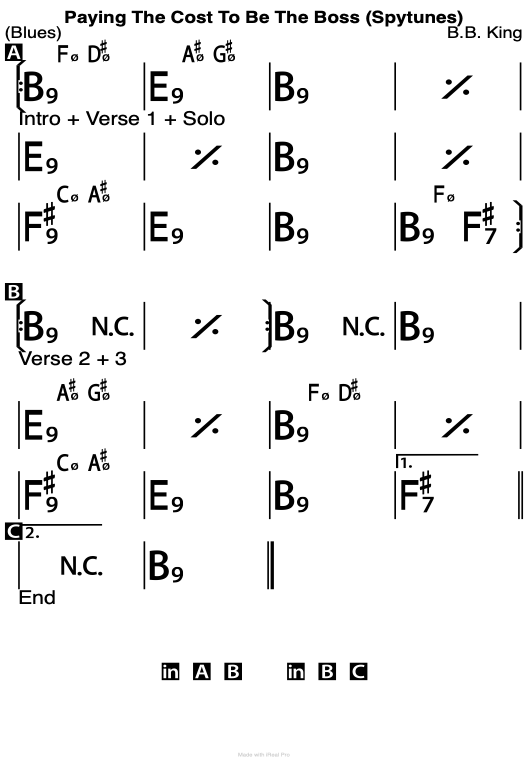
Paying The Cost To Be The Boss Chord Chart | PDF + iReal Pro Download
Download my chord chart as a static PDF, alternatively, if you wnat to put all those min7b5 extensions in, have it as the iReal Pro file and start altering the layout.
Paying The Cost To Be The Boss | TAB
Before we move to the soloing, let’s look at the rhythm guitar parts played by B.B.’s sideman — they’re brilliant.
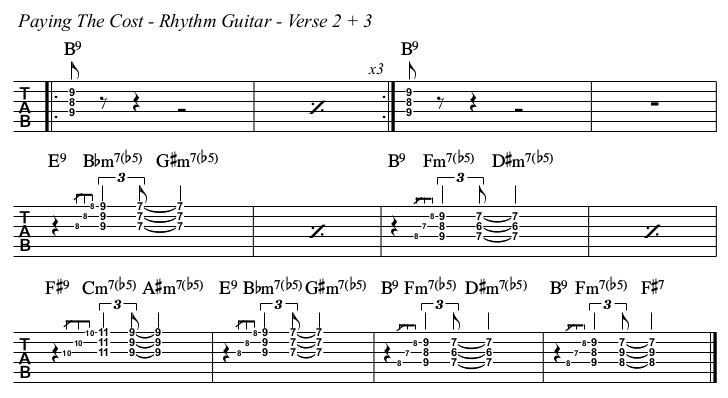
Intro + Verses
The first concept is chord substitution. Instead of B7, the I chord of the blues, we play D#m7b5, effectively creating a B9 sound. What’s more, we first slide up a tone to Fm7b5, then down to the targeted substitution.
This concept is then applied to the remaining chords in the progression:

The only real variation appears in the final bar, where instead of sliding down to the targeted substitution (D#m7b5), we move to F#7.
For verses 2 and 3, we stay on the I chord for eight bars using stops. This is followed by the same progression as verse 1.
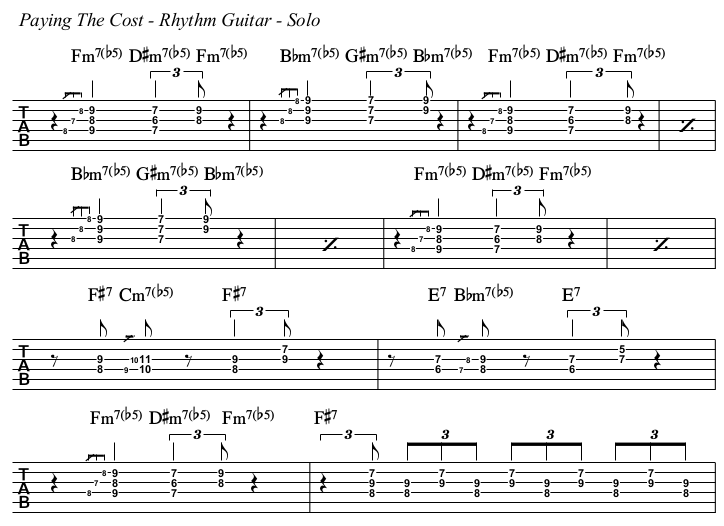
Solo (rhythm guitar)
I absolutely adore the change that happens in the rhythm guitar during the solo.
Instead of sliding up and then down to the targeted substitution, we begin on the substitute, then go up–down–up — genius.
To avoid confusion, I’ve removed the written B9 and E9 chord names and am now only showing the substitutions.
The turnaround is also new: we play F#7, briefly move up to Cm7b5, then back down to F#7. The same idea applies to E7. The final bar is completely different, as we simply play F#7.
Solo (B.B. King licks)
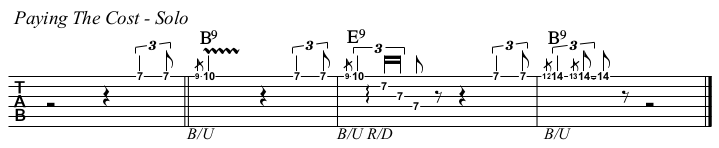
Now let’s focus on B.B.’s playing. Here’s the intro solo — study it carefully and pay attention to every detail.
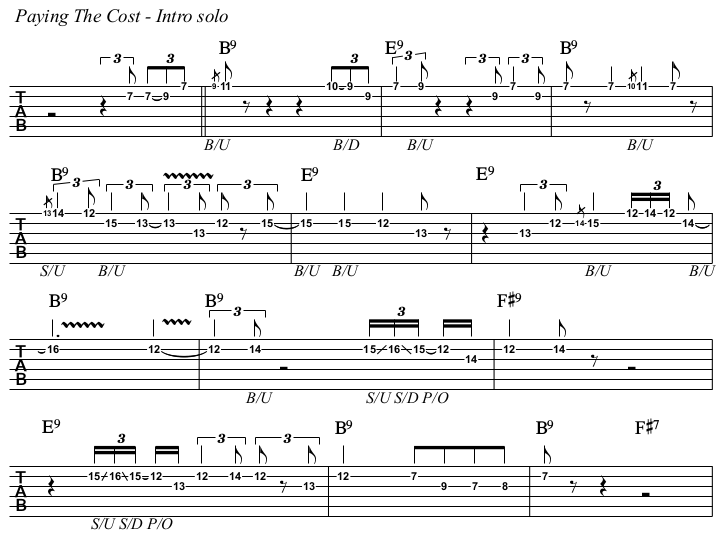
Let’s break down what makes this solo so strong, so we can apply the ideas in our own improvisations:
- Rhythmic repetition. In the opening bars, the original idea is expanded without losing focus. It bends, twists and develops, culminating in broken triplets that lead us to chord IV.
- We blend the B major and B minor pentatonic scales — sometimes through bends (bars 2 and 4), sometimes as clearly stated notes (bar 5).
- Over the IV chord, we outline an E7 arpeggio combined with the E major pentatonic.
- When returning to the I chord, we bend to the 3rd of B — a note that didn’t exist in the E chord framework (where it would function as a major 7th).
- In the final 16th-note triplets, we use B minor pentatonic with an added 9th. As the chord changes, one note shifts to target the 3rd of the E chord.
- The final lick blends B minor and B major pentatonics.
That’s a lot to take in. Practice it to the point of memorisation, then examine the first four bars of the solo.
Using what you learned from the intro, can you see how this continues the same ideas?
Can you find a way to improvise in this style? Consider:
- Rhythmic repetition and expansion
- Note choices that blend B minor and major pentatonic
- Targeting chord tones of the IV chord — especially the 3rd
Once you can play all the TAB, jam with the backing tracks and chord chart, aiming to bring everything together.
Hopefully, what you first memorised will begin to emerge naturally and with variation as you explore the fretboard using these frameworks. Remember, B.B. wouldn’t — and couldn’t — play the exact same thing twice, so why should you?
B.B. King’s Bending and Vibrato: Mastering Key Techniques
B.B. King, alongside Albert King, is renowned for two crucial techniques in guitar playing: string bending and vibrato.
B.B. was among the first to fully explore the expressive potential of these techniques, refining them into a distinctive style that became a hallmark of his playing.
Bending and vibrato are now fundamental to the electric guitar’s vocabulary, and it’s almost impossible to imagine the instrument without them. However, before the 1950s, vibrato was rarely used, and string bending was often limited to quarter-tone inflections at most.
One of his signature songs, Paying the Cost to Be the Boss, offers a great opportunity to focus on mastering both techniques. To refine it, immerse yourself in B.B.’s original recordings and practise playing along with them.
As you play, listen closely to his stylistic traits. Notice what you like about it and what could be improved in your own execution. This is the key to mastering the technique — attention to detail, careful mimicry and persistent practise.
B.B.’s vibrato remains one of the finest in the business, so why not start by learning directly from the master?
In the course, we first study the rhythm guitar, then examine solos from the original recording to see exactly how he executes them. Finally, we analyse the intervals he uses so we can apply these ideas confidently in our own improvisations.
Paying The Cost To Be The Boss Chords: Continue Learning
Step-by-step Guitar Courses

Master guitar by studying real tunes. Build your skills with video lessons, eBooks and practice routines that connect theory with the music you love!
Explore SpyTunes step-by-step Guitar Courses.
Five similar tunes | Chords + Lyrics


