
Chords + Lyrics | Parisienne Walkways
Intro
| 6/8 N.C (A) | (E C) |
| Am | Am | Dm7 | Dm7 |
| Dm7/G | Dm7/G | Cmaj7 | Cmaj7 |
| F | F | Bm7b5 | Bm7b5 |
| E7sus4 | E7 | A5 N.C (A) | (E C) |
Verse 1
| Am | Am | Dm7 | Dm7 |
I remember Paris in ’49.
| Dm7/G | Dm7/G | Cmaj7 | Cmaj7 |
The Champs-Élysées, Saint Michelle and old Beaujolais wine.
| F | F | Bm7b5 | E7 |
And I recall that you were mine,
| A | D/A | A5 N.C | N.C |
in those Parisienne days.
Solo 1
| Dm7 | Dm7 | Dm7/G | Dm7/G |
| Cmaj7 | Cmaj7 | Fmaj7 | Fmaj7 |
| Bm7b5 | Bm7b5 | Esus4 | E |
| Asus4 | D/A | A5 N.C | N.C |
Verse 2
| Dm7 | Dm7 |
Looking back at the photographs.
| Dm7/G | Dm7/G | Cmaj7 | Cmaj7 |
Those summer days spent outside corner cafes.
| Fmaj7 | Fmaj7 | Bm7b5 | Bm7b5 |
Oh, I could write you paragraphs,
| B7 | B7 | E | F |
about my old Parisienne days.
Solo 2
| E N.C | N.C | N.C | N.C |
| Dm7 | Dm7 | Dm7/G | Dm7/G |
| Cmaj7 | Cmaj7 | Fmaj7 | Fmaj7 | Bm7b5 | E7 |
||: Am | Dm7 | Am | F E :|| x8
Parisienne Walkways Backing Track | Chord Analysis
Above, you’ll find backing tracks to use when learning Parisienne Walkways. I’ve used stem separation to extract the guitar while keeping the drums, bass, keys, horns, and vocals intact.
After studying the chords and TAB, use my backing tracks to prepare for playing this tune with a band.
Should you want to play along with the original recording instead, you need to tune your guitar sharp to 443Hz. In the backing track, I’ve done this job for you by detuning it 440Hz.
Chord Progressions – What’s Going On?
There’s more to Parisienne Walkways’ chords than one might initially assume. It’s easy to get consumed by the impressive lead guitar work, but the chord progressions themselves hold plenty of interest.
Let’s break down how each section is slightly varied, starting with the intro.
Intro
The cello-like swells are based on an Am arpeggio. We then move around the cycle of 4ths with some clever extensions.
Starting with VI – II, the V chord is actually a II chord with its 4th in the bass (Dm7/G). Cmaj7 serves as the I chord, and F here is not a maj7. E7sus4 to E adds extra tension, forming a IIIx. We then stop on an A5 — neither major nor minor, which is quite clever.
| Am | Am | Dm7 | Dm7 |
| Dm7/G | Dm7/G | Cmaj7 | Cmaj7 |
| F | F | Bm7b5 | Bm7b5 |
| E7sus4 | E7 | A5 N.C (A) | (E C) |
Verse
The first verse mirrors the intro but changes slightly post the F chord. After the Bm7b5, we move to E7 earlier than expected, then play A (now major!), D/A, and finish with a stop.
| Am | Am | Dm7 | Dm7 |
| Dm7/G | Dm7/G | Cmaj7 | Cmaj7 |
| F | F | Bm7b5 | E7 |
| A | D/A | A5 N.C | N.C |
Solo 1
The first solo transitions directly to chord II. F becomes Fmaj7, and D/A shifts from Asus4, not just A.
| Dm7 | Dm7 | Dm7/G | Dm7/G |
| Cmaj7 | Cmaj7 | Fmaj7 | Fmaj7 |
| Bm7b5 | Bm7b5 | Esus4 | E |
| Asus4 | D/A | A5 N.C | N.C |
Verse 2
The next verse brings another variation. Towards the end, we play a B7 chord, pointing to E and F before stopping on the longest note ever, setting up the final solo.
| Dm7 | Dm7 | Dm7/G | Dm7/G |
| Cmaj7 | Cmaj7 | Fmaj7 | Fmaj7 |
| Bm7b5 | Bm7b5 | B7 | B7 | E | F |
Outro Solo
Finally, the outro solo introduces new chords. After playing part of the verse again, these final chords come into play.
| E N.C | N.C | N.C | N.C |
| Dm7 | Dm7 | Dm7/G | Dm7/G |
| Cmaj7 | Cmaj7 | Fmaj7 | Fmaj7 | Bm7b5 | E7 |
||: Am | Dm7 | Am | F E :|| x8
To get TAB for how to play all these chords (and the lead guitar work as well, of course), check the TAB further down this guitar lesson.
Here’s a chord chart summing it all up. I’ve placed the stops at the beginning of each section rather than at the end of the previous one.
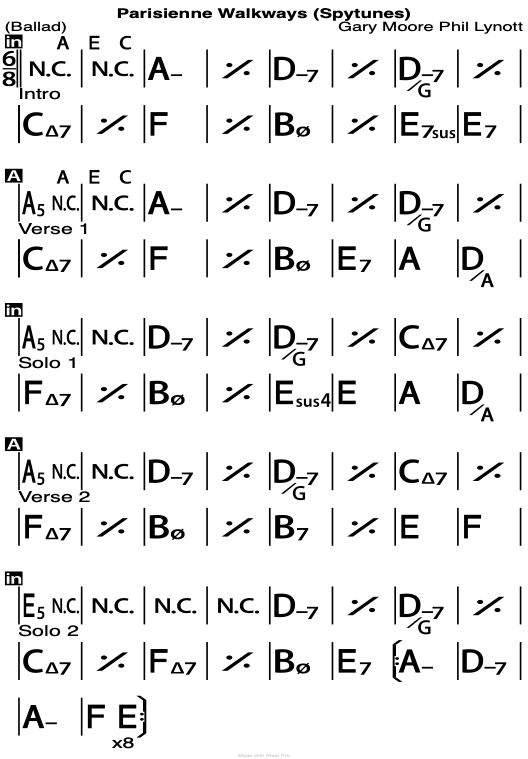
Parisienne Walkways Chord Chart | PDF + iReal Pro Download
Should you want to download and print the correct chords for Parisienne Walkways to keep in your back pocket, you can do so with this PDF: Parisienne Walkways chord chart PDF.
If you have bigger aspirations and want to change the key or alter my arrangement layout (change the stops, maybe?), you can opt for the iReal Pro format: Parisienne Walkways iReal Pro.
Parisienne Walkways | TAB
There’s plenty of consistency in Parisienne Walkways’ rhythm guitar. Almost always do we repeat the same pattern for each chord. Let’s go through all sections – even if you’re just here for the solo!
Intro (rhythm guitar)
The intro lays out the main idea, which is the cycle of 4ths, starting here on chord VI.
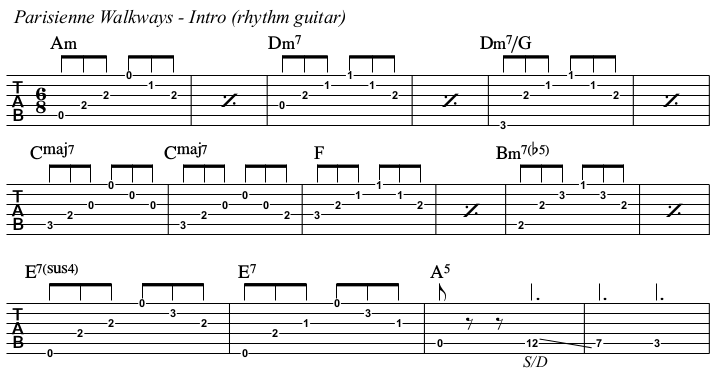
One tiny detail stands out here for me: the second Cmaj7 is different. This only happens in the intro, which makes me think it may have been a mistake – although I like it!
Most of all, however, I like the variation on the G chord as a Dm7/G.
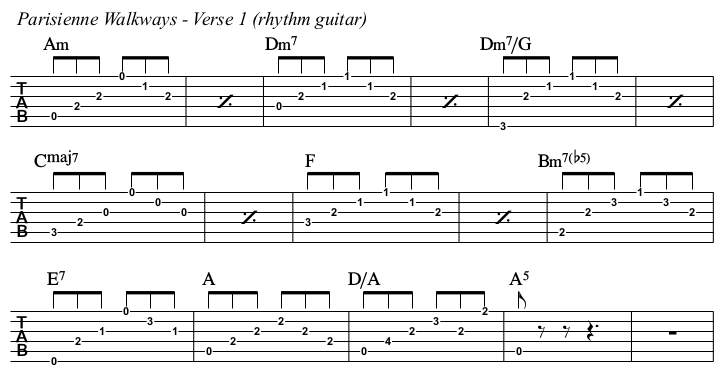
Verse 1 (rhythm guitar)
In verse 1, we play the same progression up until the Bm7b5 (that Cmaj7 is now the same twice, by the way).
After the Bm7b5 for a bar, we go to E7, then a series of A chords (not Am!) before a stop that leads into a solo.
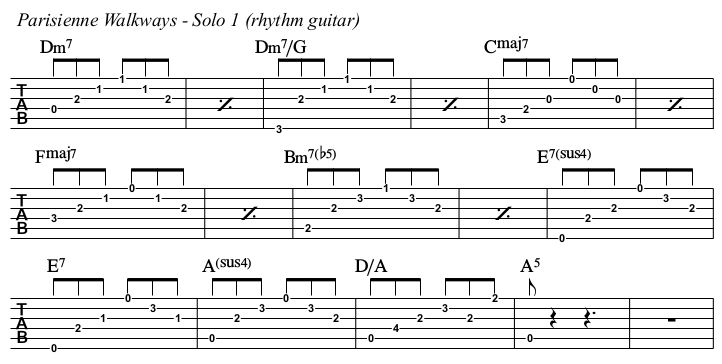
Solo 1 (rhythm guitar)
In the first solo, we don’t start on the Am. The stop has taken care of that, so we enter on Dm7. Other than that, it’s the same as the intro but with a new variation at the end, similar to verse 1 but not exactly the same.
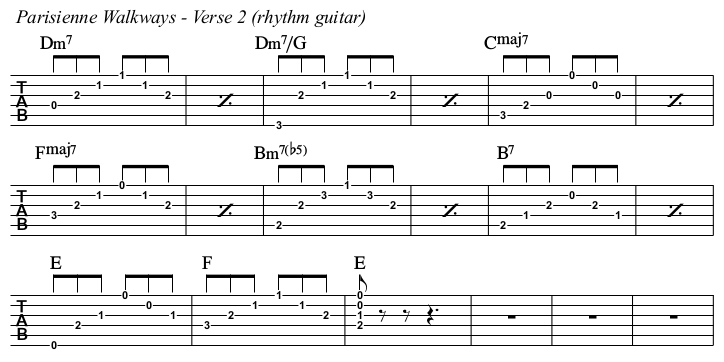
Verse 2 (rhythm guitar)
The next verse has more variation to offer. We again start on a Dm7 as there’s been an A with a stop. The new chords here are a B7 after the Bm7b5, and the E – F – E movement at the end.
The long break that follows is that feedback-held note setting up the final solo.
Solo 2 (rhythm guitar)
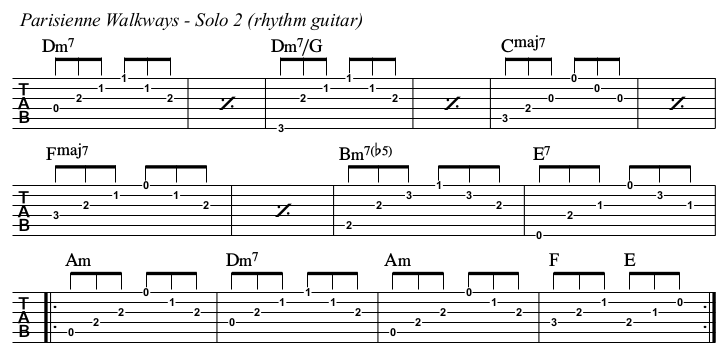
The final solo has, yet again, new chords!
First, we start as in the last solo, but then after Bm7b5 we move sooner to E7, followed by a new loop with the chords in quicker succession: Am – Dm7 – Am, followed by the now established F – E movement.
As mentioned, there’s plenty going on with the chords in Parisienne Walkways!
Solo
Let’s now get going with the lead lines – it’s all in the detail and the main detail is that you bend up to a note that is held so you can vibrato above and below the pitch. Do compare this with just fretting the target note to feel and hear the difference.
First up is the intro solo.
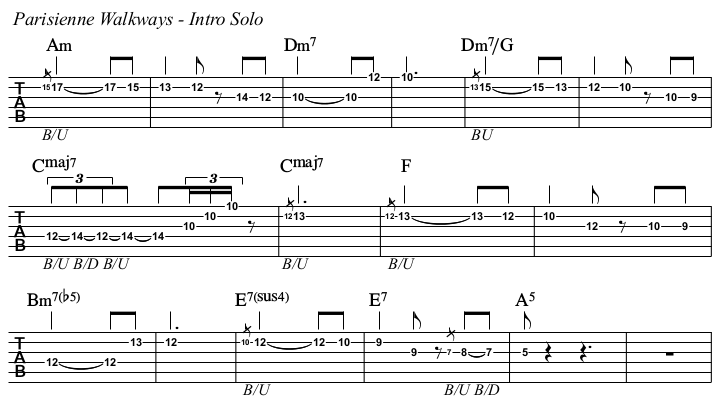
Before we move on, we must consider all the intervals, as that’s how you remember what to play and understand why it works. Here are the intervals in relation to each chord:
- Am – 5th, sus4, m3, 9, root, b7, so a descending Aeolian as this is chord VI.
- Dm7 – m3rd, 9, root.
- Dm7/G – Here we think in relation to G: 5th, sus4, 3rd, 9, b7th, 6.
- Cmaj7 – 9, 3rd, root.
- F – 5th, #4, 3rd, 9th, root, maj7, a descending Lydian mode.
- Bm7b5 – m3rd, b9, root.
- E7sus4 + E7 – 5th, 4th, 3rd, root, b7, maj7, b7.
- A5 – m3rd.
Make sure you carry out this analysis for all future sections.
Verse 1 solo
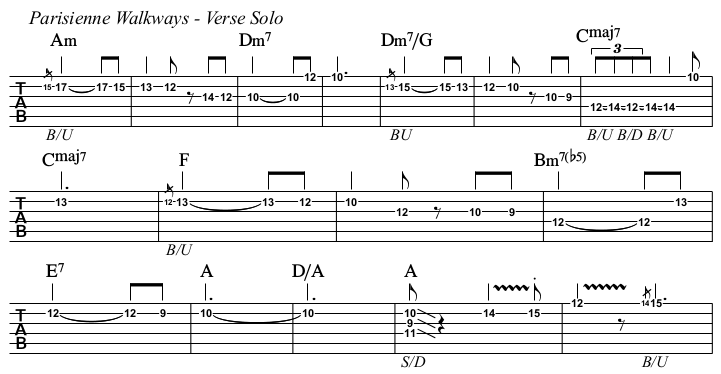
Behind the vocal, Gary plays almost the same thing again, but not exactly…
Solo 1
The first solo is more of the same, followed by an insanely fast lick!
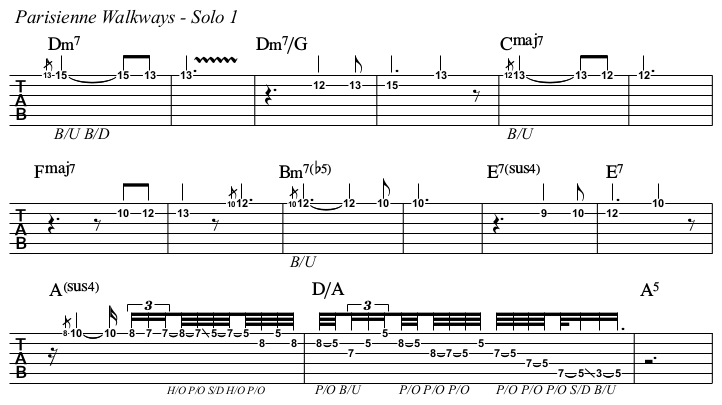
It took me a while to work out that last lick! After doing so, it became clear to me that this shouldn’t be memorised, but instead learned from. So let’s do that.
Speed exercise
What’s happening here is the idea of sequencing blended with blues licks. So let’s work on sequencing – start slowly!
This rhythm is sextuplets, so it’s a bit slower than Gary, who goes even faster!

We hammer on, pull off, then slide down. Hammer on, pull off, move between strings, and repeat.
On the third string, we do yet another slide down before resolving.
Once you can do this, you can start blending it with blues licks, exploring other scale shapes and making it your own.
Upon completing this journey to an acceptable level, you’ll realise how pointless it is to memorise an exact way to do it.
To be completely honest, I only transcribed it so you could see I could do it. It truly is pointless to copy that last lick in detail, but great to work on the technique and then let it rip!
Solo 2
The last solo has more greatness to study. Focus on the intervals and the expression details.
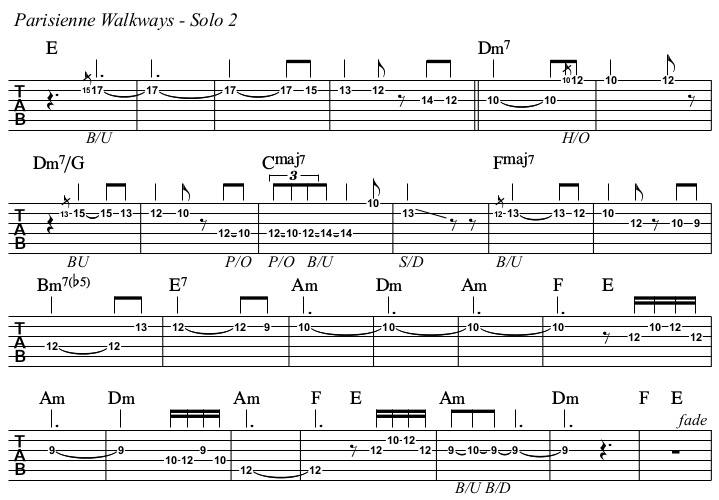
There is so much to learn here that you may have to scroll back up this guitar lesson and use the backing track to put it all together. Then come back to the TAB and study the finer details again, loop this process until you just can’t take it anymore!
Parisienne Walkways was a co-write between Gary and Phil
Originally an instrumental piece, Parisienne Walkways took shape when Gary Moore played it to Phil Lynott (Thin Lizzy) one night and Phil began writing lyrics. That’s when the song truly came together.
To achieve the huge note Moore holds at the end of the song, it’s best to crank up the amp—preferably to 10.
If you listen closely, you’ll notice the similarities between the chord progression of Parisienne Walkways and Gary Moore’s other smash hit, Still Got the Blues.
For those interested in songwriting, take a moment to examine how both melodies follow the chords. It’s a great example of the craftsmanship involved in creating a memorable piece.
Or perhaps just start working on the lead lines in the TAB lesson—don’t forget to turn that amp up to 10!
Parisienne Walkways Chords | Related Pages
Step-by-step Guitar Courses

Master guitar by studying real tunes. Build your skills with video lessons, eBooks and practice routines that connect theory with the music you love!
Explore SpyTunes step-by-step Guitar Courses.
Five similar tunes | Chords + Lyrics


